
- Catalogs
- Thermo Scientific
- Reagents, Solvents and Accessories


Reagents, Solvents and Accessories

Reagents, Solvents and Accessories
- Silylation Reagents: Used to form TMS amides, with reagents like BSA, BSTFA, and MSTFA. TMCS is used as a catalyst.
- Acylation Reagents: Includes MBTFA and TFAA for forming trifluoroacetamides, suitable for trace analysis with ECD detection.
- Alkylation Reagents: MethElute Reagent is used for on-column derivatization, particularly for drugs.
- Amphetamines: Reagents like BSTFA and TFAA are used.
- Barbiturates: MethElute Reagent and PFBBr are commonly used.
- Cocaine: Benzoylecgonine is derivatized using BSTFA and MTBSTFA.
- Marijuana: THC metabolites are derivatized using BSA and BSTFA.
- Opiates: Morphine derivatization involves reagents like BSTFA and MBTFA.
- Introduction to Derivatization: Essential for making compounds suitable for analysis, improving efficiency, and enhancing detectability.
- Suitability and Efficiency: Modifies chemical structures to make nonvolatile or insoluble compounds analyzable by GC or HPLC, improving peak resolution and reducing interference.
- Includes binding and elution buffers for affinity purification and solvents for amino acid analysis.
- Details on vials, closures, and equipment for heating, stirring, and evaporation.
- TMSI (N-Trimethylsilylimidazole): Used for silylation of hydroxyl groups in carbohydrates and steroids.
- HMDS (Hexamethyldisilazane): Popular for silylation of sugars.
- TMCS (Trimethylchlorosilane): Acts as a catalyst for forming trimethylsilyl ethers.
- MOX Reagent: Converts keto groups to methoxime derivatives.
- Tri-Sil Reagents: Various formulations for one-step derivatization of polar compounds.
- Protocol 1 (TMSI): Silylation of hydroxyl groups and acylation of amino groups for catecholamines.
- Protocol 2 (TMSI): Silylation of hydroxyl groups on highly hindered steroids.
- Protocol 3 (TMSI): General silylation procedure for various compounds.
- Use appropriate solvents like pyridine for optimal reactions.
- Avoid water or alcohol as they react with TMS reagents.
- Acylation involves converting compounds with active hydrogens into derivatives suitable for chromatography.
- Perfluoroacyl groups enhance detectability by electron capture detectors (ECD).
- MBTFA: Used for trifluoroacylating primary and secondary amines, hydroxyl, and thiol groups.
- Perfluoroacylimidazoles (TFAI and HFBI): Effective for acylating hydroxyl groups and amines.
- Fluorine atoms enhance sensitivity in ECD and GC/MS applications.
- Ensure proper handling and storage of hazardous materials.
- Teflon/Silicone Discs: Offer excellent resealability and are suitable for use with organic solvents and silylation reactions.
- Teflon/Rubber Laminated Discs: Provide a highly inert seal, suitable for corrosive substances.
- Mininert Valves: Offer a leak-tight closure for vials, ideal for chemicals that deteriorate or evaporate in conventional containers.
Catalog excerpts
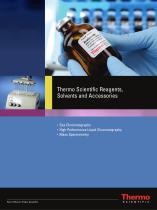
Thermo Scientific Reagents, Solvents and Accessories Part of Thermo Fisher Scientific Gas Chromatography High Performance Liquid Chromatography Mass Spectrometry
Open the catalog to page 1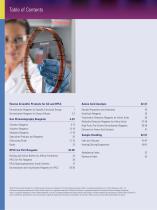
Thermo Scientific Products for GC and HPLC Derivatization Reagents for Specific Functional Groups 1 Derivatization Reagents for Drug-of-Abuse 2-3 Specialized Products and Reagents 20 HPLC Ion Pair Reagents 24-40 Binding and Elution Buffers for Affinity Purification 25 HPLC Ion Pair Reagents 26 HPLC/Spectrophotometric Grade Solvents 27 Derivatization and Visualization Reagents for HPLC 28-30 Amino Acid Analysis 32-41 Sample Preparation and Hydrolysis 34 Fluorometric Detection Reagents for Amino Acids 36 Ninhydrin Detection Reagents for Amino Acids 37-38 High-Purity Pre-Column Derivatization Reagents...
Open the catalog to page 2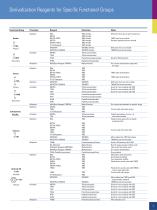
Derivatization Reagents for Specific Functional Groups Functional Group Silylation BSA BSTFA BSTFA+TMCS Amides MSTFA O MSTFA+TMCS O Tri-Sil Reagents –C–NH2 MTBSTFA –C–NH2 Primary MTBSTFA+TBDMCS O Acylation MBTFA O TFAA –C–NHR –C–NHR PFAA TMS Amides Difficult to form due to steric hindrance TMS Amides TMS Amides TMCS used as a catalyst TMS Amides Reaction byproducts more volatile TMS Amides TMS Amides TBDMCS Amides Difficult to form; very stable TBDMCS Amides TBDMCS aids derivatization Trifluoroacetamides Trifluoroacetamides Pentafluoropropionamides Secondary HFBA Alkylation MethElute Reagent...
Open the catalog to page 3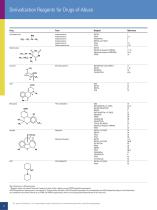
Derivatization Reagents for Drugs-of-Abuse Reagent Reference Amphetamines Amphetamines BSTFA 1 NH2 Amphetamines HFAA 2-5 CH Amphetamines HFAA/PFAA 6 C6H5 CH2 CH 3 Amphetamines MSTFA with TMCS 7 Amphetamines TFAA 7,8 Methamphetamine TFAA 9,10 Barbiturates BSTFA 1 MethElute Reagent (TMPAH) 11-13 O O NH Methylate Reagent (DMFDMA) 14,15 CH2 CH CH2 PFBBr 16 CH3 Cocaine Benzoylecgonine CH3 N COOH BSTFA/Butyl Iodine/TMAH 17 BSTFA 1,18 MTBSTFA 19 PFAA/PFPOH 9,20 BSA 21 BSTFA 22 MSTFA 21 TFAI 23 Marijuana THC metabolites COOH OH BSA 24 BSTFA/BSTFA+1% TMCS 24-27 BSTFA/TMCS/TMSI 24 MSTFA 9 MSTFA/MSTFA+1%...
Open the catalog to page 4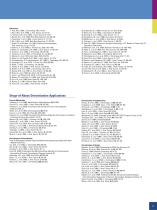
References 1. Dutt, M.C. (1982). J. Chromatogr. 248, 115-124. 2. Wu, A.H.B., et al. (1992). J. Anal. Toxicol. 16, 137-141. 3. Thurman, E.M., et al. (1992). J. Anal. Toxicol. 16, 19-27. 4. Reimer, M.L., et al. (1993). Biol. Mass Spectrom. 22, 235-242. 5. Yamamoto, T., et al. (1989). J. Anal. Toxicol. 13, 117-119. 6. Wu, A.H.B., et al. (1992). Biol. Mass Spectrom. 21, 278-284. 7. ood, H.D. and Knitter, J.A. (1991). Capillary Chromatography. R W.G. Jennings, ed., pp. 115-130. 8. DePace, A., et al. (1990). J. Forensic Sci. 35(6), 1431-1435. 9. Mulé, S.J. and Casella, G.A. (1998)....
Open the catalog to page 5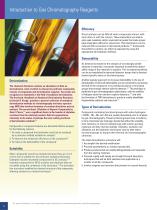
Introduction to Gas Chromatography Reagents Efficiency Direct analysis can be difficult when compounds interact with each other or with the column. These interactions can lead to poor peak resolution and/or asymmetrical peaks that make proper peak integration difficult or impractical. This interference can be reduced with conversion to derivatized products.13,14 Compounds that exhibit co-elution can often be separated by using the appropriate derivatization methods. Detectability As demand increases for the analysis of increasingly smaller amounts of materials, it becomes important to extend...
Open the catalog to page 6
Thermo Scientific Silylation Reagents Silylation and Silylation Reagents Only Thermo Scientific Reagents offer the combination of variety, quality and reliability. Silyl derivatives are the most widely used derivatives for gas chromatographic applications. Usually they are formed by the replacement of the active hydrogens from acids, alcohols, thiols, amines, amides and enolizable ketones and aldehydes with the trimethylsilyl group. A variety of reagents is available for the introduction of the trimethylsilyl group. These reagents differ in their reactivity, selectivity and side reactions and...
Open the catalog to page 7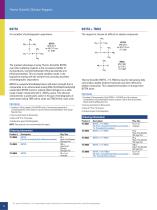
Thermo Scientific Silylation Reagents For excellent chromatographic separations. The reagent to choose for difficult-to-silylate compounds. CH 3 BSTFA is a powerful trimethylsilyl donor, with donor strength that is comparable to its unfluorinated analog BSA [N,O-Bis(trimethylsilyl) acetamide]. BSTFA reacts to replace labile hydrogens on a wide range of polar compounds with a -Si(CH3)3 group. This physical characteristic is particularly useful in the gas chromatography of some lower boiling TMS-amino acids and TMS Krebs cycle acids. PROTOCOL Thermo Scientific BSTFA + 1% TMCS is ideal for derivatizing...
Open the catalog to page 8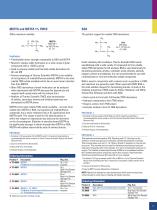
MSTFA and MSTFA 1% TMCS Offers maximum volatility. The perfect reagent for volatile TMS derivatives. CH 3 Highlights: • Trimethylsilyl donor strength comparable to BSA and BSTFA • Reacts to replace labile hydrogens on a wide range of polar compounds with a -Si(CH3)3 group • Used to prepare volatile and thermally stable derivatives for GC and MS • Primary advantage of Thermo Scientific MSTFA is the volatility of its byproduct, N-methyltrifluoroacetamide; MSTFA is the most volatile TMS-amide available which has an even lower retention time than MSTFA • Often TMS derivatives of small molecules can...
Open the catalog to page 9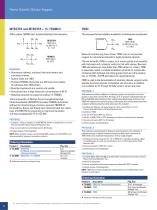
Thermo Scientific Silylation Reagents MTBSTFA and MTBSTFA + 1% TBDMCS Offers stable TBDMS (tert-butyldimethylsilyl) derivatization. The strongest hydroxyl silylator available for carbohydrates and steroids. Sakauchi and Horning have shown TMSI to be an all-purpose reagent for unhindered steroids to highly hindered steroids. Highlights: • Derivatizes hydroxyl, carboxyl, thiol and primary and secondary amines • Typical yields are >96% • Provides TBDMS ethers that are 104 times more stable to hydrolysis than TMS ethers • Reaction byproducts are neutral and volatile • Derivatives have a high molecular...
Open the catalog to page 10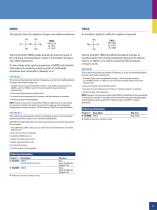
The popular choice for silylation of sugars and related substances. An excellent catalyst for difficult-to-silylate compounds. Thermo Scientific HMDS greatly extends the practical range of GC, improving chromatographic results in the silylation of sugars A critical study of the optimal proportions of HMDS and trimethyl- chlorosilane for producing maximum yield of trimethylsilyl derivatives was conducted by Sweeley, etal. This protocol describes the method of Sweeley, etal. for the trimethylsilylation of sugars and related substances. 1. Combine 10 mg or less carbohydrate sample, 1.0 ml anhydrous...
Open the catalog to page 11All Thermo Scientific catalogs and technical brochures
 Nunc Cell Factory systems
12 Pages
 CryoStar NX50
2 Pages
 MSC-Advantage BSC
54 Pages
 Multifuge
58 Pages
 Thermo Scientific Pico 17 / 21
52 Pages
 CO2 Incubator HERAcell 150 i / 240 i
196 Pages
 Revco® Blood Bank Refrigerators
37 Pages
 Multidrop Combi nL
4 Pages
 Forma Environmental Chambers
25 Pages
 MaxQ 6000
40 Pages
 Multi Tube Rotator
13 Pages
 picoSpin Spectrometer
6 Pages
 1300 Series A2
76 Pages
 CO2 Incubator Family
28 Pages
 CO2 incubators
7 Pages
 MaxQ Mini 4450 Shaker
40 Pages
 E1-ClipTip Electronic Pipette
108 Pages
 Varioskan™ LUX
54 Pages
 ISQ Series Mass Spectrometers
412 Pages
 Q Exactive™ BioPharma
16 Pages
 Q Exactive Plus
4 Pages
 LTQ XL™
4 Pages
 Platinum DNA polymerases
6 Pages
 -80°C Benchtop Freezer
2 Pages
 Nicolet iS10 FT-IR Spectrometer
12 Pages
 Ion S5 and Ion S5 XL Systems
2 Pages
 SureTect Range
4 Pages
 QuantStudio™ 3
8 Pages
 Furnaces
2 Pages
 Nunc Serological Pipettes
3 Pages
![Vanquish Duo UHPLC System [ZH]](https://img.medicalexpo.com/pdf/repository_me/78678/vanquish-duo-uhplc-system-zh-191145_1mg.jpg) Vanquish Duo UHPLC System [ZH]
Vanquish Duo UHPLC System [ZH]12 Pages
 native MS
16 Pages
 Compound Discoverer Software
12 Pages
 Vanquish Horizon UHPLC System
16 Pages
 Thermo Scientific TSQ Duo
9 Pages
 Thermo Scientific TSQ 8000 Evo
16 Pages
 Heraeus Labofuge 300
2 Pages
 Heraeus Cryofuge 5500i
8 Pages
 Heraeus Clinifuge Centrifuge
2 Pages
 Vials and Closures Catalog 2014-2015
128 Pages
 RM 200 EG
4 Pages
 Darwin LIMS
2 Pages
 Immunohistory Solutions
292 Pages
 Process Water Products Catalog
68 Pages
 Technical Training Catalog
15 Pages
 FBS Alternatives
8 Pages
 Pierce Magnetic Beads
16 Pages
 interactive catalog today
222 Pages
 HERAGUARD HPH clean benches
2 Pages
 MBC 240 Bench Top Analyzer
4 Pages
 Konelab 20
2 Pages
 Indiko
6 Pages


![ISQ 7000 Single Quadrupole GC-MS System VPI [ZH]](https://img.medicalexpo.com/pdf/repository_me/78678/isq-7000-single-quadrupole-gc-ms-system-vpi-zh-191148_1mg.jpg)
![ISQ 7000 Single Quadrupole GC-MS System [ZH]](https://img.medicalexpo.com/pdf/repository_me/78678/isq-7000-single-quadrupole-gc-ms-system-zh-191147_1mg.jpg)


![Thermo Scientific Herasafe KS and KSP Class II Biological Safety Cabinets [EN]](https://img.medicalexpo.com/pdf/repository_me/78678/thermo-scientific-herasafe-ks-ksp-class-ii-biological-safety-cabinets-en-85081_1mg.jpg)


Archived catalogs
 Nunc Cell Factory systems
8 Pages
- Vertical refrigerator
- Laboratory refrigerator
- 1-door refrigerator
- Automatic defrost refrigerator
- Electric refrigerator
- Refrigerator with glass door
- Laboratory incubator
- Laboratory centrifuge
- Benchtop centrifuge
- Laboratory agitator
- Sample tube
- Stainless steel refrigerator
- Blood centrifuge
- Sample preparation system
- Laboratory test tube
- Automatic sample processor
- Clinical chemistry analyzer
- Temperature-control laboratory incubator
- Heating oven
- Laboratory oven