
- Catalogs
- Thermo Scientific
- Simultaneous N, C and S Isotope Ratio Determination on a DELTA V Isotope Ratio MS using a Flash Elemental Analyzer


Simultaneous N, C and S Isotope Ratio Determination on a DELTA V Isotope Ratio MS using a Flash Elemental Analyzer

Simultaneous N, C and S Isotope Ratio Determination on a DELTA V Isotope Ratio MS using a Flash Elemental Analyzer
Multi-element isotope ratio analysis is crucial for applications like food authenticity and forensic investigations. The Thermo Scientific ConFlo IV interface, introduced in 2007, enhances the ability to measure nitrogen (N), carbon (C), and sulfur (S) isotopes simultaneously, reducing analysis time to under 18 minutes.
Method
The method involves using a single reactor with WO3 and copper wires for N, C, and S analysis. A magnesium perchlorate trap removes water, and Sulfinert® capillary tubing prevents acidic compound formation. The Thermo Scientific FlashEA 1112 elemental analyzer is used with specific settings for optimal performance.
Results
The analysis shows precise isotope ratio measurements with a standard deviation of ≤ 0.17‰ for d15N, ≤ 0.1‰ for d13C, and ≤ 0.17‰ for d34S. The smartEA™ option allows for automatic sample dilution, enabling three samples to be analyzed per hour.
Conclusion
The setup allows for efficient triple isotope analysis using the DELTA V series mass spectrometer and Flash elemental analyzer. Sulfinert capillaries are recommended to reduce background noise. The system is cost-effective and easy to maintain.
Key Components
Essential parts include the NCS reactor, water trap, aluminum ferrule, stainless steel tubing nut, Sulfinert separation column, and tubing, all available from Thermo Fisher Scientific and Restek.
Applications
This setup can also be used for single-element analysis, with adjustments to the column temperature for faster sulfur isotope analysis.
Catalog excerpts

Simultaneous N, C and S Isotope Ratio Determination on a DELTA V Isotope Ratio MS using a Flash Elemental Analyzer Oliver Kracht, Thermo Fisher Scientific, Bremen, Germany Introduction Key Words • ConFlo IV • DELTA V Series • Elemental Analyzer • smartEA™ • Multi-Element Analysis • Isotope Ratio MS Multi-element isotope ratio analysis is becoming increasingly important, particularly in food authenticity control and forensic applications. With increasing numbers of samples for analysis, reduced sample preparation and measurement time are required. The ability to measure N, C and S isotopes from a single sample drop was demonstrated by Avak in 1996 with an analysis time of 30 minutes.1 With the introduction of the Thermo Scientific ConFlo IV universal interface in July 2007, the ability for multi-element isotope ratio determination was both enhanced and simplified. The ConFlo IV interface allows software-controlled switching of up to five reference gases and Figure 1: N, C and S triple measurement of sulfanilamide. Top: mass traces, middle: TCD trace of automatic dilution of sample gases down Flash EA, bottom: tabs with comprehensive data and results for each isotope. to 1:100 according to the varying amounts FlashEA 1112 settings NCS triple analysis of the three elements in the samples. Using the Thermo Reactor temperature 1,020 °C Scientific smartEA option, the simultaneous analysis of N, GC temperature 70 °C Carrier flow 80 mL/min C and S is simplified even further. The smartEA™ option Autosampler type MAS 200R adjusts the dilution of sample gases as a direct response to Table 1: System settings for triple measurement. the TCD signals from the Flash Elemental Analyzer (EA). The optimized chromatography now reduces the analysis The ConFlo IV universal interface and the Flash EA time to less than 18 minutes. were connected with the smartEA™ option to make use of This technical note explains the modifications needed the automatic dilution ability. The isotope ratio mass for triple measurements of N, C and S isotope ratios and spectrometer (IRMS) used was a Thermo Scientific DELTA shows the performance that can be achieved. V Plus with a universal triple collector. A fast magnet field jump of the IRMS takes place automatically between the Method N2 and CO2 peaks followed by a slow magnet field jump Optimal conditions for sulfur isotope ratio analysis require to SO2. a short transfer line and reduced volumes in a water-free environment. Therefore a single reactor filled with WO3 Results and electrolytic copper wires is used for the triple N, C and The chromatogram in Figure 1 shows flat top reference gas S analysis. A chemical trap of magnesium perchlorate pulses from the ConFlo IV interface and the chromaremoves water produced in the combustion process. Tubing tographically separated sample peaks of N2, CO2 and SO2 in the Flash EA and the connection to the ConFlo IV from the elemental analyzer (400 µg of sulfanilamide). N2 interface is made of 1/16” Sulfinert® capillary to avoid the and CO2 show a separation of 17 seconds which is required formation of acidic compounds by SO2 with adsorbed to perform a fast magnet field jump immediately after the water. The commonly used Teflon® tubing cannot be used detection of the N2 sample peak at 191 seconds. The for triple analysis of N, C and S due to increased nitrogen change of the magnet field from CO2 to SO2 is performed background. An optimized chromatographic column slowly between the CO2 and SO2 reference gas pulses at separates N2 and CO2 with an improved retention time of 460 seconds. the SO2. The Flash elemental analyzer used was a Thermo Scientific FlashEA 1112, system paramete
Open the catalog to page 1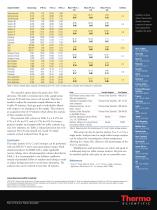
Sample Identifier Sulfanilamide Sulfanilamide Sulfanilamide Vitamin B1 Vitamin B1 Vitamin B1 Vitamin H Vitamin H Vitamin H Cysteine Cysteine Cysteine Soil Soil Soil Octopus Tissue Octopus Tissue Octopus Tissue Bird Feather Bird Feather Bird Feather Pesticide Pesticide Pesticide River Sediment River Sediment River Sediment Conclusion The triple analysis of N, C and S isotopes can be performed with any DELTA V series mass spectrometer using a Flash elemental analyzer for IRMS with a sulfur applicable reactor, tubing, and a chromatographic column described in Table 3. It is recommended to use Sulfinert...
Open the catalog to page 2All Thermo Scientific catalogs and technical brochures
 Nunc Cell Factory systems
12 Pages
 CryoStar NX50
2 Pages
 MSC-Advantage BSC
54 Pages
 Multifuge
58 Pages
 Thermo Scientific Pico 17 / 21
52 Pages
 CO2 Incubator HERAcell 150 i / 240 i
196 Pages
 Revco® Blood Bank Refrigerators
37 Pages
 Multidrop Combi nL
4 Pages
 Forma Environmental Chambers
25 Pages
 MaxQ 6000
40 Pages
 Multi Tube Rotator
13 Pages
 picoSpin Spectrometer
6 Pages
 1300 Series A2
76 Pages
 CO2 Incubator Family
28 Pages
 CO2 incubators
7 Pages
 MaxQ Mini 4450 Shaker
40 Pages
 E1-ClipTip Electronic Pipette
108 Pages
 Varioskan™ LUX
54 Pages
 ISQ Series Mass Spectrometers
412 Pages
 Q Exactive™ BioPharma
16 Pages
 Q Exactive Plus
4 Pages
 LTQ XL™
4 Pages
 Platinum DNA polymerases
6 Pages
 -80°C Benchtop Freezer
2 Pages
 Nicolet iS10 FT-IR Spectrometer
12 Pages
 Ion S5 and Ion S5 XL Systems
2 Pages
 SureTect Range
4 Pages
 QuantStudio™ 3
8 Pages
 Furnaces
2 Pages
 Nunc Serological Pipettes
3 Pages
![Vanquish Duo UHPLC System [ZH]](https://img.medicalexpo.com/pdf/repository_me/78678/vanquish-duo-uhplc-system-zh-191145_1mg.jpg) Vanquish Duo UHPLC System [ZH]
Vanquish Duo UHPLC System [ZH]12 Pages
 native MS
16 Pages
 Compound Discoverer Software
12 Pages
 Vanquish Horizon UHPLC System
16 Pages
 Thermo Scientific TSQ Duo
9 Pages
 Thermo Scientific TSQ 8000 Evo
16 Pages
 Heraeus Labofuge 300
2 Pages
 Heraeus Cryofuge 5500i
8 Pages
 Heraeus Clinifuge Centrifuge
2 Pages
 Vials and Closures Catalog 2014-2015
128 Pages
 RM 200 EG
4 Pages
 Darwin LIMS
2 Pages
 Immunohistory Solutions
292 Pages
 Process Water Products Catalog
68 Pages
 Technical Training Catalog
15 Pages
 FBS Alternatives
8 Pages
 Pierce Magnetic Beads
16 Pages
 interactive catalog today
222 Pages
 HERAGUARD HPH clean benches
2 Pages
 MBC 240 Bench Top Analyzer
4 Pages
 Konelab 20
2 Pages
 Indiko
6 Pages


![ISQ 7000 Single Quadrupole GC-MS System VPI [ZH]](https://img.medicalexpo.com/pdf/repository_me/78678/isq-7000-single-quadrupole-gc-ms-system-vpi-zh-191148_1mg.jpg)
![ISQ 7000 Single Quadrupole GC-MS System [ZH]](https://img.medicalexpo.com/pdf/repository_me/78678/isq-7000-single-quadrupole-gc-ms-system-zh-191147_1mg.jpg)


![Thermo Scientific Herasafe KS and KSP Class II Biological Safety Cabinets [EN]](https://img.medicalexpo.com/pdf/repository_me/78678/thermo-scientific-herasafe-ks-ksp-class-ii-biological-safety-cabinets-en-85081_1mg.jpg)


Archived catalogs
 Nunc Cell Factory systems
8 Pages
- Vertical refrigerator
- Laboratory refrigerator
- 1-door refrigerator
- Automatic defrost refrigerator
- Electric refrigerator
- Laboratory incubator
- Refrigerator with glass door
- Laboratory centrifuge
- Benchtop centrifuge
- Laboratory agitator
- Sample tube
- Stainless steel refrigerator
- Blood centrifuge
- Sample preparation system
- Laboratory test tube
- Automatic sample processor
- Clinical chemistry analyzer
- Temperature-control laboratory incubator
- Heating oven
- Laboratory oven