
- Catalogs
- TMSi systems
- Porti 7

Porti 7

Porti 7
This document outlines the technical specifications for various configurations of the Porti7 device, intended to complement the User Manual.
1. Locate the device label on the bottom of your Porti device.
2. Use the table of contents to find your device by REF code.
3. Navigate to the specified page for detailed technical specifications.
- Porti7-32at 2000 Hz
REF code: 95-0207-0022-1
AUX Inputs: RMS Noise < 20 µV, Gain 1x, Input signal difference -3 V to +3 V, Input impedance > 100 MΩ, CMRR > 70 dB.
Trigger Input: 2 mA @ 3 V input, Isolation > 4000 V.
Sampling: Resolution 22 bits, Sample frequency options: 2000 Hz, 1000 Hz, 500 Hz, 250 Hz, 125 Hz.
Bluetooth: Limited to 250 Hz and 125 Hz for all channels. - Porti7-16at 2000 Hz
REF code: 95-0207-0062-1
Similar specifications to Porti7-32at with fewer channels (16 AUX inputs). - Porti7-16at 2048 Hz
REF code: 95-0207-0062-2
Similar specifications with a higher sample frequency option of 2048 Hz. - Porti7-8at 2000 Hz
REF code: 95-0207-0082-1
Similar specifications with 8 AUX inputs.
Each configuration includes a list of channels with their respective functions, resolution, and range. For example, AUX inputs have a resolution of 1.4305 µV and a range of -3 V to +3 V.
Bluetooth communication supports limited sample frequencies, with higher frequencies not possible for all channels.
The device operates with an output voltage of +5 V and -5 V, with a maximum current of 40 mA for all channels combined. It uses a 5-pin plastic connector for connections.
The trigger input requires a turn-on current of 2 mA at a 3 V input, with a maximum input of 5 V. It features isolation greater than 4000 V using an optocoupler (H11L1) and uses a plastic LEMO FFA.00 connector with the center pin as positive.
The device supports a resolution of 22 bits, with AUX channels having a resolution of 1.4305 µV per bit. Sample frequencies include 2048 Hz, 1024 Hz, 512 Hz, 256 Hz, and 128 Hz. Bluetooth communication does not support 2048 Hz and 1024 Hz sample frequencies for all channels.
The device includes multiple auxiliary (AUX) and bipolar (BIP) channels. AUX channels have a resolution of 1.4305 µV and a range of -3 V to +3 V. BIP channels have a resolution of 0.0715 µV and a range of -150 mV to +150 mV. Digital channels operate with a resolution of 1 bit and a range of 0 to 255.
Bluetooth supports various channel rates depending on the base sample frequency. For instance, at 2048 Hz, Bluetooth communication is not possible, while at 512 Hz, it is supported for a limited number of channels.
AUX inputs have an RMS noise of less than 20 µV at the lowest sample frequency with a gain of 1x. Bipolar ExG inputs have an RMS noise of less than 1 µV with a gain of 20x.
The input signal difference for AUX inputs ranges from -3 V to +3 V, while for BIP inputs, it ranges from -150 mV to +150 mV. The input impedance is greater than 100 MΩ, and the common mode rejection ratio (CMRR) is greater than 70 dB for AUX and 90 dB for BIP inputs.
- Porti7-8b8at (2000 Hz): REF code 95-0207-0882-1
- Porti7-8b8at (2048 Hz): REF code 95-0207-0882-2
- Porti7-32et (2000 Hz): REF code 95-0207-2002-1
- Porti7-32et (2048 Hz): REF code 95-0207-2002-2
- Porti7-12e4at (2048 Hz): REF code 95-0207-2042-2
- Bipolar ExG Inputs: EEG, ECG, EOG, EMG
- RMS Noise: < 1 µV
- Gain: 20x
- Input Signal Difference: -150 mV to +150 mV
- Input Common Mode Range: -2 V to +2 V
- Input Impedance: > 100 MΩ
- CMRR: > 90 dB
- Connector: 4 pin plastic connector
- AUX Inputs:
- RMS Noise: < 20 µV
- Gain: 1x
- Input Signal Difference: -3 V to +3 V
- Input Common Mode Range: -4 V to +4 V
- Input Impedance: > 100 MΩ
- CMRR: > 70 dB
- Output Voltage: +5 V & -5 V, max 40 mA
- Connector: 5 pin plastic connector
- Input Turn-On Current: 2 mA @ 3 V input, max. input = 5 V
- Isolation: > 4000 V, optocoupler (H11L1)
- Connector Type: Plastic LEMO FFA.00
- Resolution: 22 bits
- BIP Resolution: 0.0715 µV per bit
- AUX Resolution: 1.4305 µV per bit
- Sample Frequencies: 2000 Hz, 1000 Hz, 500 Hz, 250 Hz, 125 Hz (varies by model)
- Not all frequencies are supported via Bluetooth.
- 2000 Hz and 2048 Hz are not possible using Bluetooth.
- Limited support for 1000 Hz and 1024 Hz for certain channels.
- Bipolar Inputs (BIP1 to BIP8): 0.0715 µV resolution, -150 mV to +150 mV range
- Auxiliary Inputs (AUX9 to AUX16): 1.4305 µV resolution, -3 V to +3 V range
- Digital Channel: 1 bit, 0 to 255 range
- Sawtooth Test Signal: 32-sample interval, steps of 2
- Similar specifications to Bipolar ExG inputs with micro coax connectors and active shielding.
The device supports a maximum input of 5 V and provides isolation greater than 4000 V using an optocoupler (H11L1). The connector type is a plastic LEMO FFA.00 with the center pin as positive.
The device offers a resolution of 22 bits with different sampling frequencies: 2048 Hz, 1024 Hz, 512 Hz, 256 Hz, and 128 Hz. The resolution for BIP is 0.0715 µV per bit and for AUX is 1.4305 µV per bit.
Bluetooth supports limited sample frequencies. 2048 Hz and 1024 Hz are not possible via Bluetooth, and 512 Hz is supported for a limited number of channels. Channels ExG1 to ExG24 support 512, 256, and 128 Hz, while AUX channels support lower frequencies.
The device includes multiple channels for different inputs:
- ExG channels (1-24) are unipolar with a resolution of 0.0715 µV and a range of -150 mV to +150 mV.
- BIP channels (25-28) are bipolar with similar resolution and range as ExG channels.
- AUX channels (29-32) have a resolution of 1.4305 µV and a range of -3 V to +3 V.
- Additional channels include SaO2 for oxygen saturation, Pleth for plethysmographic waveform, and HRate for heart rate.
Unipolar and bipolar ExG inputs have an RMS noise of less than 1 µV at the lowest sample frequency with a gain of 20x. AUX inputs have an RMS noise of less than 20 µV with a gain of 1x.
The input impedance is greater than 100 MΩ, and the common-mode rejection ratio (CMRR) is greater than 90 dB for ExG inputs and greater than 70 dB for AUX inputs.
The device uses micro coax connectors with active shielding for ExG inputs and 4-pin plastic connectors for bipolar inputs. AUX inputs use a 5-pin plastic connector.
The trigger input requires a turn-on current of 2 mA at 3 V input, with a maximum input of 5 V.
The document details specifications for various Porti7 models, including Porti7-24e4b4at and Porti7-24e8bt, with reference codes 95-0207-4442-1, 95-0207-4442-2, 95-0207-4801-2, and 95-0207-4802-1.
Both unipolar and bipolar ExG inputs (EEG, ECG, EOG, EMG) are supported with RMS noise less than 1 µV, a gain of 20x, and an input signal difference range of -150 mV to +150 mV. The input impedance is greater than 100 MΩ, and the CMRR is over 90 dB. Connectors vary between micro coax with active shielding and 4-pin plastic connectors.
These have an RMS noise of less than 20 µV, a gain of 1x, and an input signal difference range of -3 V to +3 V. The input impedance is greater than 100 MΩ, with a CMRR of over 70 dB. The output voltage is ±5 V, with a maximum of 40 mA for all channels combined, using a 5-pin plastic connector.
The input turn-on current is 2 mA at 3 V input, with a maximum input of 5 V. Isolation is greater than 4000 V, achieved through an optocoupler (H11L1), and the connector type is Plastic LEMO FFA.00.
The devices offer a resolution of 22 bits, with ExG/BIP at 0.0715 µV per bit and AUX at 1.4305 µV per bit. Sample frequencies include 2048 Hz, 1024 Hz, 512 Hz, 256 Hz, and 128 Hz, with Bluetooth communication limitations at higher frequencies.
The document lists supported Bluetooth channel rates for various sample frequencies, noting that higher frequencies like 2048 Hz and 1024 Hz are not possible via Bluetooth, and 512 Hz is limited to certain channels.
The document provides a detailed list of channels, including ExG, BIP, AUX, Digi, and Saw channels, with their respective functions, resolutions, and ranges.
The digital channel operates with bits ranging from 0 to 255, with specific bit functions such as ON/OFF button pressed and battery low indication. The sawtooth test signal operates over a 32-sample interval with steps of 2.
The document outlines the Bluetooth channel rates at various base sample frequencies for different channels. Notably, 2000 Hz and 1000 Hz sample frequencies are not possible using Bluetooth communication, and 500 Hz is supported for a limited number of channels.
The document provides a detailed list of channels, their functions, resolution, and range. Channels 1 to 24 are unipolar inputs with a resolution of 0.0715 µV and a range of -150 mV to +150 mV. Channels 25 to 32 are bipolar inputs with the same resolution and range. Channel 33 is a digital channel with various bit functions, and Channel 34 is a sawtooth test signal.
The Porti7-16et device specifications include unipolar ExG inputs with RMS noise less than 1 µV, a gain of 20x, and an input impedance greater than 100 MΩ. The input signal difference ranges from -150 mV to +150 mV, and the common mode range is -2 V to +2 V.
The trigger input specifications include an input turn-on current of 2 mA at 3 V, with a maximum input of 5 V. Isolation is greater than 4000 V, achieved through an optocoupler.
The device supports a resolution of 22 bits, with ExG/BIP channels having a resolution of 0.0715 µV per bit and AUX channels at 1.4305 µV per bit. Supported sample frequencies include 2048 Hz, 1024 Hz, 512 Hz, 256 Hz, and 128 Hz.
Bluetooth communication does not support 2048 Hz and 1024 Hz sample frequencies, and 512 Hz is only possible for a limited number of channels.
The document also describes other variants of the Porti7 device, such as the Porti7-16et(5) and Porti7-16e12b4at, with specific differences in gain, input signal range, and Bluetooth capabilities.
1. Porti7-16e12b4at (REF code: 95-0207-6242-2)
2. Porti7-16e12b4at (REF code: 95-0207-6242-3-1)
3. Porti7-16e4b10a2st (REF code: 95-0207-6405-2)
4. DCbox (REF code: 95-0905-0000-0)
Unipolar ExG Inputs: EEG, ECG, EOG, EMG with RMS Noise < 1 µV, Gain 20x, Input signal difference -150 mV to +150 mV, Input impedance > 100 MΩ, CMRR > 90 dB.
Bipolar ExG Inputs: Similar specifications as Unipolar.
AUX Inputs: RMS Noise < 20 µV, Gain 1x, Input signal difference -3 V to +3 V, CMRR > 70 dB.
Input turn-on current 2 mA @ 3 V, Isolation > 4000 V via optocoupler.
Resolution: 22 bits, ExG/BIP 0.0715 µV per bit, AUX 1.4305 µV per bit.
Sample Frequencies: 2048 Hz, 1024 Hz, 512 Hz, 256 Hz, 128 Hz.
Bluetooth supports limited sample frequencies, not possible with DC Box connected.
Includes ExG, BIP, AUX, Digi, and Saw channels with specific resolution and range details.
Dimensions: 120 x 65 x 25 mm.
Power Supply: AC input 100-240 V, DC output 9 V, 550 mA.
Input Signal Range: 1 V and 5 V signals with respective RMS noise and gain.
- Maximum current per channel: 25 mA
- Connector type: 5 pin BINDER 710 series
- Resolution: 12 bits for general signals, 22 bits for ExG/BIP and AUX inputs
- Sample frequency: 128 Hz for general signals, up to 2048 Hz for ExG/BIP and AUX inputs
- No high pass or low pass filtering applied
- Baud rate: 115200 bps
- Direct connection of the DC Box to a patient is prohibited due to lack of isolation from mains.
- RMS Noise: < 1 µV
- Gain: 20x
- Input signal difference: -150 mV to +150 mV
- Input common mode range: -2 V to +2 V
- Input impedance: > 100 MΩ
- CMRR: > 90 dB
- Connectors: Micro coax with active shielding for unipolar, 4 pin plastic for bipolar
- RMS Noise: < 20 µV
- Gain: 1x
- Input signal difference: -3 V to +3 V
- Input common mode range: -4 V to +4 V
- Input impedance: > 100 MΩ
- CMRR: > 70 dB
- Output voltage: +5 V & -5 V, max 40 mA for all channels
- Connector: 5 pin plastic
- Input turn-on current: 2 mA @ 3 V input, max input = 5 V
- Isolation: > 4000 V via optocoupler (H11L1)
- Connector type: Plastic LEMO FFA.00
- Sample frequencies of 2000 Hz and 2048 Hz are not supported via Bluetooth
- Limited channel support for 500 Hz and 512 Hz frequencies
- ExG channels (1-16): Unipolar inputs with 0.0715 µV resolution
- BIP channels (17-20): Bipolar inputs with 0.0715 µV resolution
- AUX channels (21-31): Auxiliary inputs with 1.4305 µV resolution
- Additional channels for SaO2, Pleth, HRate, Status, Digi, and Saw signals
- Mode range: -4 V to +4 V (0 V differential signal)
- Input impedance: > 100 MΩ
- Common Mode Rejection Ratio (CMRR): > 70 dB
- Output voltage: +5 V & -5 V, max 40 mA for all channels together
- Connector: 5 pin plastic connector
- Input turn-on current: 2mA @ Vin = 3.0 V, Vin_max = 5V
- Isolation: > 4000 V, via optocoupler (H11L1)
- Connector type: Plastic LEMO FFA.00, center pin is +
- Resolution: 22 bits, ExG/BIP 0.0715 µV per bit, AUX 1.4305 µV per bit
- Sample frequencies: 2048 Hz, 1024 Hz, 512 Hz, 256 Hz, 128 Hz
- 2048 Hz and 1024 Hz sample frequencies are not possible using Bluetooth communication
- 512 Hz sample frequency possible with a limited number of channels
- ExG channels (1-16): Unipolar input, 0.0715 µV resolution, range -150 mV to +150 mV
- BIP channels (17-20): Bipolar input, 0.0715 µV resolution, range -150 mV to +150 mV
- AUX channels (21-24): Auxiliary input, 1.4305 µV resolution, range -3 V to +3 V
- SaO2: Oxygen saturation, 1% resolution, range 0/100, 127 = invalid
- Pleth: Plethysmographic waveform, 1 bit resolution, range 0 to 255
- HRate: Pulseoximeter heart rate, 1 BPM resolution, range 0 to 255
- Status: Pulseoximeter status, 1 bit resolution, range 0 to 255
- Digi: Digital channel, 1 bit resolution, range 0 to 255
- Saw: Sawtooth test signal, 32-sample interval, steps of 2, range 1 to 63
- Porti7-16e8b8at: REF code 95-0207-6882-2
- Porti7-8e: REF code 95-0207-8000-2
- Porti7-8et: REF code 95-0207-8002-1
- Porti7-8et 2048 Hz: REF code 95-0207-8002-2
- Porti7-8e7ast: REF code 95-0207-8073-1
- Unipolar ExG inputs (EEG, ECG, EOG, EMG etc.) have RMS noise < 1 µV at the lowest sample frequency, gain of 20x, and input impedance > 100 MΩ.
- Bipolar ExG inputs have similar specifications to unipolar inputs.
- AUX inputs have RMS noise < 20 µV at the lowest sample frequency, gain of 1x, and input impedance > 100 MΩ.
The document specifies the use of a Plastic LEMO FFA.00 connector with the center pin designated as positive.
The device supports a resolution of 22 bits with different microvolt per bit values for ExG/BIP (0.0715 µV) and AUX (1.4305 µV). Sample frequencies include 2000 Hz, 1000 Hz, 500 Hz, 250 Hz, and 125 Hz, with specific limitations on Bluetooth communication capabilities.
The document outlines the Bluetooth channel rates for various channels at different base sample frequencies. Notably, 2000 Hz is not possible via Bluetooth, and 1000 Hz is limited to certain channels.
The document provides a detailed list of channels, their functions, resolutions, and ranges. ExG channels have a resolution of 0.0715 µV and a range of -150 mV to +150 mV, while AUX channels have a resolution of 1.4305 µV and a range of -3 V to +3 V.
The document includes specifications for different types of Porti7 devices, detailing RMS noise levels, gain, input signal differences, input impedance, and CMRR for both ExG and AUX inputs. It also specifies connector types and output voltages.
The trigger input specifications include an input turn-on current of 2 mA at 3 V, with isolation greater than 4000 V using an optocoupler.
The document provides specific details for different Porti7 models, including variations in RMS noise, gain, and input signal ranges. It also highlights the limitations of Bluetooth communication for higher sample frequencies.
These inputs are used for EEG, ECG, EOG, EMG, etc. They have an RMS noise of less than 1 µV at the lowest sample frequency, a gain of 20x, and an input signal difference range from -150 mV to +150 mV. The input common mode range is -2 V to +2 V, with an input impedance greater than 100 MΩ and a CMRR greater than 90 dB. The connector type is micro coax with active shielding.
These inputs have an RMS noise of less than 20 µV at the lowest sample frequency, a gain of 1x, and an input signal difference range from -3 V to +3 V. The input common mode range is -4 V to +4 V, with an input impedance greater than 100 MΩ and a CMRR greater than 70 dB. The output voltage is +5 V & -5 V, with a maximum of 40 mA for all channels together. The connector type is a 5-pin plastic connector.
The input turn-on current is 2 mA at 3 V input, with a maximum input of 5 V. It has an isolation greater than 4000 V, achieved through an optocoupler (H11L1). The connector type is Plastic LEMO FFA.00, with the center pin being positive.
The resolution is 22 bits, with ExG at 0.0715 µV per bit and AUX at 1.4305 µV per bit. The sample frequencies supported are 2048 Hz, 1024 Hz, 512 Hz, 256 Hz, and 128 Hz.
The document lists various channels with their respective Bluetooth channel rates at different base sample frequencies. Notably, 2048 Hz sample frequency is not possible using Bluetooth communication, and 1024 Hz is supported for a limited number of channels.
The document provides a detailed list of channels, including their functions, resolutions, and ranges. For example, ExG channels have a resolution of 0.0715 µV and a range of -150 mV to +150 mV, while AUX channels have a resolution of 1.4305 µV and a range of -3 V to +3 V.
- Maximum current for all channels: 40 mA
- Connector: 5 pin plastic connector
- Turn-on current: 2 mA at 3 V input, maximum input: 5 V
- Isolation: Greater than 4000 V using optocoupler (H11L1)
- Connector type: Plastic LEMO FFA.00, center pin is positive
- Resolution: 22 bits
- ExG/BIP resolution: 0.0715 µV per bit
- AUX resolution: 1.4305 µV per bit
- Sample frequencies: 2048 Hz, 1024 Hz, 512 Hz, 256 Hz, 128 Hz
- 2048 Hz and 1024 Hz sample frequencies are not possible using Bluetooth communication
- 512 Hz sample frequency is supported for a limited number of channels
- ExG1-ExG8: Unipolar inputs, resolution 0.0715 µV, range -150 mV to +150 mV
- BIP9-BIP16: Bipolar inputs, resolution 0.0715 µV, range -150 mV to +150 mV
- AUX13-AUX32: Auxiliary inputs, resolution 1.4305 µV, range -3 V to +3 V
- Digi: Digital channel, 1 bit, range 0 to 255
- Saw: Sawtooth test signal, 32-sample interval, steps of 2, 1 bit, range 1 to 63
- RMS Noise: Less than 1 µV at lowest sample frequency
- Gain: 20x
- Input signal difference: -150 mV to +150 mV
- Input common mode range: -2 V to +2 V
- Input impedance: Greater than 100 MΩ
- CMRR: Greater than 90 dB
- Connector: Micro coax with active shielding for unipolar, 4 pin plastic for bipolar
- RMS Noise: Less than 20 µV at lowest sample frequency
- Gain: 1x
- Input signal difference: -3 V to +3 V
- Input common mode range: -4 V to +4 V
- Input impedance: Greater than 100 MΩ
- CMRR: Greater than 70 dB
- Output voltage: +5 V & -5 V, max 40 mA for all channels together
- Connector: 5 pin plastic connector
Catalog excerpts
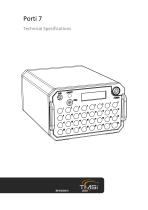
Porti 7 Technical Specifications
Open the catalog to page 1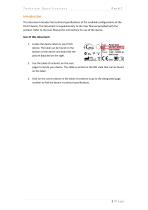
Technical Specifications Introduction This document includes the technical specifications of the available configurations of the Porti7 device. This document is supplementary to the User Manual provided with the product. Refer to the User Manual for instructions for use of the device. Use of this document 1. Locate the device label on your Porti device. The label can be found on the bottom of the device and looks like the picture depicted on the right. 2. Use the table of contents on the next pages to locate your device. This table is sorted on the REF code that can be found on the label. 3....
Open the catalog to page 2
Technical Specifications
Open the catalog to page 3
Technical Specifications
Open the catalog to page 4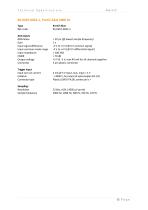
Technical Specifications
Open the catalog to page 5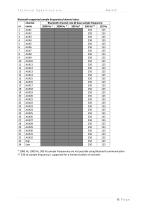
Technical Specifications Bluetooth supported sample frequencies/channel rates: * 2000 Hz, 1000 Hz, 500 Hz sample frequencies are not possible using Bluetooth communication ** 250 Hz sample frequency is supported for a limited number of channels
Open the catalog to page 6
Technical Specifications Channel list:
Open the catalog to page 7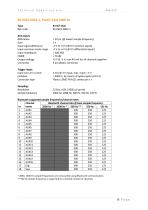
Technical Specifications < 20 pV (@ lowest sample frequency) 1 x -3 V to +3 V (@ 0 V common signal) -4 V to +4 V (@ 0 V differential signal) > 100 MQ > 70 dB +5 V & -5 V, max 40 mA for all channels together 5 pin plastic connector 2 mA @ 3 V input, max. input = 5 V > 4000 V, by means of optocoupler (H11L1) Plastic LEMO FFA.00, center pin is + AUX inputs RMS Noise Gain Input signal difference Input common mode range Input impedance CMRR Output voltage Connector Trigger input: Input turn-on current Isolation Connector type 2000, 1000 Hz sample frequencies are not possible using Bluetooth communication....
Open the catalog to page 8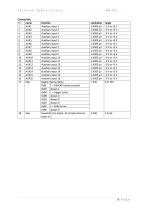
Technical Specifications Channel list:
Open the catalog to page 9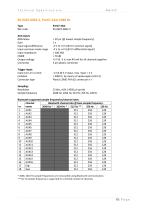
Technical Specifications < 20 pV (@ lowest sample frequency) 1 x -3 V to +3 V (@ 0 V common signal) -4 V to +4 V (@ 0 V differential signal) > 100 MQ > 70 dB +5 V & -5 V, max 40 mA for all channels together 5 pin plastic connector 2 mA @ 3 V input, max. input = 5 V > 4000 V, by means of optocoupler (H11L1) Plastic LEMO FFA.00, center pin is + AUX inputs RMS Noise Gain Input signal difference Input common mode range Input impedance CMRR Output voltage Connector Trigger input: Input turn-on current Isolation Connector type 2048, 1024 Hz sample frequencies are not possible using Bluetooth communication....
Open the catalog to page 10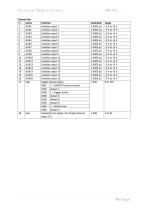
Technical Specifications Channel list:
Open the catalog to page 11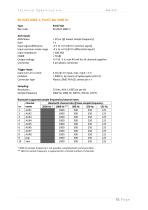
Technical Specifications < 20 pV (@ lowest sample frequency) 1 x -3 V to +3 V (@ 0 V common signal) -4 V to +4 V (@ 0 V differential signal) > 100 MQ > 70 dB +5 V & -5 V, max 40 mA for all channels together 5 pin plastic connector 2 mA @ 3 V input, max. input = 5 V > 4000 V, by means of optocoupler (H11L1) Plastic LEMO FFA.00, center pin is + AUX inputs RMS Noise Gain Input signal difference Input common mode range Input impedance CMRR Output voltage Connector Trigger input: Input turn-on current Isolation Connector type 2048 Hz sample frequency is not possible using Bluetooth communication....
Open the catalog to page 12
Technical Specifications Channel list:
Open the catalog to page 13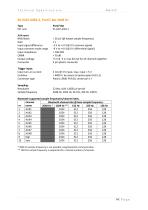
Technical Specifications < 20 pV (@ lowest sample frequency) 1 x -3 V to +3 V (@ 0 V common signal) -4 V to +4 V (@ 0 V differential signal) > 100 MQ > 70 dB +5 V & -5 V, max 40 mA for all channels together 5 pin plastic connector 2 mA @ 3 V input, max. input = 5 V > 4000 V, by means of optocoupler (H11L1) Plastic LEMO FFA.00, center pin is + AUX inputs RMS Noise Gain Input signal difference Input common mode range Input impedance CMRR Output voltage Connector Trigger input: Input turn-on current Isolation Connector type * 2048 Hz sample frequency is not possible using Bluetooth communication....
Open the catalog to page 14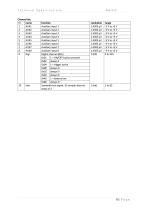
Technical Specifications Channel list:
Open the catalog to page 15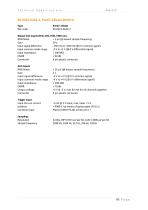
Technical Specifications Bipolar ExG inputs (EEG, ECG, EOG, EMG etc.) RMS Noise < 1 pV (@ lowest sample frequency)
Open the catalog to page 16
Technical Specifications * 2048 Hz, 1024Hz sample frequencies are not possible using Bluetooth communication ** 512 Hz sample frequency is supported for a limited number of channels.
Open the catalog to page 17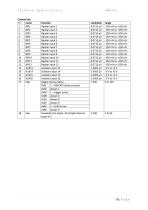
Technical Specifications Channel list:
Open the catalog to page 18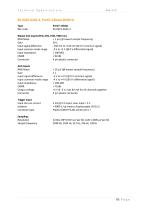
Technical Specifications Bipolar ExG inputs (EEG, ECG, EOG, EMG etc.) RMS Noise < 1 pV (@ lowest sample frequency)
Open the catalog to page 19
Technical Specifications * 2048 Hz, sample frequencies are not possible using Bluetooth communication ** 1024 Hz sample frequency is supported for a limited number of channels.
Open the catalog to page 20
Technical Specifications Channel list:
Open the catalog to page 21
Technical Specifications Bipolar ExG inputs (EEG, ECG, EOG, EMG etc.) RMS Noise < 1 pV (@ lowest sample frequency)
Open the catalog to page 22
Technical Specifications Bluetooth supported sample frequencies/channel rates: * 2048 Hz, 1024 Hz, sample frequencies are not possible using Bluetooth communication ** 512 Hz possible with limited number of channels
Open the catalog to page 23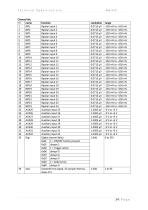
Technical Specifications Channel list:
Open the catalog to page 24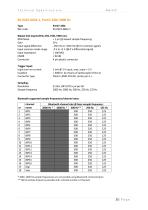
Technical Specifications Bipolar ExG inputs (EEG, ECG, EOG, EMG etc.) RMS Noise < 1 pV (@ lowest sample frequency) Input signal difference -150 mV to +150 mV (@ 0 V common signal) Input common mode range -2 V to +2 V (@ 0 V differential signal) Input impedance > 100 MQ Trigger input: Input turn-on current Isolation Connector type 2 mA @ 3 V input, max. input = 5 V > 4000 V, by means of optocoupler (H11L1) Plastic LEMO FFA.00, center pin is + Bluetooth supported sample frequencies/channel rates: 2000, 1000 Hz sample frequencies are not possible using Bluetooth communication 500 Hz...
Open the catalog to page 25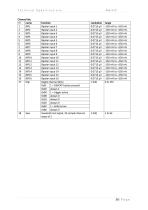
Technical Specifications Channel list:
Open the catalog to page 26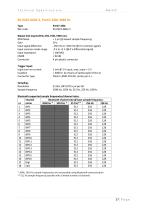
Technical Specifications RMS Noise < 1 pV (@ lowest sample frequency) Input signal difference -150 mV to +150 mV (@ 0 V common signal) Input common mode range -2 V to +2 V (@ 0 V differential signal) Input impedance > 100 MQ Connector 4 pin plastic connector 2 mA @ 3 V input, max. input = 5 V > 4000 V, by means of optocoupler (H11L1) Plastic LEMO FFA.00, center pin is + Trigger input: Input turn-on current Isolation Connector type 2048, 1024 Hz sample frequencies are not possible using Bluetooth communication 512 Hz sample frequency possible with a limited number of channels
Open the catalog to page 27
Technical Specifications Channel list:
Open the catalog to page 28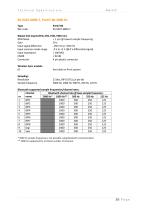
Technical Specifications Bipolar ExG inputs (EEG, ECG, EOG, EMG etc.) RMS Noise < 1 pV (@ lowest sample frequency) Input signal difference -150 mV to +150 mV Input common mode range -2 V to +2 V (@ 0 V differential signal) Input impedance > 100 MQ Wireless Sync module ID See label on Porti system * 2000 Hz sample frequency is not possible using Bluetooth communication ** 1000 Hz supported for a limited number of channels
Open the catalog to page 29All TMSi systems catalogs and technical brochures
 Measuring respiration
13 Pages
 Mobi
Mobi16 Pages
 Refa
Refa80 Pages

- Analysis software
- Visualization software
- ECG cable
- Straight electrode
- Monitoring sensor
- Acquisition software
- Electrophysiological exploration electrode
- Sharing software
- Import software
- EMG electrode
- Medical web application
- Electrophysiology amplifier
- EEG amplifier
- 32-channel electrophysiology amplifier
- EMG amplifier
- Electrophysiology software
- Tablet PC web application
- 64-channel electrophysiology amplifier
- Cutaneous electrode
- Windows web application