
- Catalogs
- Truemed Group
- HALSES PLA TE

HALSES PLA TE

HALSES PLA TE
The document discusses the development of the CERVICAL DOHLER SYSTEM, designed to enhance versatility and safety in cervical spine surgeries while reducing surgical time. This system integrates technical complexity with simplified surgical techniques.
Implant Design
The Halses Cervical Anterior plate and Arzzt screws are crafted from TITANIUM 6AI4V. The plates are available in various lengths ranging from 24.0mm to 64.0mm, with screws available in diameters of 4.0mm and 4.35mm, and lengths from 10mm to 20mm.
Pre-operative Planning
Patients should be informed of potential risks such as persistent pain, infection, and possible need for additional surgeries. Surgeons should consider blood self-transfusion for extensive surgeries and administer first-generation antibiotics pre-incision to minimize infection risks.
Patient Position
The patient is positioned supine with the head in extension to maintain normal cervical lordosis. The surgical approach can be from the right or left, with head rotation to adjust the superior cervical spine position.
Surgical Approach
A transverse cutaneous incision is made, followed by atraumatic dissection between the trachea and esophagus, and laterally in the sternocleidomastoid and carotid. A soft tissue distractor may be used for better access. Intervertebral disc removal is performed, followed by necessary maneuvers like corpectomy or discectomy.
Plate Positioning
The plate-holder clamp is used to select and mold the suitable length plate. A punch is used to create an initial hole, followed by manual insertion of a wick to the desired length. The thread is then made into the hole, and screws are inserted using a screwdriver. The blocking system is activated by turning the latch 45° to the right.
Conclusion
The Halses Arzzt plate allows for screw fixation in convergent, divergent, or fixed positions in both longitudinal and sagittal planes, providing flexibility in surgical applications.
Catalog excerpts
Halses Plate
Open the catalog to page 1
ARZZT Techniques HALSES PLATE
Open the catalog to page 2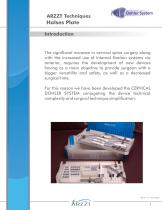
ARZZT Techniques Halses Plate Introduction The significant increase in cervical spine surgery along with the increased use of internal fixation systems via anterior, requires the development of new devices having as a main objective to provide surgeon with a bigger versatility and safety, as well as a decreased surgical time. For this reason we have been developed the CERVICAL DOHLER SYSTEM conjugating the device technical complexity and surgical technique simplification.
Open the catalog to page 3
ARZZT Techniques Halses Plate Implant design Halses Cervical Anterior plate and Arzzt screws are available for the following holes with TITANIUM 6AI4V, 2.0mm profile, and its screws with a diameter of 4.0mm and 4.35mm and length from 10mm to 20mm having a 2mm difference between each measure.
Open the catalog to page 4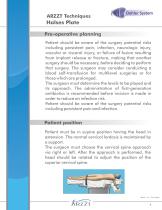
ARZZT Techniques Halses Plate Pre-operative planning Patient should be aware of the surgery potential risks including persistent pain, infection, neurologic injury, vascular or visceral injury, or failure of fusion resulting from implant release or fracture, making that another surgery should be necessary, before deciding to perform that surgery. The surgeon may consider conducting a blood self-transfusion for multilevel surgeries or for those which are prolonged. The surgeon must determine the levels to be played and its approach. The administration of first-generation antibiotics is recommended...
Open the catalog to page 5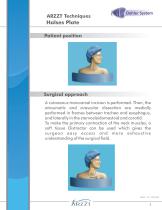
ARZZT Techniques Halses Plate Patient position Surgical approach A cutaneous transversal incision is performed. Then, the atraumatic and avascular dissection are medially performed in frames between trachea and esophagus, and laterally in the sternocleidomastoid and carotid. To make the primary contraction of the neck muscles, a soft tissue Distractor can be used which gives the surgeon easy access and more exhaustive understanding of the surgical field.
Open the catalog to page 6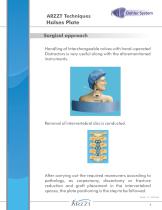
ARZZT Techniques Halses Plate Surgical approach Handling of interchangeable valves with hand-operated Distractors is very useful along with the aforementioned instruments. Removal of intervertebral disc is conducted. After carrying out the required maneuvers according to pathology, as corpectomy, discectomy or fracture reduction and graft placement in the intervertebral spaces, the plate positioning is the step to be followed. Back to Content
Open the catalog to page 7
The plate-holder clamp is used for this step. The suitable length plate is selected and the required molding level is verified. The plate is molded by folding-plate clamp on the area located between blocking devices to obtain an anatomical profile. To make the initial hole, the punch is used and placing the end in the plate hole, giving the desired angular target and then, a gentle strength is applied to enter the lip around 10mm into the thickness of the vertebral body. Using the hole made by the punch, the wick is manually turning inserted, when the desired length has previously been selected....
Open the catalog to page 8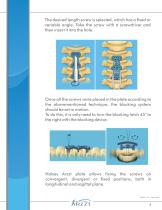
The desired length screw is selected, which has a fixed or variable angle. Take the screw with a screwdriver and then insert it into the hole. Once all the screws were placed in the plate according to the abovementioned technique, the blocking system should be set in motion. To do this, it is only need to turn the blocking latch 45° to the right with the blocking device. Halses Arzzt plate allows fixing the screws on convergent, divergent or fixed positions, both in longitudinal and sagittal plane. Back to Content
Open the catalog to page 9All Truemed Group catalogs and technical brochures
 Intramedullary Tibial Nail
2 Pages
 Intramedullary Humerus Naif
2 Pages
 Intramedullary Femoral Nail
2 Pages
 Pertrochanteric Hip Device
20 Pages
 Surgical Technique
24 Pages
 ZHS1 Cementless Hip System
13 Pages
 Bein System 5.0 mm
6 Pages
 Ins Hilden Humerus
15 Pages
 Ins Hilden Femoral
11 Pages
 Dohler System: Halses
9 Pages
 Dohler System: Spalte
16 Pages
 Cementless Hip System
13 Pages
 LCP 5.0 mm Plates
6 Pages
 Intramedullary Nail tibia
8 Pages
 Intramedullary Nail for Humerus
15 Pages


- Bone plate
- Compression plate
- Metallic compression plate
- Locking compression plate
- Surgery forceps
- Orthopedic surgery instrument kit
- Distal compression plate
- Compression bone screw
- Metallic compression bone screw
- Proximal compression plate
- Arthrodesis nail
- Forearm compression plate
- Lateral compression plate
- Medial compression plate
- Tibia compression plate
- Metallic intramedullary nail
- Humerus compression plate
- Radius compression plate
- Cannulated compression bone screw
- Toothed forceps