
- Catalogs
- Truemed Group
- Intramedullary locked Nailing With Screws for Humerus Fractures

Intramedullary locked Nailing With Screws for Humerus Fractures

Intramedullary locked Nailing With Screws for Humerus Fractures
The document serves as a comprehensive guide for orthopedic traumatologists on the ARZZT intramedullary nail system, specifically for treating humerus fractures. It highlights the biomechanical principles of using internal splints for diaphyseal and proximal fractures.
Implant Design
The ARZZT system features solid and cannulated nails made from titanium alloy, available in various diameters and lengths. These nails allow for three methods of proximal blocking to ensure stability. Locking screws, also made from titanium, are available in different sizes.
Indications
The system is intended for fixing various fracture types, including shaft fractures and malunions of the humerus, femur, and tibia. Pre-operative planning involves determining the appropriate nail size using X-rays and considering the patient's anatomy.
Pre-operative Planning and Patient Positioning
Patients are positioned in a 'beach chair' position to facilitate fracture reduction and surgical access, which also helps reduce venous stasis.
Preparing the Nail and Instruments
The nail is assembled and calibrated before use, involving groove alignment, fastening with a hexagon key, and ensuring symmetry with the instrumental frame.
Surgical Techniques
Solid Nail Technique: This involves making an incision, accessing the humeral head, and using a primer punch to create an entry portal. The nail is introduced with rotational movements and secured with locking screws.
Cannulated Nail Technique: Similar to the solid nail technique but involves using a guide wire and medullar drilling. The nail is inserted over the guide wire and secured similarly.
Distal and Proximal Blocking
Blocking involves placing sheaths and drilling to secure the nail with screws, ensuring the nail is firmly fixed in place.
Post-operative Care
Post-surgery, the wound is dressed, and a shoulder immobilizer is applied. The document emphasizes verifying screw alignment and fracture reduction.
Conclusion
The ARZZT intramedullary nail system provides a robust solution for humerus fractures, offering stability and flexibility in surgical approaches. The guide outlines detailed steps for both solid and cannulated nail techniques, ensuring effective fracture management.
This document provides a detailed guide on the use of the ARZZT intramedullary nail system for humerus fractures, covering the surgical procedure, post-operative care, and implant extraction.
Surgical Procedure
The procedure involves inserting locking screws at proximal and distal orifices, with the orthopedic surgeon selecting the appropriate orifices based on fracture characteristics. The proximal arm supports the introduction of locking screws, and the reduction and longitude of screws are verified before sealing the nail with a cap. The rotator cuff is repaired, and the wound is sutured and dressed. A shoulder immobilizer or sling is applied post-surgery.
Post-Operative Care
The ARZZT intramedullary nail provides sufficient stability, eliminating the need for external splints. Physical therapy is recommended to reduce edema, and the timing for movement resumption and stitch removal is at the surgeon's discretion.
Implant Extraction
For nail extraction, the patient is positioned in a 'beach chair' position. The proximal locking screws are removed first, followed by the distal screws, ensuring the nail is fastened to prevent rotation. A 3 cm incision is recommended for implant removal. The procedure involves layered dissection, removal of fibrous tissue, and extraction of the nail using an impactor/extractor. The wound is closed in layers and covered with a sterile dressing.
Contact Information
ARZZT, 202 Timberloch PI Suite 200, The Woodlands, TX, 77380. Email: [email protected]
Catalog excerpts
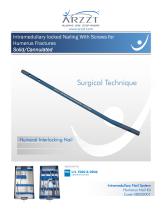
Intramedullary locked Nailing With Screws for Humerus Fractures Solid/Cannulated Surgical Technique Humeral Interlocking Nail Intramedullary Nail System Humerus Nail Kit Code 08050001
Open the catalog to page 1
Intramedullary locked Nailing With Screws for Humerus Fractures Solid/Cannulated www.arzzt.com ► Preparing the nail and instruments 8 ► Solid nail technique 10 ► Cannulated nail technique 11 ► Distal and proximal blocking 16 Intramedullary Nail System
Open the catalog to page 2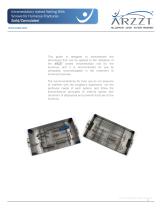
Intramedullary locked Nailing With Screws for Humerus Fractures Solid/Cannulated www.arzzt.com This guide is designed to demonstrate the techniques that can be applied to the utilization of the ARZZT locked intramedullary nail for the humerus, and it is recommended for use by orthopedic traumatologists in the treatment of humerus fractures. The recommendations for their use do not presume to interfere with the surgeon’s experience, nor the particular needs of each patient, and follow the biomechanical principles of internal splints with treatment of diaphyseal and proximal fractures of the humerus....
Open the catalog to page 3
Intramedullary locked Nailing With Screws for Humerus Fractures Solid/Cannulated www.arzzt.com Introduction Conservative treatment does not always lead to favorable results, and is linked to long periods of immobilization, as well as trophic and functional problems in the upper part of the affected extremity. The fracture line can extend from the metaphyseal area to the superior and inferior diaphyseal thirds (diaphyseal lesions or fractures). The management of these lesions caused by highenergy trauma, which are increasingly more frequent, has led to the development of implants like the ARZZT...
Open the catalog to page 4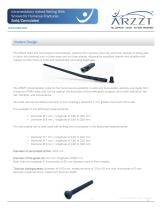
Intramedullary locked Nailing With Screws for Humerus Fractures Solid/Cannulated www.arzzt.com The ARZZT solid and cannulated intramedullary nails for the humerus have the particular feature of being able to block the proximal part in three ways and on three planes, allowing for excellent fixation and stability with respect to both fracture lines and tuberosities (including diaphysis). The ARZZT intramedullary nails for the humerus are available in solid and cannulated versions, are made from a titanium 6AI4V alloy, and can be used at the discretion of the orthopedic surgeon, who must evaluation...
Open the catalog to page 5
Intramedullary locked Nailing With Screws for Humerus Fractures Solid/Cannulated Ins Hilden Arzzt Nail Systems, consisting of intramedullary solid and cannulated nails, end cap and locking screws, are intended for fixation of fractures of different types: of the shaft, open and closed shaft fractures; and malunion and non-unions of the Femur, Tibia, and Humerus. The diameter and longitude of the nail can be established by way of X-rays of—if possible—the healthy extremity, which are to be used as templates, taking into account the magnification, which varies between 10 and 15%. Some surgeons...
Open the catalog to page 6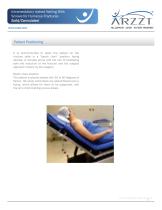
Intramedullary locked Nailing With Screws for Humerus Fractures Solid/Cannulated www.arzzt.com Patient Positioning It is recommended to place the patient on the fracture table in a “beach chair” position, laying laterally or dorsally prone with the aim of facilitating both the reduction of the fracture and the surgical approach chosen by the surgeon. Beach chair position: The patient is placed seated with 30 to 60 degrees of flexion, the lower extremities are placed flexed over a bump, which allows for them to be supported, with the aim of diminishing venous stasis. Intramedullary Nail System
Open the catalog to page 7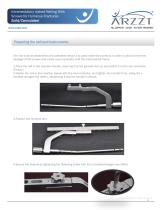
Intramedullary locked Nailing With Screws for Humerus Fractures Solid/Cannulated www.arzzt.com Preparing the nail and Instruments The nail must be assembled and calibrated before it is used inside the humerus in order to allow for the free passage of the screws and create exact symmetry with the instrumental frame. 1.Place the nail in the insertion handle, ensuring that the grooves line up, and attach it to the nail connector. (Picture) 2.Fasten the nail in the insertion sleeve with the nail connector, and tighten the handle firmly, using the Lhandled hexagon key (Allen), introducing it into...
Open the catalog to page 8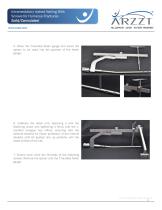
Intramedullary locked Nailing With Screws for Humerus Fractures Solid/Cannulated www.arzzt.com 5. Place the T-handled feeler gauge and insert the spacer to be used into the grooves of the feeler gauge. 6. Calibrate the distal arm, fastening it with the fastening screw and tightening it firmly with the Lhandled hexagon key (Allen), ensuring that the external sheaths for tissue protection of the internal sheaths (drill bit guides) line up perfectly with the distal orifices of the nail. 7. Ensure once more the firmness of the fastening screws. Remove the spacer and the T-handled feeler gauge. Intramedullary...
Open the catalog to page 9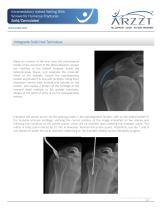
Intramedullary locked Nailing With Screws for Humerus Fractures Solid/Cannulated www.arzzt.com Antegrade Solid Nail Technique Make an incision of the skin from the anterolateral border of the acromion in the distal direction, toward the insertion of the deltoid muscles. Incise the subcutaneous tissue, and separate the muscular fibers of the deltoids. Locate the supraspinatus tendon and divide it in line with its fibers. Using blunt dissection, retract both borders with sutures on the tendon, and expose a portion of the cartilage of the humeral head medially to the greater tuberosity. Access to...
Open the catalog to page 10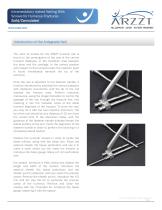
Intramedullary locked Nailing With Screws for Humerus Fractures Solid/Cannulated www.arzzt.com The point of access for the ARZZT humeral nail is found on the prolongation of the axis of the central humeral diaphysis, in the transition area between the bone and the cartilage. In the correct position with respect to the humeral head, the insertion point is found immediately beneath the tip of the acromion. Once the nail is attached to the fastener handle, it must be introduced by exerting firm manual pressure with rotational movements until the tip of the nail reaches the fracture area. Perform...
Open the catalog to page 11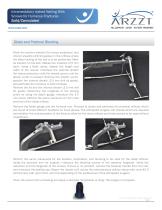
Intramedullary locked Nailing With Screws for Humerus Fractures Solid/Cannulated www.arzzt.com Distal and Proximal Blocking Place the exterior sheaths (for tissue protection) and interior sheaths (drill bit guides) in the orifices where the distal locking of the nail is to be performed. Mark its location on the skin. Makes two incisions of 5 mm each. Using a Kelly clamp, dissect the length and width of the wound. Introduce the external sheath (for tissue protection) with the sheath punch until the lateral cortex is located. Remove the sheath punch, position the internal sheath (3.5 mm drill bit...
Open the catalog to page 12All Truemed Group catalogs and technical brochures
 Intramedullary Tibial Nail
2 Pages
 Intramedullary Humerus Naif
2 Pages
 Intramedullary Femoral Nail
2 Pages
 Pertrochanteric Hip Device
20 Pages
 Surgical Technique
24 Pages
 ZHS1 Cementless Hip System
13 Pages
 Bein System 5.0 mm
6 Pages
 Ins Hilden Humerus
15 Pages
 Ins Hilden Femoral
11 Pages
 Dohler System: Halses
9 Pages
 Dohler System: Spalte
16 Pages
 HALSES PLA TE
9 Pages
 Cementless Hip System
13 Pages
 LCP 5.0 mm Plates
6 Pages
 Intramedullary Nail tibia
8 Pages
 Intramedullary Nail for Humerus
15 Pages


- Bone plate
- Compression plate
- Metallic compression plate
- Locking compression plate
- Surgery forceps
- Orthopedic surgery instrument kit
- Distal compression plate
- Compression bone screw
- Metallic compression bone screw
- Proximal compression plate
- Forearm compression plate
- Lateral compression plate
- Medial compression plate
- Tibia compression plate
- Metallic intramedullary nail
- Humerus compression plate
- Radius compression plate
- Cannulated compression bone screw
- Toothed forceps