
- Catalogs
- Truemed Group
- Intramedullary Locked Nailing With Screws for Tibia Fractures

Intramedullary Locked Nailing With Screws for Tibia Fractures

Intramedullary Locked Nailing With Screws for Tibia Fractures
The document provides a comprehensive guide on the use of ARZZT Intramedullary Nails for treating diaphyseal tibia fractures. It emphasizes the biological and biomechanical advantages of intramedullary nailing, which is widely accepted as the preferred treatment for most tibia fractures.
Indications and Contraindications
The ARZZT Nail Systems are designed for fixing various types of fractures, including shaft fractures and malunions of the femur, tibia, and humerus. Specific indications and contraindications are provided for both solid and cannulated nails, with infections and certain open fracture types listed as contraindications.
Implant Design
The document details the specifications of the cannulated and solid tibia nails, both made from Titanium 6AI4V. The nails are available in various diameters and lengths, with specific measurements for the cannulated orifice and guide wire.
Set of Instruments
Instrument selection is based on X-ray measurements of the healthy extremity, considering image magnification standards. The document outlines methods for determining the appropriate nail size.
Surgical Planning and System Calibration
Instructions are provided for attaching the nail to the insertion handle and calibrating the system. This includes securing the system with an L-handled hexagon key and ensuring proper alignment and fastening of components.
Surgical Technique
The surgical procedure involves patient positioning, incision, and nail insertion. Specific steps are outlined for both solid and cannulated nails, including the use of manual reamers and guide rods.
Nail Insertion and Locking
Details are provided for distal and proximal locking of the nail, including the use of external and internal sheaths for tissue protection and drill bit guides. The procedure concludes with washing, closing, and dressing the surgical site.
Implant Extraction
The extraction process involves locating and removing locking screws, followed by the removal of the nail using an impactor/extractor. The document provides detailed steps for suturing and dressing the wounds.
Bibliography
The document references several studies and articles related to intramedullary nailing techniques and outcomes.
Catalog excerpts

Intramedullary Locked Nailing With Screws for Tibia Fractures Solid/Cannulated Surgical Technique Cannulated Tibial Interlocking Nail Intramedullary Nail System Tibia Nail Kit Code 08060001
Open the catalog to page 1
Intramedullary locked Nailing With Screws for Tibia Fractures Solid/Cannulated www.arzzt.com Intramedullary Nail System
Open the catalog to page 2
Intramedullary locked Nailing With Screws for Tibia Fractures Solid/Cannulated www.arzzt.com The purpose of this guide is to demonstrate the technique and recommended indications for the use of ARZZT Intramedullary Nails in the treatment of diaphyseal tibia fractures. The recommendations for their use do not presume to interfere with the surgeon’s experience, nor the particular needs of each patient, and follow the basic norms for the treatment of diaphyseal fractures through fixation with locked intramedullary nails. Intramedullary Nail System 3
Open the catalog to page 3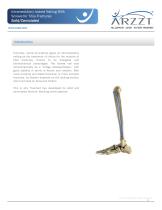
Intramedullary locked Nailing With Screws for Tibia Fractures Solid/Cannulated www.arzzt.com Introduction Currently, nearly all authors agree on intramedullary nailing as the treatment of choice for the majority of tibia fractures, thanks to its biological and biomechanical advantages. The locked nail acts biomechanically as a “bridge osteosynthesis,” with good stability in terms of flexion and rotation. With more proximal and distal fractures, or more complex fractures, its fixation depends on the locking screws, and much less on bone-nail friction. This is why Truemed has developed its solid...
Open the catalog to page 4
Intramedullary locked Nailing With Screws for Tibia Fractures Solid/Cannulated www.arzzt.com Indications : Ins Hilden Arzzt Nail Systems, consisting of intramedullary solid and cannulated nails, end cap and locking screws, are intended for fixation of fractures of different types: of the shaft, open and closed shaft fractures; and malunion and non-unions of the Femur, Tibia, and Humerus. Cannulated nail: - Tibia fracture classifications 42-A, 42-B, and 42-C (AO) - Exposed tibia fractures I, II, and IIIA (Gustilo) - Non-union or pseudoarthrosis of the tibia Contraindications: - Infections - Open...
Open the catalog to page 5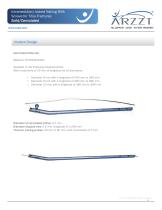
Intramedullary locked Nailing With Screws for Tibia Fractures Solid/Cannulated www.arzzt.com Implant Design Cannulated tibia nail Material: TITANIUM 6AI4V Available in the following measurements: With increments of 20 mm of longitude for all diameters. • Diameter 8 mm with a longitude of 240 mm to 340 mm • Diameter 9 mm with a longitude of 260 mm to 360 mm • Diameter 10 mm with a longitude of 280 mm to 360 mm Diameter of cannulated orifice: 3.7 mm Diameter of guide wire: 2.5 mm, longitude of 1,000 mm Titanium locking screws: 30 mm to 80 mm, with increments of 5 mm Intramedullary Nail Syste
Open the catalog to page 6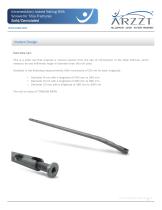
Intramedullary locked Nailing With Screws for Tibia Fractures Solid/Cannulated www.arzzt.com Implant Design Solid tibia nail: This is a solid nail that requires a manual reamer from the site of introduction to the tibial isthmus, which needs to be one millimeter larger in diameter than the nail used. Available in the following measurements: With increments of 20 mm for each longitude: • Diameter 8 mm with a longitude of 240 mm to 340 mm • Diameter 9 mm with a longitude of 260 mm to 360 mm • Diameter 10 mm with a longitude of 280 mm to 360 mm The nail is made of TITANIUM 6AI4V Intramedullary Nail...
Open the catalog to page 7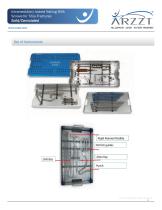
Intramedullary locked Nailing With Screws for Tibia Fractures Solid/Cannulated www.arzzt.com Intramedullary Nail System 8
Open the catalog to page 8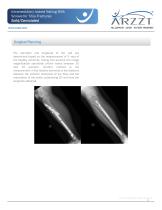
Intramedullary locked Nailing With Screws for Tibia Fractures Solid/Cannulated www.arzzt.com Surgical Planning The diameter and longitude of the nail are determined based on the measurement of X- rays of the healthy extremity, taking into account the image magnification standards (which varies between 10 and 15 percent). Another method is the measurement in the healthy extremity of the distance between the anterior tuberosity of the tibia and the articulation of the ankle, subtracting 20 mm from the longitude obtained. Intramedullary Nail System 9
Open the catalog to page 9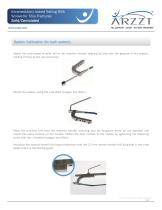
Intramedullary locked Nailing With Screws for Tibia Fractures Solid/Cannulated www.arzzt.com System Calibration (for both system): Attach the cannulated or solid nail to the insertion handle, aligning its tabs with the grooves of the implant, holding it firmly by the nail connector. Secure the system using the L-handled hexagon key (Allen). Place the proximal arm over the insertion handle, ensuring that the longitude arrow for the selected nail meets the arrow located on the handle. Fasten the tibia module to the handle by tightening the fastening screw with the L-handled hexagon key (Allen)....
Open the catalog to page 10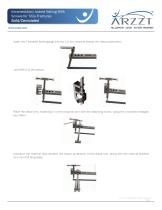
Intramedullary locked Nailing With Screws for Tibia Fractures Solid/Cannulated www.arzzt.com Insert the T-handled feeler gauge into the 5.2 mm external sheath (for tissue protection) Place the distal arm, fastening it to the proximal arm with the fastening screw, using the L-handled hexagon key (Allen). Introduce the external tibia sheaths (for tissue protection) to the distal arm, along with the internal sheaths (3.5 mm drill bit guides). Intramedullary Nail System 11
Open the catalog to page 11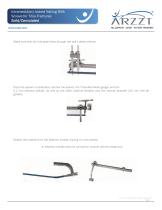
Intramedullary locked Nailing With Screws for Tibia Fractures Solid/Cannulated www.arzzt.com Make sure that the bits pass freely through the nail’s distal orifices. Once the system is calibrated, remove the spacer, the T-handled feeler gauge, and the 5.2 mm external sheath, as well as the other external sheaths and the internal sheaths (3.5 mm drill bit guides). Detach the module from the fastener handle, leaving it in two pieces: a) Insertion handle with the nail and b) module with the distal arm. Intramedullary Nail System 12
Open the catalog to page 12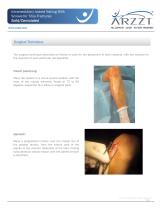
Intramedullary locked Nailing With Screws for Tibia Fractures Solid/Cannulated www.arzzt.com Surgical Technique The surgical technique described as follows is used for the placement of both implants, with the variants for the insertion of each particular nail specified. Patient positioning: Place the patient in a prone supine position with the knee of the injured extremity flexed at 70 to 90 degrees, supported by a pillow or surgical pack. Approach: Make a longitudinal incision over the medial line of the patellar tendon, from the inferior pole of the patella to the anterior tuberosity of the...
Open the catalog to page 13All Truemed Group catalogs and technical brochures
 Intramedullary Tibial Nail
2 Pages
 Intramedullary Humerus Naif
2 Pages
 Intramedullary Femoral Nail
2 Pages
 Pertrochanteric Hip Device
20 Pages
 Surgical Technique
24 Pages
 ZHS1 Cementless Hip System
13 Pages
 Bein System 5.0 mm
6 Pages
 Ins Hilden Humerus
15 Pages
 Ins Hilden Femoral
11 Pages
 Dohler System: Halses
9 Pages
 Dohler System: Spalte
16 Pages
 HALSES PLA TE
9 Pages
 Cementless Hip System
13 Pages
 LCP 5.0 mm Plates
6 Pages
 Intramedullary Nail tibia
8 Pages
 Intramedullary Nail for Humerus
15 Pages


- Bone plate
- Compression plate
- Metallic compression plate
- Locking compression plate
- Surgery forceps
- Orthopedic surgery instrument kit
- Distal compression plate
- Compression bone screw
- Metallic compression bone screw
- Proximal compression plate
- Forearm compression plate
- Lateral compression plate
- Medial compression plate
- Tibia compression plate
- Metallic intramedullary nail
- Humerus compression plate
- Radius compression plate
- Cannulated compression bone screw
- Toothed forceps