
- Catalogs
- Truemed Group
- Intramedullary Nail for Humerus

Intramedullary Nail for Humerus

Intramedullary Nail for Humerus
The document provides guidelines for the ARZZT intramedullary locked nail used in humerus fracture treatment. It is designed for orthopedic and trauma surgeons, emphasizing minimal soft tissue aggression and versatile application for various fracture types.
Implant Design
The ARZZT nail is available in steel and titanium, with diameters of 7 and 8 mm and lengths from 180 to 280 mm. Screws range from 20 to 50 mm. The design allows for proximal locking in three ways, ensuring excellent fixation and stability.
Preoperative Planning
Patient positioning is crucial and can be in a 'beach chair', lateral decubitus, or supine position. X-rays of the healthy limb are recommended for setting nail diameter and length.
Surgical Approach
A lateral incision is made at the acromioclavicular joint, extending as needed. The medullary channel is prepared using a bradawl and reamers based on the chosen nail diameter.
Nail Assembling in the Instrument
The nail is assembled and calibrated with the instrument frame to ensure free passage of screws. This involves securing the nail in a flex handle and using an Allen wrench for adjustments.
Nail Insertion
The assembled nail is inserted into the humeral shaft under image intensifier guidance. Proper alignment and reduction are verified before proceeding with distal and proximal locking.
Distal and Proximal Locking
Distal locking involves marking and drilling through the skin to insert screws. Proximal locking is performed similarly, with the option to use up to three screws based on fracture characteristics.
Postsurgical Care
External stabilization is generally unnecessary due to the nail's stability. Edema reduction and stitch removal timing are at the surgeon's discretion.
Catalog excerpts
SURGICAL TECHNIQUE OF ARZZT INTRAMEDULLARY NAIL FOR HUMERUS
Open the catalog to page 1
ARZZT Techniques ► NAIL ASSEMBLING IN THE INSTRUMENT ► DISTAL AND PROXIMAL LOCKING
Open the catalog to page 2
ARZZT Techniques Ins Hilden INTRODUCTION This guideline is aimed to explain the techniques and applications that could be applied for ARZZT intramedullary locked nail for humerus and it would be recommended for use by Orthopedic and Trauma Surgeons for humerus fracture treatment. The recommendations for use are not to be intended to interfere with the surgeon's experience or the specific needs of each patient, according to the internal splint biomechanics principles for treatment of humerus shaft or proximal fractures.
Open the catalog to page 3
ARZZT Techniques Ins Hilden INTRODUCTION • The treatment of complex fracture lines due to high energy trauma which is becoming more increased and which makes the humerus fracture complexity is becoming more difficult to solve in addition to finding less and less extensive surgical approaches intended to cause the least possible aggression for functional anatomical restoration that causes the patient is faster reinstated to daily and working activities, for that reason, medullary fixation systems very versatile were created such as Arzzt intramedullary nail for humerus. • These innovations resulted...
Open the catalog to page 4
ARZZT Techniques • Arzzt intramedullary nail for humerus is available on grade implant steel and titanium, in diameters of: 7 and 8 mm with lengths ranged from 180 to 280 mm with a 20 mm difference between each measure. It is made of surgical metal: STEEL 316 LS and TITANIUM 6Al4V, to be used at the orthopedic surgeon discretion. • The screws used are available from 20 to 50 mm, with a 5 mm difference between measures. • It is recommended to assess its use by an experienced orthopedic surgeon evaluating risk, benefit and suitability.
Open the catalog to page 5
ARZZT Techniques Ins Hilden PREOPERATIVE PLANNING • Nail diameter and length can be set by X-rays of the healthy limb, if possible, to use as templates, taking into account the magnification fluctuating between 10 and 15%. Some surgeons use the image intensifier overlying the nail to affected limb to set the diameter and get a safety distance from the joint as well as the nail insertion point. • In very narrow bones, it is suggested to place the smaller diameter nail upon surgeon's choice and depending on fracture comminution and stability it is recommended to use a larger diameter nail in order...
Open the catalog to page 6
ARZZT Techniques Ins Hilden SURGICAL APPROACH • A lateral incision of acromioclavicular joint of 2 to 3 cm length (the approach can be extended in case of obese patients) in the direction of the arm, dissecting by planes up to the tip of greater tuberosity, dissecting the rotator cuff and reaching the trochiter tip. • The starting bradawl will be introduced following its curvature which will be calibrated when entering to medullar channel, then, the 7 and 8 mm rima will be used to enlarge the channel diameter, depending on the diameter chosen by orthopedic surgeon. NAIL ASSEMBLING IN THE INSTRUMENT...
Open the catalog to page 7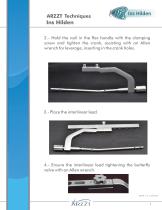
ARZZT Techniques Ins Hilden 2.- Hold the nail in the flex handle with the clamping screw and tighten the crank, assisting with an Allen wrench for leverage, inserting in the crank holes. 3.- Place the interlinear lead. 4.- Ensure the interlinear lead tightening the butterfly valve with an Allen wrench.
Open the catalog to page 8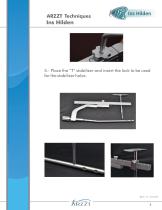
ARZZT Techniques 5.- Place the “T” stabilizer and insert the lock to be used for the stabilizer holes.
Open the catalog to page 9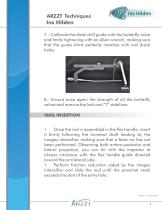
ARZZT Techniques Ins Hilden 7.- Calibrate the distal drill guide with the butterfly valve and firmly tightening with an Allen wrench, making sure that the guide shirts perfectly matches with nail distal holes. 8.- Ensure once again the strength of all the butterfly valves and remove the lock and “T” stabilizer. NAIL INSERTION • Once the nail is assembled in the flex handle, insert it firmly following the humeral shaft leading by the images intensifier, making sure that a false via has not been performed. Observing both antero-posterior and lateral projection, you can hit with the impactor to...
Open the catalog to page 10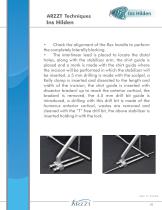
ARZZT Techniques • Check the alignment of the flex handle to perform the completely laterally blocking. • The interlinear lead is placed to locate the distal holes, along with the stabilizer arm, the shirt guide is placed and a mark is made with the shirt guide where the incision will be performed in which the stabilizer will be inserted, a 5 mm drilling is made with the scalpel, a Kelly clamp is inserted and dissected to the length and width of the incision, the shirt guide is inserted with dissector bradawl up to reach the anterior cortical, the bradawl is removed, the 4.5 mm drill bit guide...
Open the catalog to page 11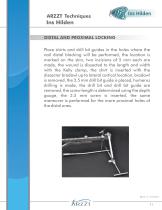
ARZZT Techniques Ins Hilden DISTAL AND PROXIMAL LOCKING Place shirts and drill bit guides in the holes where the nail distal blocking will be performed, the location is marked on the skin, two incisions of 5 mm each are made, the wound is dissected to the length and width with the Kelly clamp, the shirt is inserted with the dissector bradawl up to lateral cortical location, bradawl is removed, the 3.5 mm drill bit guide is placed, humerus drilling is made, the drill bit and drill bit guide are removed, the screw length is determined using the depth gauge, the 3.5 mm screw is inserted, the same...
Open the catalog to page 12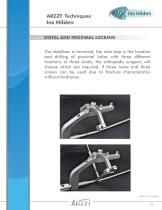
ARZZT Techniques Ins Hilden DISTAL AND PROXIMAL LOCKING The stabilizer is removed, the next step is the location and drilling of proximal holes with three different locations at three levels, the orthopedic surgeon will choose which are required, if three holes and three screws can be used due to fracture characteristics without hindrance.
Open the catalog to page 13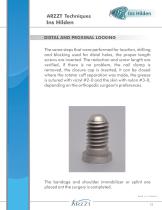
ARZZT Techniques Ins Hilden DISTAL AND PROXIMAL LOCKING The same steps that were performed for location, drilling and blocking used for distal holes, the proper length screws are inserted. The reduction and screw length are verified, if there is no problem, the nail clamp is removed, the closure cap is inserted, it can be closed where the rotator cuff separation was made, the grease is sutured with vicryl #2-0 and the skin with nylon #3-0, depending on the orthopedic surgeon's preferences. The bandage and shoulder immobilizer or splint are placed ant the surgery is completed. Back to Content
Open the catalog to page 14All Truemed Group catalogs and technical brochures
 Intramedullary Tibial Nail
2 Pages
 Intramedullary Humerus Naif
2 Pages
 Intramedullary Femoral Nail
2 Pages
 Pertrochanteric Hip Device
20 Pages
 Surgical Technique
24 Pages
 ZHS1 Cementless Hip System
13 Pages
 Bein System 5.0 mm
6 Pages
 Ins Hilden Humerus
15 Pages
 Ins Hilden Femoral
11 Pages
 Dohler System: Halses
9 Pages
 Dohler System: Spalte
16 Pages
 HALSES PLA TE
9 Pages
 Cementless Hip System
13 Pages
 LCP 5.0 mm Plates
6 Pages
 Intramedullary Nail tibia
8 Pages


- Bone plate
- Compression plate
- Metallic compression plate
- Locking compression plate
- Surgery forceps
- Orthopedic surgery instrument kit
- Distal compression plate
- Compression bone screw
- Metallic compression bone screw
- Proximal compression plate
- Forearm compression plate
- Lateral compression plate
- Medial compression plate
- Tibia compression plate
- Metallic intramedullary nail
- Humerus compression plate
- Radius compression plate
- Cannulated compression bone screw
- Toothed forceps