
- Catalogs
- Truemed Group
- SURGICAL TECHNIQUE FOR ARZZT SP AL TE SCREWS

SURGICAL TECHNIQUE FOR ARZZT SP AL TE SCREWS

SURGICAL TECHNIQUE FOR ARZZT SP AL TE SCREWS
The document provides guidelines for the use of ARZZT Lumbar Spine Screws by orthopedic and trauma surgeons for fracture treatment. It emphasizes that these recommendations should not override the surgeon's expertise or the specific needs of each patient.
Instructions for Use
The screws are indicated for conditions such as spondylolisthesis, fractures, non-treatable low back pain, congenital and progressive malformations, degenerative and post-surgical instabilities. They can be used in vertebrae from T11 to the sacrum.
Implant Design
The screws are poly-axial and made of titanium, available in various sizes (5.5, 6.5, and 7.5 mm diameters with lengths of 35, 40, 45, and 50 mm).
Patient Position
Proper patient positioning on the operating table is crucial to minimize venous bleeding and maintain spinal alignment during long spinal fusions.
Surgical Approach
The patient is positioned in ventral decubitus with foam pillows under the thighs. The posterior midline approach is preferred for its ease in decompressive procedures and osteotomies.
Reference Point Identification
Reference points for screw insertion vary by spinal region (thoracic, lumbar, sacral) and are crucial for accurate placement. Use of a fluoroscope is recommended for precision.
Preparation for Screw Placement
Osteotomy of the spinal apophysis allows proper screw head linkage. The entry point is prepared with a puncture instrument, and a probe is used to guide screw orientation.
Inserting Screws
The pedicle screw is positioned using a quick-hitching wrench. It is self-centering and self-tapping, requiring no directional guidance. Proper alignment is crucial to avoid future loosening.
Bar Placement
The bar is malleable and can be shaped to fit the spinal outline. Proper length and curvature are essential for effective reconstruction.
Distraction and Compression Procedure
Distraction increases intervertebral space, while compression is used sparingly to avoid nerve root compression. Both procedures affect spinal curvature and require caution.
Final Adjustment
Final adjustments are made with a hex wrench, ensuring screw tightness and system stability. The process is reversible during surgery.
Innovations
The poly-axial screw design optimizes biomechanics, reduces head breakage, and allows for greater flexibility in placement. The self-tapping thread profile minimizes bone expansion forces.
Catalog excerpts

SURGICAL TECHNIQUE FOR ARZZT SPALTE SCREWS
Open the catalog to page 1
Techniques ARZZT Spalte Screw ► REFERENCE POINT IDENTIFICATION ► PREPARATION FOR SCREW PLACEMENT ► DISTRACTION AND COMPRESSION PROCEDURE
Open the catalog to page 2
ARZZT Techniques Spalte Screw INTRODUCTION The present guideline is aimed to explain the recommended techniques and applications for using the ARZZT Lumbar Spine SCREW by Orthopedic and Trauma Surgeons for fracture treatment. The recommendations for use are not to be intended to interfere with the surgeon's experience or the specific needs of each patient according to the basic canons in fracture treatment. Spondylolisthesis Fractures Non-treatable Low Back Pain Congenital malformations Progressive malformations Degenerative instabilities Post-surgical instabilities Combination of the different...
Open the catalog to page 3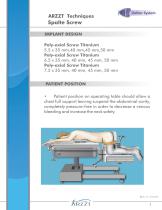
ARZZT Techniques Spalte Screw IMPLANT DESIGN Poly-axial Screw Titanium 5.5 x 35 mm,40 mm,45 mm,50 mm Poly-axial Screw Titanium 6.5 x 35 mm, 40 mm, 45 mm, 50 mm Poly-axial Screw Titanium 7.5 x 35 mm, 40 mm, 45 mm, 50 mm PATIENT POSITION • Patient position on operating table should allow a chest full support leaving suspend the abdominal cavity, completely pressure-free in order to decrease a venous bleeding and increase the neck safety.
Open the catalog to page 4
ARZZT Techniques Spalte Screw • The patient position in any long spinal fusion, including sacrum, is very important. For long fusions, a normal sagittal plane on the spine must be essentially maintained and trunk anterior slope lumbar lordosis loss should be prevented. • Patient is positioned in ventral decubitus, with foam pillows under thighs in order to stimulate the hip extension. The spinal shape should be maintained as if the patient is at standing position, maintaining the normal lumbar lordosis. SURGICAL APPROACH The approach to the posterior midline is the most used because it easily...
Open the catalog to page 5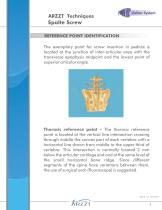
ARZZT Techniques Spalte Screw REFERENCE POINT IDENTIFICATION The exemplary point for screw insertion in pedicle is located at the junction of inter-articular area with the transverse apophysis midpoint and the lowest point of superior articular angle. Thoracic reference point – The thoracic reference point is located at the vertical line intersection crossing through middle the convex part of each vertebra with a horizontal line drawn from middle to the upper third of vertebra. This intersection is normally located 2 mm below the articular cartilage end and at the same level of the small horizontal...
Open the catalog to page 6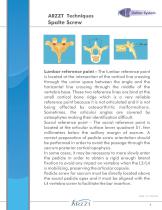
ARZZT Techniques Spalte Screw Lumbar reference point – The lumbar reference point is located at the intersection of the vertical line crossing through the union space between the angle and the horizontal line crossing through the middle of the vertebra base. These two reference lines are bind at the small cortical bone ridge which is a very reliable reference point because it is not articulated and it is not being affected by osteoarthritic malformations. Sometimes, the articular angles are covered by osteophytes making their identification difficult. Sacral reference point – The sacral reference...
Open the catalog to page 7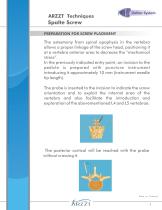
ARZZT Techniques Spalte Screw PREPARATION FOR SCREW PLACEMENT The osteotomy from spinal apophysis in the vertebra allows a proper linkage of the screw head, positioning it at a vertebra anterior area to decrease the “mechanical stress”. In the previously indicated entry point, an incision to the pedicle is prepared with puncture instrument introducing it approximately 10 mm (instrument needle tip length). The probe is inserted to the incision to indicate the screw orientation and to exploit the internal area of the vertebra and also facilitate the introduction and exploration of the abovementioned...
Open the catalog to page 8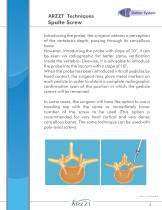
ARZZT Techniques Spalte Screw Introducing the probe, the surgeon obtains a perception of the vertebra's depth, passing through its cancellous bone. However, introducing the probe with slope of 10°, it can be seen via radiographic for better status verification inside the vertebra. Likewise, it is advisable to introduce the probe into the sacrum with a slope of 10°. When the probe has been introduced into all pedicles by hand contact, the surgeon may place metal markers on each pedicle in order to obtain a complete radiographic confirmation scan of the position in which the pedicle screws will...
Open the catalog to page 9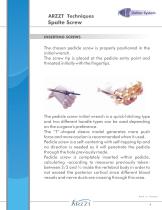
ARZZT Techniques Spalte Screw INSERTING SCREWS The chosen pedicle screw is properly positioned in the initial wrench. The screw tip is placed at the pedicle entry point and threated initially with the fingertips. The pedicle screw initial wrench is a quick-hitching type and two different handle types can be used depending on the surgeon's preference. The “T”-shaped sleeve model generates more push force and more caution is recommended when it used. Pedicle screw is a self-centering with self-tapping tip and no direction is needed as it will penetrate the pedicle through the hole previously made....
Open the catalog to page 10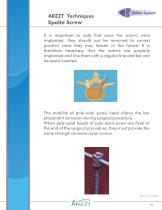
ARZZT Techniques Spalte Screw It is important to note that once the screws were implanted, they should not be removed to correct position since they may loosen in the future. It is therefore necessary that the screws are properly implanted and line them with a regular line and bar can be easily inserted. The mobility of poly-axial screw head allows the bar placement corrosion during surgical procedure. When poly-axial heads of poly-axial screw are fixed at the end of the surgical procedure, they must provide the same strength as mono-axial screws.
Open the catalog to page 11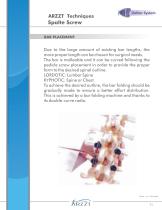
ARZZT Techniques Spalte Screw BAR PLACEMENT Due to the large amount of existing bar lengths, the more proper length can be chosen for surgical needs. The bar is malleable and it can be curved following the pedicle screw placement in order to provide the proper form to the desired spinal outline. LORDOTIC: Lumbar Spine KYPHOTIC: Spine or Chest. To achieve the desired outline, the bar folding should be gradually made to ensure a better effort distribution. This is achieved by a bar folding machine and thanks to its double-curve radio.
Open the catalog to page 12All Truemed Group catalogs and technical brochures
 Intramedullary Tibial Nail
2 Pages
 Intramedullary Humerus Naif
2 Pages
 Intramedullary Femoral Nail
2 Pages
 Pertrochanteric Hip Device
20 Pages
 Surgical Technique
24 Pages
 ZHS1 Cementless Hip System
13 Pages
 Bein System 5.0 mm
6 Pages
 Ins Hilden Humerus
15 Pages
 Ins Hilden Femoral
11 Pages
 Dohler System: Halses
9 Pages
 Dohler System: Spalte
16 Pages
 HALSES PLA TE
9 Pages
 Cementless Hip System
13 Pages
 LCP 5.0 mm Plates
6 Pages
 Intramedullary Nail tibia
8 Pages
 Intramedullary Nail for Humerus
15 Pages


- Bone plate
- Compression plate
- Metallic compression plate
- Locking compression plate
- Surgery forceps
- Orthopedic surgery instrument kit
- Distal compression plate
- Compression bone screw
- Metallic compression bone screw
- Proximal compression plate
- Arthrodesis nail
- Forearm compression plate
- Lateral compression plate
- Medial compression plate
- Tibia compression plate
- Metallic intramedullary nail
- Humerus compression plate
- Radius compression plate
- Cannulated compression bone screw
- Toothed forceps