
- Catalogs
- Truemed Group
- Surgical Technique

Surgical Technique

Surgical Technique
The document serves as a comprehensive guide for orthopedic traumatologists on the ARZZT intramedullary nail system, specifically designed for femoral fractures. It highlights the biological and biomechanical benefits of closed-focus intramedullary nailing, emphasizing the use of solid and cannulated nails as internal splints.
Implant Design
The ARZZT nails are crafted from titanium 6AI4V alloy, suitable for diaphyseal fractures. They are available in various diameters and lengths, with specific features for distal and proximal locking. The nails are universal for both left and right femurs and come in solid and cannulated forms.
Pre-operative Planning
This section details the process of determining the appropriate nail diameter and length using X-rays and image intensifiers, with methods for measuring and selecting the correct nail size based on patient anatomy.
Patient Positioning
The preferred method for femoral fracture reduction is closed, with the patient positioned supine. Proper positioning is crucial for surgical access and imaging.
Preparing the Nail and Instruments
Preparation involves assembling and calibrating the nail and instruments to ensure symmetry and proper alignment, with detailed steps for positioning and securing the nail and aiming arms.
Solid Nail Technique
This technique involves introducing the nail with rotational movements, ensuring fracture reduction, and using an impactor for final positioning. Distal and proximal blocking is achieved through precise placement of locking screws.
Post-operative Care
Post-operative care includes suturing the surgical wound, applying dressings, and removing the patient from the fracture table. Emphasis is placed on following the surgeon's preferences for wound care.
Set of Instruments
A list of necessary instruments for the procedure is provided, including sheaths, drill bit guides, and screwdrivers.
Implant Extraction
Guidelines for implant extraction focus on the removal of the end cap and screws, ensuring minimal trauma to the patient.
Specifications and Procedures
- Insertion Point: Located on the piriform fossa or the tip of the great trochanter, avoiding medial placement to prevent damage to the circumflex femoral artery.
- Medullar Canal Opening: Use a primer punch to open the canal, verified by an image intensifier, reaching a depth of 5–10 cm.
- Guide Wire Introduction: Insert a 2.5 mm guide wire, ensuring alignment with the fracture line using AP and lateral projections.
- Drilling: Begin with a 9.0 mm reamer, increasing by 0.5 mm increments. The final diameter should be 1.5–2 mm greater than the nail's diameter.
- Nail Introduction: Verify system calibration, introduce the nail with light turns, and confirm fracture reduction.
- Proximal and Distal Blocking: Position arms and sheaths, perform incisions, and insert screws for static or dynamic locking.
Post-Operative Care
- Apply an elastic bandage and elevate the extremity. Flexion and extension are allowed as tolerated.
- Walking with partial support can begin two weeks post-operation, following X-ray inspection.
- Sutures are removed after two to three weeks, with regular X-ray inspections every four weeks.
Implant Extraction
- Position the patient laterally for nail extraction.
- Remove proximal and distal screws, ensuring the nail connector is in place to prevent rotation.
- Perform a layered dissection to expose the implant, remove fibrous tissue, and extract the nail using an impactor.
- Close the wound in layers and cover with sterile gauze.
Contact Information
Arzzt, 202 Timberloch PI Suite 200, The Woodlands, TX, 77380. Email: [email protected]
Catalog excerpts
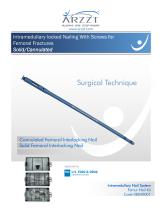
Intramedullary locked Nailing With Screws for Femoral Fractures Solid/Cannulated Surgical Technique Cannulated Femoral Interlocking Nail Solid Femoral Interlocking Nail Intramedullary Nail System Femur Nail Kit Code 08040001
Open the catalog to page 1
Intramedullary locked Nailing With Screws for Femoral Fractures Solid/Cannulated www.arzzt.com ► Preparing the Nail and Instruments 8 ► Solid Nail Technique 13 ► Distal and Proximal Blocking 14 ► Cannulated Nail Technique 16 Intramedullary Nail System
Open the catalog to page 2
Intramedullary locked Nailing With Screws for Femoral Fractures Solid/Cannulated www.arzzt.com This guide is designed to demonstrate the recommended techniques and applications for the use of the ARZZT intramedullary nail for femurs, meant for orthopedic traumatologists in the treatment of fractures. The recommendations for their use do not presume to interfere with the surgeon’s experience, nor the particular needs of each patient, and follow the basic norms for the treatment of fractures through intramedullary fixation with the biomechanical principle of internal splints or tutors. Intramedullary...
Open the catalog to page 3
Intramedullary locked Nailing With Screws for Femoral Fractures Solid/Cannulated www.arzzt.com Introduction The treatment of diaphyseal femoral fractures is currently based on closed- focus intramedullary nailing by virtue of its biological and biomechanical advantages. The solid nails—drilled or not drilled—act as internal splints, serving as “bridge nails” between the proximal fragments, with both their distal and proximal locking being essential due to the fact that all efforts are transmitted and supported via the locking screws. In cases of simple transverse fractures and short oblique fractures...
Open the catalog to page 4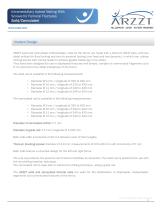
Intramedullary locked Nailing With Screws for Femoral Fractures Solid/Cannulated www.arzzt.com Implant Design ARZZT solid and cannulated intramedullary nails for the femur are made with a titanium 6AI4V alloy, with two distal orifices for fixed locking and two for proximal locking (one fixed and one dynamic), in which one places locking screws with conical heads to achieve greater fastening in the cortex. They have been designed for use in diaphyseal fractures with simple, complex or comminuted fragments up to 5 cm proximal to the distal metaphysis of the femur. The solid nail is available in...
Open the catalog to page 5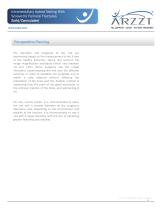
Intramedullary locked Nailing With Screws for Femoral Fractures Solid/Cannulated www.arzzt.com Pre-operative Planning The diameter and longitude of the nail are determined based on the measurement of the X-rays of the healthy extremity, taking into account the image magnification standards (which vary between 10 and 15%). Some surgeons use the image intensifier, superimposing the nail over the affected extremity in order to establish the longitude and to obtain a safe distance without affecting the articulation of the knee and hip. Another method is measuring from the point of the great trochanter...
Open the catalog to page 6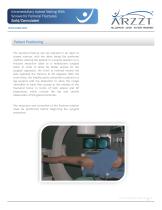
Intramedullary locked Nailing With Screws for Femoral Fractures Solid/Cannulated www.arzzt.com Patient Positioning The femoral fracture can be reduced in an open or closed manner, with the latter being the preferred method, placing the patient in a supine position on a fracture reduction table or a radiolucent surgical table. In order to allow for better access for the surgical approach, the trunk is inclined toward the side opposite the fracture at 25 degrees. With the trunk fixed, the healthy pelvic extremity is placed in a leg support with hip abduction to allow the image intensifier to have...
Open the catalog to page 7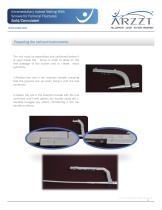
Intramedullary locked Nailing With Screws for Femoral Fractures Solid/Cannulated www.arzzt.com Preparing the nail and Instruments The nail must be assembled and calibrated before it is used inside the femur in order to allow for the free passage of the screws and to create exact symmetry. 1.Position the nail in the insertion handle, ensuring that the grooves line up when fixing it with the nail connector. 2.Fasten the nail in the insertion handle with the nail connector and firmly tighten the handle using the Lhandled hexagon key (Allen), introducing it into the handle’s orifices. Intramedullary...
Open the catalog to page 8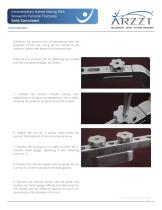
Intramedullary locked Nailing With Screws for Femoral Fractures Solid/Cannulated www.arzzt.com 3.Position the proximal arm in accordance with the longitude of the nail, lining up the arrows of the insertion handle with those of the proximal arm. 4.Secure the proximal arm by tightening the handle with the L-handled hexagon key (Allen). 5. Position the second module (aiming arm) depending on the leg to be operated on (left or right), following the direction of the arrow on the module. 6. Tighten the two no. 2 screws while taking into account the longitude of the nail arrow by arrow. 7. Position...
Open the catalog to page 9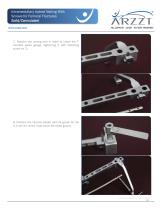
Intramedullary locked Nailing With Screws for Femoral Fractures Solid/Cannulated www.arzzt.com 7. Position the aiming arm in order to insert the Thandled feeler gauge, tightening it with fastening screw no. 3. 8. Position the internal sheath (drill bit guide) for the 5.2 mm bit, which must touch the distal groove. Intramedullary Nail System 10
Open the catalog to page 10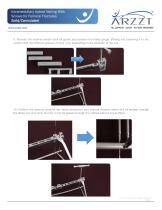
Intramedullary locked Nailing With Screws for Femoral Fractures Solid/Cannulated www.arzzt.com 9. Remove the internal sheath (drill bit guide) and position the feeler gauge, affixing and fastening it to the module with the different spacers (to lock it in), depending on the diameter of the nail. 10. Position the external sheaths (for tissue protection) and internal sheaths (distal drill bit guides) through the distal arm and verify that the 4 mm bit passes through the orifices without any problem. Intramedullary Nail System 11
Open the catalog to page 11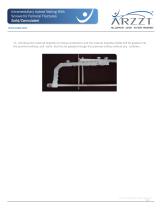
Intramedullary locked Nailing With Screws for Femoral Fractures Solid/Cannulated www.arzzt.com 11. Introduce the external sheaths (for tissue protection) and the internal sheaths (distal drill bit guides) into the proximal orifices, and verify that the bit passes through the proximal orifices without any problem. Intramedullary Nail System 12
Open the catalog to page 12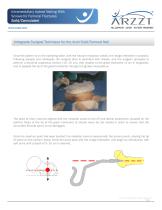
Intramedullary locked Nailing With Screws for Femoral Fractures Solid/Cannulated www.arzzt.com Antegrade Surigcal Technique for the Arzzt Solid Femoral Nail Once the patient is on the operating table, with the fracture reduction closed, the image intensifier in position, following asepsis and antisepsis the surgical area is delimited with drapes, and the surgeon proceeds to perform a proximal cutaneous incision (10–15 cm), with respect to the great trochanter (3 cm in longitude), and to palpate the tip of the great trochanter through the gluteal musculature. The point of entry must be aligned...
Open the catalog to page 13All Truemed Group catalogs and technical brochures
 Intramedullary Tibial Nail
2 Pages
 Intramedullary Humerus Naif
2 Pages
 Intramedullary Femoral Nail
2 Pages
 Pertrochanteric Hip Device
20 Pages
 ZHS1 Cementless Hip System
13 Pages
 Bein System 5.0 mm
6 Pages
 Ins Hilden Humerus
15 Pages
 Ins Hilden Femoral
11 Pages
 Dohler System: Halses
9 Pages
 Dohler System: Spalte
16 Pages
 HALSES PLA TE
9 Pages
 Cementless Hip System
13 Pages
 LCP 5.0 mm Plates
6 Pages
 Intramedullary Nail tibia
8 Pages
 Intramedullary Nail for Humerus
15 Pages


- Bone plate
- Compression plate
- Metallic compression plate
- Locking compression plate
- Surgery forceps
- Orthopedic surgery instrument kit
- Distal compression plate
- Compression bone screw
- Metallic compression bone screw
- Proximal compression plate
- Forearm compression plate
- Lateral compression plate
- Medial compression plate
- Tibia compression plate
- Metallic intramedullary nail
- Humerus compression plate
- Radius compression plate
- Cannulated compression bone screw
- Toothed forceps