
- Catalogs
- TST Othopedics
- Clavicle Plates Surgical Technique

Clavicle Plates Surgical Technique

Clavicle Plates Surgical Technique
Catalog excerpts

Clavicle Plates Surgical Technique
Open the catalog to page 1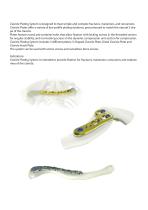
Clavicle Plating System is designed to treat simple and complex fractures, malunions, and nonunions. Clavicle Plates offer a variety of low-profile plating solutions, precontoured to match the natural S-shape of the clavicle. Plates feature round and combine holes that allow fixation with locking screws in the threaded section for angular stability, and non-locking screws in the dynamic compression unit section for compression. Clavicle Plating System includes 3 different plates; S-Shaped Clavicle Plate, Distal Clavicle Plate and Clavicle Hook Plate. The system can be used with cortex screws...
Open the catalog to page 2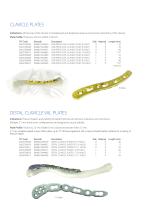
Indications: All fractures of the clavicle in metaphyseal and diaphyseal areas and corrective osteotomy of the clavicle. Plate Profile: Thickness: 3.0 mm, Width: 10.0 mm. Description LOW PROF. LOCK. CLAVICLE PLATE 4 HOLES LOW PROF. LOCK. CLAVICLE PLATE 6 HOLES LOW PROF. LOCK. CLAVICLE PLATE 8 HOLES LOW PROF. LOCK. CLAVICLE PLATE 10 HOLES LOW PROF. LOCK. CLAVICLE PLATE 4 HOLES LOW PROF. LOCK. CLAVICLE PLATE 6 HOLES LOW PROF. LOCK. CLAVICLE PLATE 8 HOLES Side Material Length (mm) Ti DISTAL CLAVICLE VAL PLATES Indications: Fracture fixation and stability for lateral third clavicle fractures, malunions...
Open the catalog to page 3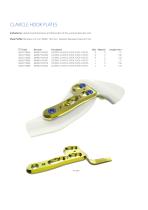
Description LOCKING CLAVICLE HOOK PLATE 4 HOLES LOCKING CLAVICLE HOOK PLATE 6 HOLES LOCKING CLAVICLE HOOK PLATE 8 HOLES LOCKING CLAVICLE HOOK PLATE 4 HOLES LOCKING CLAVICLE HOOK PLATE 6 HOLES LOCKING CLAVICLE HOOK PLATE 8 HOLES Side Material Length (mm) R Ti 75
Open the catalog to page 4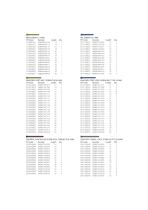
TST Code Barcode Length Qty LOW PROF. CORT. SELFT SCREW Ti 0 3.5 MM TST Code Barcode Length Qty LOW PROF. CORT. LOCK. SCREW SELFT Ti 0 3.5 MM TST Code Barcode Length Qty LOWPROF. CANCELLOUS SCREW (FULL THREAD) Ti 0 4 MM TST Code Barcode Length Qty LOW PROF. CANCEL. LOCK. SCREW SELFT Ti 0 4 MM Barcode Length
Open the catalog to page 5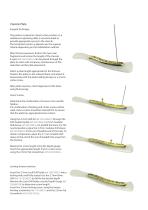
Clavicle Plate Surgical Technique The patient is placed in a beach chair position on a radiolucent operating table is recommended to provide appropriate access to the clavicle. The horizontal incision is placed over the superior clavicle depending on the stabilization method. After fracture exposure, distract the two main fragments and restore the length of the clavicle. K-wires (ref 23410180015) can be placed through the plate to assist with temporary maintenance of the reduction and for plate placement. Select a plate length appropriate for the fracture. Position the plate on the reduced bone,...
Open the catalog to page 6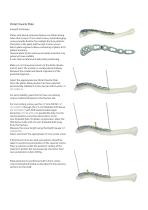
Distal Clavicle Plate Surgical Technique Plates with lateral extension feature six distal locking holes that accept 2.7mm small screws. Small diverging screws provide fixation for multiple fracture patterns. The holes in the plate shaft accept 3.5mm screws. Recon plate segments allow contouring of plates to fit patient anatomy. Tapered plate tip for submuscular plate insertion may preserve tissue viability K-wire hole on lateral end aids plate positioning. Make a 4 cm transverse incision to the distal clavicle and AC joint. The incision is usually placed midway between the medial and lateral...
Open the catalog to page 7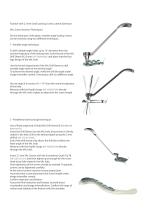
Fixation with 2.7mm Small Locking Screws Lateral Extension VAL Screw Insertion Techniques On the distal part of the plate, variable-angle locking screws can be inserted using two different techniques; 1– Variable angle technique; To drill variable angle holes up to 15° deviation from the nominal trajectory of the locking hole, insert the tip of the VAL Drill Sleeve Ø 2.0 mm (ref 2005900002) and place into the four legs design of the VAL hole. Use the funnel-shaped end of the VAL Drill Sleeve to drill variable angle holes at the desired angle. To achieve the desired angle, verify the drill bit...
Open the catalog to page 8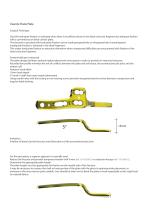
Clavicle Hook Plate Surgical Technique Clavicle hook plate fixation is indicated when there is insufficient bone in the distal clavicular fragment for adequate fixation with a conventional or distal clavicle plate. The decision to proceed with hook plate fixation can be made preoperatively or intraoperatively if unanticipated inadequate fixation is obtained in the distal fragment. This makes hook plate fixation an attractive alternative when unexpected difficulties are encountered with fixation of the distal clavicular fragment. Anatomically pre-contoured The plate design facilitates optimal...
Open the catalog to page 9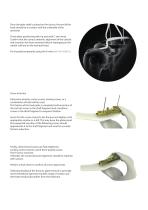
Once the plate shaft is placed on the clavice, the end of the hook should be in contact with the underside of the acromion. Check plate positioning with Ap and axial C-arm views. Confirm that the correct anatomic alignment of the clavicle and acromion has been restored without impinging on the rotator cuff and on the humeral head. Fix the plate temporarily using the K-wires (ref 23410180015). Screw Insertion Determine whether cortex screws, locking screws, or a combination of both will be used. The fixation of the hook plate is completed with insertion of the cortical screws in the shaft fragment...
Open the catalog to page 10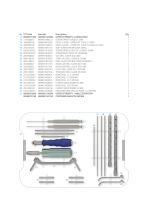
DescriptionUPPER EXTREMITY 4. DESIGN TRAY SCREW DRIVER TORQUE 1.5NM DEPTH GAUGE - UPPER EXT. PLATE (2.7 MM) DEPTH GAUGE - UPPER EXT. PLATE (3.5 MM & 4.0 MM ) SOFT SCREW DRIVER QUICK SMALL SCREW DRIVER QUICK TIP 2.5X05X130 MM STABL VAL DRILL SLEEVE 0 2.0 MM DRILL GUIDE DOUBLE UPPER EXTREMITY MODULAR DRILL SLEEVE 02.7 MM MODULAR DRILL SLEEVE 03.2 MM LOCK. DRILL GUIDE 0 2.7X50 MM THREADED DRILL GUIDE 03.2 MM KIRSCHNER WIRE TROCAR POINT 1.5X180 MM
Open the catalog to page 11All TST Othopedics catalogs and technical brochures
 OLECRANON PLATES
1 Page
 Calcar Stem
98 Pages
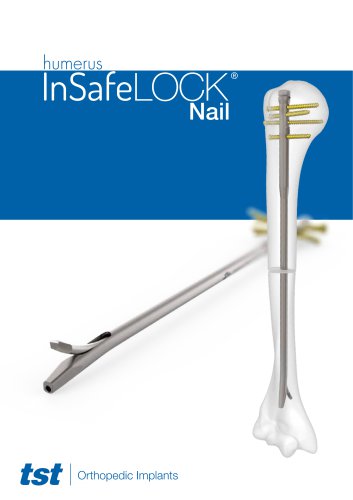 humerus InSafeLOCK Nail
28 Pages
 Catalog
2 Pages
 Plates&Screws Catalog
154 Pages

- Bone plate
- Compression plate
- Metallic compression plate
- Locking compression plate
- Titanium compression plate
- Distal compression plate
- Arthrodesis nail
- Table on castors
- Lateral compression plate
- External fixation system
- Metallic intramedullary nail
- Humerus compression plate
- Femoral stem
- Adult external fixation system
- Proximal fixation intramedullary nail
- Acetabular prosthesis
- Titanium intramedullary nail
- Cementless femoral stem
- Cementless acetabular prosthesis
- Tibia external fixation system