
- Catalogs
- Tulpar Medical
- Shoulder Instruments catalog

- Company
- Products
- Catalogs
- News & Trends
- Exhibitions
Shoulder Instruments catalog
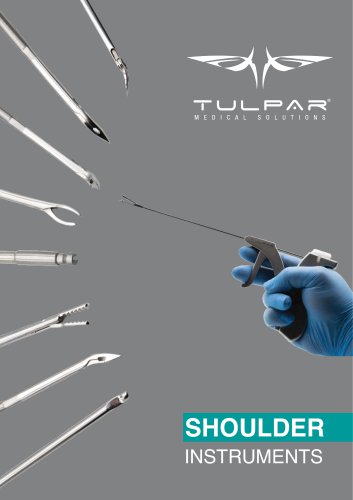
1 / 7 PagesView full catalog
Shoulder Instruments catalog
Product catalog summary
Overview
This technical document provides detailed instructions and specifications for soldering and assembly processes, focusing on best practices, equipment requirements, and design considerations to ensure high-quality and reliable connections.
1. Soldering Instructions
- Use the handle designed for the soldering iron to avoid conversion issues and ensure safety.
- The soldering process should be performed carefully to prevent damage and maintain consistency with the improved design.
- Recommended soldering irons include SLA3, Laburo, and Rotator flux irons for best support.
2. Equipment Specifications
- Use soldering irons with model numbers 68785X and 68785X RETIYED for inserting and grasping components during manipulation.
- Best support is provided by SLA3, Laburo, and Rotator flux irons.
3. Design and Construction Guidelines
- Design and construct soldering handles and tools to be compatible with standard force to avoid conversion issues.
- Use single-hole designs for soldering nodes and hold sticks, with specific angles for right and left angled degrees.
- Maintain straight and upward angled degrees for proper soldering orientation.
4. Additional Equipment Recommendations
- Use Rotator, Laburo, and Capsule shift irons for optimal soldering performance.
- Follow specific procedures for economic soldering hand tools such as the PREL and RAZOR ergonomic hand tools.
- Ensure proper twisting and orientation of left and right Laburo and Capsule irons during soldering.
Summary of Critical Points
- Handle design is crucial to prevent conversion and ensure safety.
- Use recommended soldering irons and flux irons for best results.
- Follow specified angles and orientations for soldering nodes and hold sticks.
- Adhere to ergonomic and procedural guidelines for hand tools to improve efficiency and reduce errors.
See more
Archived catalogs
 TULPAR CATALOGUE 2022
24 Pages
Related Searches
- Bone plate
- Tulpar surgery forceps
- Grasping forceps
- Surgery electrode
- Straight forceps
- Infusion set
- Orthopedic surgery instrument kit
- Reusable forceps
- Compression bone screw
- Monopolar electrode
- Interbody fusion cage
- Metallic compression bone screw
- Sealing forceps
- Coagulation electrode
- Bent forceps
- Suture thread
- General purpose compression bone screw
- Infusion set with Y port
- PEEK interbody fusion cage
- Cannulated compression bone screw
*Prices are pre-tax. They exclude delivery charges and customs duties and do not include additional charges for installation or activation options. Prices are indicative only and may vary by country, with changes to the cost of raw materials and exchange rates.
About MedicalExpo
MedicalExpo is a marketplace that offers B2B players a complete experience, from product sourcing to purchase. MedicalExpo is an entity of VirtualExpo Group.
Are you a buyer?
Are you a supplier?