- Catalogs
- Unomedical
- ConvaTec Little Ones® Two-Piece ostomy system*


ConvaTec Little Ones® Two-Piece ostomy system*
ConvaTec Little Ones® Two-Piece ostomy system*
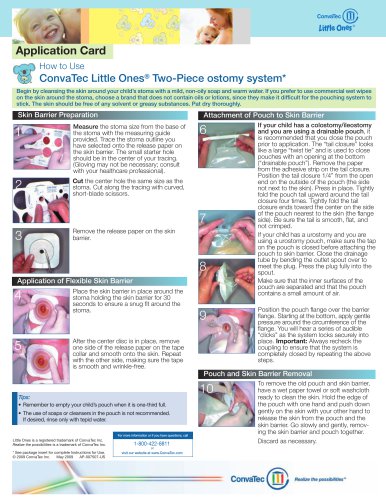
- Measuring and Tracing: Measure the stoma size using the provided guide and trace the outline onto the release paper on the skin barrier.
- Skin Preparation: Clean the skin around the stoma with mild, non-oily soap and warm water. Avoid products with oils or lotions.
- Skin Barrier Preparation: Cut the center hole to match the stoma size and remove the release paper.
- Application: Place the skin barrier around the stoma, holding it for 30 seconds to ensure a snug fit. Attach the pouch by aligning the flanges and applying pressure until you hear clicks.
- Removal: Gently remove the pouch and skin barrier using a wet paper towel or washcloth.
- Empty the pouch when it is one-third full.
- Avoid using soaps or cleansers inside the pouch; rinse with tepid water if necessary.
Catalog excerpts
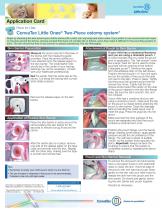
ConvaTec Little Ones® Two-Piece ostomy system* Begin by cleansing the skin around your child’s stoma with a mild, non-oily soap and warm water. If you prefer to use commercial wet wipes on the skin around the stoma, choose a brand that does not contain oils or lotions, since they make it difficult for the pouching system to stick. The skin should be free of any solvent or greasy substances. Pat dry thoroughly. Skin Barrier Preparation Attachment of Pouch to Skin Barrier Measure the stoma size from the base of the stoma with the measuring guide provided. Trace the stoma outline you have selected onto the release paper on the skin barrier. The small starter hole should be in the center of your tracing. (Gloving may not be necessary; consult with your healthcare professional). Cut the center hole the same size as the stoma. Cut along the tracing with curved, short-blade scissors. Remove the release paper on the skin barrier. 8 Application of Flexible Skin Barrier Place the skin barrier in place around the stoma holding the skin barrier for 30 seconds to ensure a snug fit around the stoma. After the center disc is in place, remove one side of the release paper on the tape collar and smooth onto the skin. Repeat with the other side, making sure the tape is smooth and wrinkle-free. If your child has a colostomy/ileostomy and you are using a drainable pouch, it is recommended that you close the pouch prior to application. The “tail closure” looks like a large “twist tie” and is used to close pouches with an opening at the bottom (“drainable pouch”). Remove the paper from the adhesive strip on the tail closure. Position the tail closure 1/4” from the open end on the outside of the pouch (the side not next to the skin). Press in place. Tightly fold the pouch tail upward around the tail closure four times. Tightly fold the tail closure ends toward the center on the side of the pouch nearest to the skin (the flange side). Be sure the tail is smooth, flat, and not crimped. If your child has a urostomy and you are using a urostomy pouch, make sure the tap on the pouch is closed before attaching the pouch to skin barrier. Close the drainage tube by bending the outlet spout over to meet the plug. Press the plug fully into the spout. Make sure that the inner surfaces of the pouch are separated and that the pouch contains a small amount of air. Position the pouch flange over the barrier flange. Starting at the bottom, apply gentle pressure around the circumference of the flange. You will hear a series of audible “clicks” as the system locks securely into place. Important: Always recheck the coupling to ensure that the system is completely closed by repeating the above steps. Pouch and Skin Barrier Removal Tips: • Remember to empty your child’s pouch when it is one-third full. • The use of soaps or cleansers in the pouch is not recommended. If desired, rinse only with tepid water. For more information or if you have questions, call Little Ones is a registered trademark of ConvaTec Inc. Realize the possibilities is a trademark of ConvaTec Inc. * See package insert for complete Instructions for Use. © 2009 ConvaTec Inc. May 2009 AP-007507-US 1-800-422-8811 or visit our website at www.ConvaTec.com To remove the old pouch and skin barrier, have a wet paper towel or soft washcloth ready to clean the skin. Hold the edge of the pouch with one hand and push down gently on the skin with your other hand to release the skin from the pouch and the skin barrier. Go slowly and gently, removing the skin barrier and pouch toget
Open the catalog to page 1All Unomedical catalogs and technical brochures
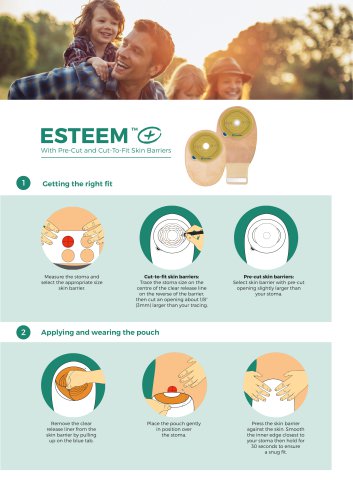 Esteem+ PC & CTF
2 Pages