

USCOM BP+

USCOM BP+
This document describes the BP+ device, which utilizes SupraSystolic Oscillometry technology to measure central blood pressure (cBP) and brachial blood pressure accurately and non-invasively. It highlights the importance of cBP as a marker for cardiovascular risk and outcomes.
Specifications and Features
- SupraSystolic Oscillometry: Measures central and brachial BP in under 60 seconds with a direct physics-based algorithm.
- Central Pulse Pressure Wave Analysis: Provides detailed analysis of the pulse pressure waveform.
- Ease of Use: The device is operator-independent, requiring no training, and is affordable as a standalone device.
- Accurate Measurement: BP+ measures cBP by holding the cuff 30mmHg above the systolic pressure to eliminate noise, ensuring reproducibility and accuracy.
- Comprehensive Data: Includes central systolic and diastolic pressures, brachial blood pressure, and pulse wave analysis.
- Additional Features: Augmentation index, rhythm strip for arrhythmia detection, cardiac performance monitoring, and invasive validation against catheter measurements.
Technology and Methodology
- Physics-Based Models: Uses first principles models rather than empirical statistical regressions, providing realistic waveforms with clear morphological features.
- Quality Control: Automatic rejection of motion artifacts and ectopic beats, with a meaningful signal-to-noise ratio.
- On-Device Calculations: No computer is needed for measurements, simplifying the process.
Conclusion
The BP+ device represents an innovative approach to hypertension and cardiovascular care, offering a personalized assessment and treatment standard. It is designed for ease of use, accuracy, and comprehensive data analysis, making it a premium tool for central BP and pulse wave analysis.
Catalog excerpts

The premium tool for hypertension and cardiovascular care SupraSystolic Oscillometry • central BP and brachial BP in less than 60s • central pulse pressure wave analysis • accurate, non-invasive and operator independent • direct physics based algorithm • easy to use, familiar with no training required • affordable standalone device Central blood pressure (cBP) is a more accurate marker of cardiovascular risk and outcomes, and a more appropriate target for interventions. A better way to measure blood pressure Raising the standard of care to personalized assessment and treatment SupraSystolic Oscillometric Technology High quality signal acquisition and detailed analysis of the pulse pressure waveform • BP+ measures cBP by briefly holding the cuff 30mmHg above the measured systolic pressure, eliminating sub systolic noise to achieve excellent reproducibility and accuracy • BP+ uses a 1st principles model of the arterial system to reconstruct the entire central BP waveform and calculate the systolic and diastolic central BP Artery occluded by SupraSystolic pressure 1 Pressure in the aorta is generated by the heart 2 Pressure waves travel to the end of the artery and are transferred to the cuff 3 Cuff pressure is measured by BP+
Open the catalog to page 1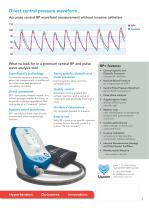
Direct central pressure waveform Accurate central BP waveform measurement without invasive catheters 110 What to look for in a premium central BP and pulse wave analysis tool SupraSystolic technology Pulse wave analysis is most accurate when the measurement is unaffected by radial-ulnar and peripheral circulatory variations Direct assessment BP+ uses physics-based models, not cohort average transfer functions, or empirical statistical regressions that only apply to an “average” patient Realistic entire waveforms BP+ waveforms show clear dicrotic notches and other morphologic features Aortic systolic,...
Open the catalog to page 2All Uscom catalogs and technical brochures
 Uscom Q4 FY20 4C Presentation
19 Pages
 Uscom Q4 FY20 4C Report
10 Pages
 USCOM 1A
3 Pages
- Blood pressure monitor
- Automatic blood pressure monitor
- Multi-parameter monitor
- Multi-parameter O2 monitor
- Pulse oximetry multi-parameter monitor
- Multi-parameter ECG monitor
- Blood pressure multi-parameter monitor
- Oscillometric blood pressure monitor
- Multi-parameter NIBP monitor
- Critical care multi-parameter monitor
- Multi-parameter monitor with touchscreen
- Blood pressure monitor with built-in cuff
- Spirometer
- Hand-held spirometer
- Computer-based spirometer
- Spirometer with USB connection
- Non-invasive multi-parameter monitor
- High-resolution multi-parameter monitor
- Home use spirometer
- Portable spirometer