
- Catalogs
- Varian Oncology
- HyperArc Overview

- Products
- Catalogs
- News & Trends
- Exhibitions
HyperArc Overview

HyperArc Overview
Approximately 20% of newly diagnosed cancer patients develop brain metastases, with stereotactic radiosurgery (SRS) often recommended as a primary treatment. However, SRS can be complex and costly, making it inaccessible for many patients and institutions. HyperArc™ high-definition radiotherapy (HDRT) aims to address these challenges by simplifying the SRS process.
- Prescriptive Workflow: Includes specified immobilization, patient setup, automated treatment delivery, intra-fraction imaging, and a pre-determined delivery sequence.
- Simplified Non-Coplanar Treatments: Automates and simplifies operations to make non-coplanar SRS delivery easier.
- Automated Treatment Delivery: Fully automated robotic motion allows for treatment delivery without re-entering the room.
- Increased Accessibility: Enables clinics to offer radiosurgery to more patients.
- Improved Clinical Quality: Enhances the quality of treatments and cost efficiency.
- Time Efficiency: Non-coplanar SRS procedures can be delivered within the time required for standard IMRT treatments.
- Enhanced Revenue: Utilizes the TrueBeam® platform to increase equipment utilization without needing SRS-specific equipment.
- Retreatment Challenges: Non-coplanar delivery provides compact dose distributions, sparing healthy tissue and increasing confidence in retreatments.
- Multiple Metastases Treatment: Designed to irradiate multiple lesions simultaneously, improving patient management and saving time.
HyperArc HDRT is designed to deliver high-quality SRS treatments safely, efficiently, and accurately on the TrueBeam platform. It aims to simplify advanced SRS delivery, allowing more facilities to offer radiosurgical procedures.
Catalog excerpts
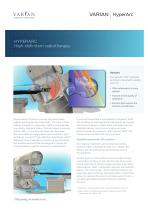
VARTAN medical systems VARIANHyperArc'HYPERARCHigh-definition radiotherapy Highlights The HyperArc HDRT treatment technique is designed to enable clinics to: • Offer radiosurgery to more patients • Improve clinical quality of treatments • Enhance SRS revenue and improve cost efficiency Approximately 20 percent of newly diagnosed cancer patients will develop brain metastases.1 For many of these patients, stereotactic radiosurgery (SRS) is recommended as a primary treatment option.2 Concerns about complexity, patient safety, cost, and human resources often make SRS inaccessible for many patients and unviable for many institutions. HyperArc™ high-definition radiotherapy (HDRT) addresses these challenges by introducing key technology and workflow elements that are designed to change the clinical landscape, enabling more clinics to deliver SRS. A prescriptive workflow is a key element of HyperArc HDRT. This workflow includes specified immobilization for imaging and treatment delivery, patient setup, automated one-click treatment delivery, intra-fraction imaging and a predetermined delivery sequence. With HyperArc HDRT, SRS may become a standard offering in your clinic. Simplified reproducible SRS workflow Non-coplanar treatments can be extremely complex. HyperArc HDRT is designed to make non-coplanar SRS delivery easy by automating and simplifying many of the operations. Varian’s goal is to offer treatment reproducibility through a prescribed workflow so that clinicians may focus on the clinical objectives of defining targets and dose prescription, while HyperArc HDRT is designed to optimize the treatment delivery. Our vision is one in which treatment delivery has never been easier, with fully automated robotic motion that allows the radiation therapist to commence and monitor a complete automated treatment without re-entering the room. 1 DeSantis CE, Cancer treatment and survivorship statistics, 2014 CA. 2 Nabors LB et al. Central Nervous System Cancers, Version 2.2014. J Natl Compr Canc Netw. 2014.
Open the catalog to page 1
Retreatment challenge Due to prolonged survival and higher utilization of radiosurgery without whole brain radiation for patients with brain metastases3, an increasing number of patients return for retreatment of their disease. This trend presents new challenges that require clinicians to deliver more compact and conformal radiation doses than before to avoid overlap with previous treatments. Non-coplanar delivery of radiation may provide more compact dose distributions that spare a larger amount of healthy tissue and may increase the clinicians’ confidence in retreatments.4 Multiple metastases...
Open the catalog to page 2All Varian Oncology catalogs and technical brochures
 Halcyon
15 Pages
 Eclipse
7 Pages
 TrueBeam Safety Features
2 Pages
 TrueBeam Brochure
11 Pages
 ProBeam Brochure
16 Pages
Archived catalogs
 Brachytherapy Applicator Catalog
150 Pages
 GammaMedplus™ iX Afterloader
4 Pages
 Trilogy Brochure
7 Pages
 VitalBeam
8 Pages
 Eclipse™
2 Pages
 INTRACRANIAL SRS PACKAGE
4 Pages
 ProBeam 360
2 Pages
 VELOCITY SOFTWARE
3 Pages
 ProBeam Compact Brochure
9 Pages
 oNCOLOGY CARE MANAGEMENT
3 Pages
 360 ONCOLOGY
3 Pages
 Proton Therapy reatment
4 Pages
 PaxScan ® 3030X
2 Pages
 PaxScan ® 4336X
4 Pages
 PaxScan ® 4343R
2 Pages
 Nexus-DRF™
2 Pages
 2520DX
2 Pages
 1515DXT
2 Pages
 PaxScan 1508 DXT
2 Pages
 PaxScan 1313DXT
2 Pages
 1308DXT
2 Pages
 Calypso Product Brief
2 Pages
 Clinac Brochure
12 Pages
 Capri? Applicator Set
2 Pages
 Edge Brochure
22 Pages
 NDI-452
4 Pages
 M-101G
6 Pages
 M-105SP
6 Pages
 M-109
M-1096 Pages
 M-113
M-1136 Pages
 M-143
M-1436 Pages
 M-147SP
6 Pages
 M-146
M-1466 Pages
 M-147
M-1476 Pages
 RAD-85S
6 Pages
 M-149
M-1496 Pages
 M-151
M-15110 Pages
 M-152
M-15212 Pages
 M-153
M-1538 Pages
 PaxScan 3030+
2 Pages
 M-171
M-1716 Pages
 PaxScan 2520E+
2 Pages
 PaxScan 4030E
2 Pages
 PaxScan 4336R
2 Pages
 PaxScan® 2520XI/V
2 Pages
 PaxScan® 2520D/CL
2 Pages
 PaxScan® 2020X
2 Pages
 PaxScan® 2020+
2 Pages
 1313
13132 Pages
 PaxScan® 1308
2 Pages
 Vitesse 3.0
3 Pages
 BrachyVision
7 Pages
 RapidArc
8 Pages
 Varian Exact© IGRT couch
2 Pages
 ARIA Oncology Information System
12 Pages
 PaxScan ® 4030CB
2 Pages
 PaxScan ® 1508DXT
2 Pages
 PaxScan ® 1313DX
2 Pages
 PaxScan ® 1308DX
2 Pages
 Vitesse? 2.5
2 Pages
 VariSeed? 8.0 Brochure
7 Pages
 BrachyVision Acuros
3 Pages
 BrachyVision? 8.5
7 Pages
 Varian BrachyTherapy
147 Pages


- Analysis software
- Surgical system
- Cutting electrosurgical system
- Radiology software
- Visualization software
- Tablet computer software
- Coagulation surgical system
- Tablet PC software
- Control software
- Cloud-based software
- Planning software
- Acquisition software
- Treatment software
- Traceability software
- Software module
- Data management software
- AI-assisted software
- Artificial intelligence software
- Surgery software
- Import software