
- Catalogs
- VATA, Inc.
- Chester_Chest

Chester_Chest

Chester_Chest
- Left Chest Area: Mimics human tissue with an outer flap, real implanted port, and inserts for simulating various port placements.
- Right Chest Area: Includes a visible tunneled central catheter and options for additional catheters.
- Arm: Contains a dual lumen PICC and a pre-positioned IV catheter, with an optional port access arm.
- Simulated Blood Reservoir Bags: For Chester torso and arm models.
- Universal Catheter Connector: 9.6 FR size.
- Replacement Arms for Chester: Available in different pigmentations for port access and standard arms.
- Simulated Blood: Offered in quart and gallon sizes with a stain-resistant formula.
- Huber Needles: Right angle needles in ¾ʺ and 1ʺ sizes, sold in sets of one dozen.
- Advanced Venipuncture Training Aid™: Available in different pigmentations.
- Port – Body in a Box™: Available in different pigmentations.
- Vascular Access Ultrasound Phantom: Available in different pigmentations.
Catalog excerpts

Chester Chest™ – 2400/2402 and 2410/2412 USER MANUA
Open the catalog to page 1
Thank You For Your Purchase! Thank you for your purchase of VATA’s Chester Chest™ . Chester Chest™, an industry standard since 1987, enables physicians, nurses, home health staff, patients and support persons to develop competence with the most common types of vascular access devices. Within one realistic and portable training aid, is a great tool for teaching, training, competency testing and skills assessment. This is the most realistic and complete model for central line care offered anywhere! The area around all catheter sites can be used to practice cleansing, application of dressings and...
Open the catalog to page 2
Overview of Chester Chest™ The left chest area of Chester Chest™ features: • Outer Tissue Flap 0405/0404 – A specially formulated material duplicates the feel of human tissue which, when placed over the chest port, provides a realistic practice of palpating and accessing, with proper access of the port being confirmed by a blood withdrawal – just like the real thing! • A real implanted port under the Outer Tissue Flap • Difficult Accessing Inserts 0420/0421, 0430/0431 and 0440/0441 which are made of a soft tissue like material and placed either under or over the port to simulate palpating and...
Open the catalog to page 3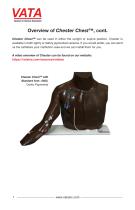
Overview of Chester Chest™, cont. Chester Chest™ can be used in either the upright or supine position. Chester is available in both lightly or darkly pigmented versions. If you would prefer, you can send us the catheters your institution uses and we can install them for you. A video overview of Chester can be found on our website: https://vatainc.com/resources/videos Chester ChestTM with Standard Arm– 2402, Darkly Pigmented
Open the catalog to page 4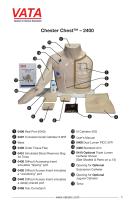
1 0406 Real Port (IVAD) 12 0408 Dual Lumen PICC 5FR 13 2388 Standard Arm 2 0407 Tunneled Cental Catheter 9.6FR 4 0405 Outer Tissue Flap 5 0451 Simulated Blood Reservior Bag for Torso 6 0430 Difficult Accessing Insert simulates “tipping” port 7 0420 Difficult Access Insert simulates a “wandering” port 8 0440 Difficult Access Insert simulates a deeply placed port 14 0410 Optional Triple Lumen Catheter Shown Subcalvian Catheter 16 Opening for Optional Jugular Catheter
Open the catalog to page 5
Backside of Chester Chest™ Torso 3 2 Retention Strap for Simulated Blood Reservoir Bag 3 0450 Three Way Parallel Tubing Set for Torso 4 Extra connection for use with with Optional Triple Lumen, Subclavian and Jugular Catheters 5 0455 Bolt and Wing Nut to Attach Arm to Torso (use legend on page 7 ‘Arm Features’)
Open the catalog to page 6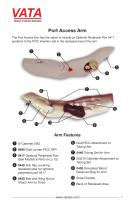
Port Access Arm The Port Access Arm has the option to include an Optional Peripheral Port 0417 posterior to the PICC insertion site in the recessed area of the arm. Arm Features 1 IV Catheter 20G 2 0408 Dual Lumen PICC 5FR 3 0417 Optional Peripheral Port (See Models & Parts on p.15) 4 0442 skin flap covering recessed area for optional peripheral port 0417 5 0455 Bolt and Wing Nut to Attach Arm to Torso 6 Dual PICC Attachment to Tubing Set 8 20G IV Catheter Attachment to Tubing Set 9 0453 Simulated Blood Reservoir Bag for Arm 11 Back of Recessed Area
Open the catalog to page 7
A video overview of Chester can be found on our website: https://vatainc.com/resources/videos Setting up your Chester Chest™ Unwrap the arm and body. Set the bag of additional parts, packed with the torso, aside for use later. Place the torso on a flat surface in an upright position. Remove the wing nut from the arm, keeping the bolt in place, and align the bolt with the hole in the right shoulder; insert and reattach the wing nut (see fig. 1). If you are going to use injection caps or needleless access caps, attach before attaching the simulated blood reservoir bag. On the backside of the torso,...
Open the catalog to page 8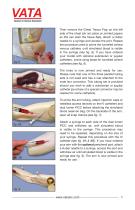
Then remove the Chest Tissue Flap on the left side of the chest (do not place on printed papers as this can stain the tissue flap), attach a Huber needle to a syringe and access the port. Repeat the procedure used to prime the tunneled central venous catheter, until simulated blood is visible in the syringe (see fig. 6). If you have ordered your model with optional subclavian or jugular catheters, prime using steps for tunneled central catheters (see fig. 6). The torso is now primed and ready for use. Please note that one of the three parallel tubing sets is not used and has a cap attached to...
Open the catalog to page 9
Proper Use of your Chester Chest™ Chest Tissue Flap – 0405 When removing the Chest Tissue Flap, always pull gently from the edge to prevent damage to the flap. Due to the elasticity of the Chest Tissue Flap, it may be easier to attach when Chester Chest™ is in a supine position. In order to ensure a realistic feel when palpating the port (IVAD), the Chest Tissue Flap is formulated to be soft to the touch. As the material is soft, care must be taken to maximize the useful life. There are three areas that should be avoided, as all can cause premature tearing of the Chest Tissue Flap: Do not pull...
Open the catalog to page 10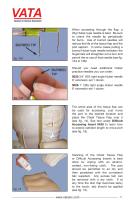
When accessing through the flap, a 22g Huber-type needle is best. Be sure to check the needle tip periodically for burrs. Use of burred needles will reduce the life of the tissue flap and the port septum. In some cases pulling a burred Huber-type needle between the fingernails will straighten out a burr and permit the re-use of that needle (see fig. 13A & 13B). Should you need additional Huber practice needles you can order: 5025 3/4ʺ 20G right angle Huber needle 8ʺ extension set 1 dozen. 5026 1ʺ 20G right angle Huber needle 8ʺ extension set 1 dozen. The entire area of the tissue flap can be...
Open the catalog to page 11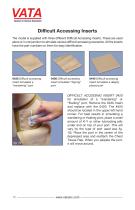
Difficult Accessing Inserts The model is supplied with three different Difficult Accessing Inserts. These are used alone or in conjunction to simulate various difficult accessing scenarios. All the inserts have the part numbers on them for easy identification. 0420 Difficult accessing insert simulates a “wandering” port 0430 Difficult accessing insert simulates “tipping” port 0440 Difficult accessing insert simulates a deeply placed port DIFFICULT ACCESSING INSERT 0420 for simulation of a “wandering” or “floating” port. Remove the 0430 insert and replace with the 0420. The #420 should be located...
Open the catalog to page 12All VATA, Inc. catalogs and technical brochures
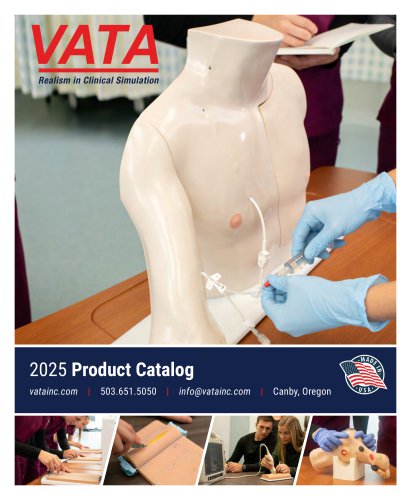 2025 Product Catalog
32 Pages
 Peter PICC Line™
12 Pages
 BonnieBone
12 Pages
 2365/2366
12 Pages
Archived catalogs
 LF00999
6 Pages
 VATA Catalog
24 Pages
- Anatomy model
- Training anatomy model
- Teaching anatomical model
- Training phantom
- General care phantom
- Test phantom
- Upper body simulator
- Bone anatomy model
- Surgical phantom
- Suture thread
- Injection simulator
- Pad simulator
- Leg anatomical model
- Spinal anatomical model
- Female simulator
- General purpose test phantom
- Non-absorbable suture thread
- Lower body simulator
- Puncture simulator
- Ultrasound imaging test phantom