


A112
A112
- Tissue Section/Adherent Cell Experiment: Detailed steps for sample preprocessing, positive treatment, and labeling for paraffin-embedded and frozen tissue sections, as well as adherent cells, are provided.
- Suspension Cell Experiment: Specific procedures for suspension cells are outlined separately.
- TUNEL and Immunofluorescence Co-staining: Steps for co-staining in paraffin sections, frozen sections, and cell coverslips are included.
- Sample Preparation: Instructions for preparing adherent and suspension cells, including fixation and permeabilization.
- Positive Treatment: Preparation of DNase I Buffer and treatment of samples to create positive controls.
- Labeling and Detection: Equilibration, preparation of TdT reaction mixture, and incubation for DNA end labeling, followed by counterstaining for analysis.
Catalog excerpts
TUNEL BrightGreen Apoptosis Detection Kit A112
Open the catalog to page 1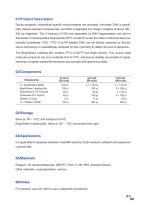
During apoptosis, intracellular specific endonucleases are activated, chromatin DNA is specifically cleaved between nucleosomes, and DNA is degraded into integer multiples of about 180 -200 bp fragments. The 3'-hydroxyl (3'-OH) end generated by DNA fragmentation can bind to fluorescein-12-deoxyuridine triphosphate (FITC-12-dUTP) under the action of terminal deoxynu-cleotidyl transferase (TdT). FITC-12-dUTP-labeled DNA can be directly observed by fluorescence microscopy or quantitatively analyzed by flow cytometry to reflect the level of apoptosis. The BrightGreen Labeling Mix contains FITC-12-dUTP...
Open the catalog to page 3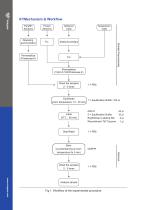
07/Mechanism & Workflow Frozen Sections Adherent Cells Suspension Cells Sample Preprocessing Paraffin Sections Wash the samples 2 - 3 times Equilibrate 1 × Equilibration Buffer: 100 μl (room temperature, 10 - 30 min) ddH2O 34 μl 5 × Equilibration Buffer 10 μl BrightGreen Labeling Mix 5 μl Recombinant TdT Enzyme 1 μl Stain (counterstaining at room temperature for 5 min) Wash the samples 2 - 3 times Analyze sample
Open the catalog to page 4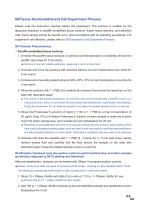
08/Tissue Section/Adherent Cell Experiment Process Please read this instruction carefully before the experiment. This protocol is suitable for the apoptosis detection of paraffin-embedded tissue sections, frozen tissue sections, and adherent cells. Each sample should be carried out in strict accordance with its operating procedures. For suspension cell detection, please refer to 09/Suspension Cell Experiment Process. 08-1/Sample Preprocessing ◇Paraffin-embedded tissue sections 1. Immerse the paraffin tissue sections in xylene at room temperature to completely remove the paraffin (two times for...
Open the catalog to page 5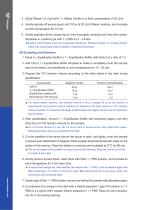
3. Dilute DNase I (2 U/jl) with 1 x DNase I Buffer to a final concentration of 20 U/ml. 4. Gently aspirate off excess liquid, add 100 |jl of 20 U/ml DNase I solution, and incubate at room temperature for 10 min. 5. Gently aspirate off the excess liquid, then thoroughly immerse and rinse the covers-lips/slides in a staining jar with 1 x PBS for 2 - 3 times. ▲ Positive control slides must use a separate staining jar. Residual DNase I on positive control slides may cause false positive signals in experimental groups. 1. Dilute 5 x Equilibration Buffer to 1 x Equilibration Buffer with ddhhO at a...
Open the catalog to page 6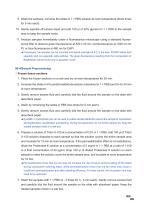
9. Wash the samples, immerse the slides in 1 × PBS solution at room temperature (three times for 5 min each). 10. Gently aspirate off excess liquid and add 100 μl of 20% glycerol in 1 × PBS to the sample area to keep the sample moist. 11. Analyze samples immediately under a fluorescence microscope using a standard fluorescence filter to observe green fluorescence at 520 ± 20 nm; red fluorescence at >620 nm for PI, or blue fluorescence at 460 nm for DAPI. ▲If necessary, the samples can be mounted and stored overnight at 4℃ in the dark. PI/DAPI stains both apoptotic and non-apoptotic cells red/blue....
Open the catalog to page 7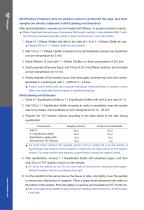
08-5/Positive Treatment (only the positive control is performed this step, and other samples are directly subjected to 08-6/Labeling and Detection) After permeabilization, samples can be treated with DNase I to prepare positive controls. ▲ DNase I treats fixed cells will cause chromosomal DNA breaks, resulting in many labelable DNA 3' ends. The following processes generally results in green fluorescence in most cells treated. 1. Dilute 10 x DNase I Buffer with dd-hO at a ratio of 1:10 to 1 * DNase I Buffer for use. ▲ Prepare 200 pl of 1 * DNase I Buffer for each sample. 2. Add 100 pl 1 * DNase...
Open the catalog to page 8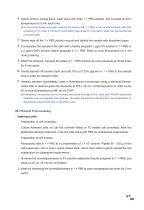
6. Gently remove excess liquid, wash twice with fresh 1 × PBS solution, and incubate at room temperature for 5 min each time. ▲To reduce the background, after washing the sample with 1 × PBS, it can be washed again with PBS containing 0.1% Triton X-100 and 5 mg/ml BSA (three times for 5 min each), which can remove the free unreacted label. 7. Gently wipe off the 1 × PBS solution around and behind the sample with absorbent paper. 8. Counterstain the sample in the dark with a freshly prepared 1 μg/ml PI solution in 1 × PBS or a 2 μg/ml DAPI solution freshly prepared in 1 × PBS. Place at room temperature...
Open the catalog to page 9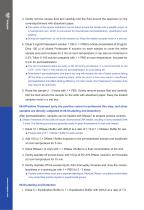
3. Gently remove excess fluid and carefully blot the fluid around the specimen on the coverslips/smears with absorbent paper. ▲ The outline of the sample distribution can be drawn around the sample with a paraffin crayon or a hydrophobic pen, which is convenient for downstream permeabilization, equilibration and labeling. ▲ During the experiment, do not let the sample dry. Keep the treated samples moist in a wet box. 4. Dilute 2 mg/ml Proteinase K solution 1:100 in 1 x PBS to a final concentration of 20 pg/ml. Drop 100 pl of diluted Proteinase K solution on each sample to cover the entire sample...
Open the catalog to page 10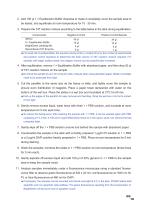
2. Add 100 |jl 1 x Equilibration Buffer dropwise to make it completely cover the sample area to be tested, and equilibrate at room temperature for 10 - 30 min. 3. Prepare the TdT reaction mixture according to the table below in the dark during equilibration. Components Negative Control Positive Control/Sample ▲ For sma|| ce|| covers|ips/s|ides, the required vo|ume is 50 p|, mu|tip|y 50 p| by the number of experimenta| and positive control reactions to determine the total volume of TdT reaction mixture required. For samples with larger surface areas, the reagent volume can be proportionally increased....
Open the catalog to page 11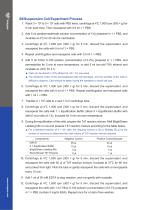
09/Suspension Cell Experiment Process 1. Wash 3 x 10⁶ to 5 x 10⁶ cells with PBS twice, centrifuge at 4°C 1,800 rpm (300 x g) for 5 min each time. Then resuspend with 0.5 ml 1 x PBS. 2. Add 5 ml paraformaldehyde solution (concentration of 1%) prepared in 1 x PBS, and incubate at 4C for 20 min for cell fixation. 3. Centrifuge at 4C 1,800 rpm (300 x g) for 5 min, discard the supernatant, and resuspend the cells with 5 ml of 1 x PBS. 4. Repeat centrifugation and resuspend cells with 0.5 ml 1 x PBS. 5. Add 5 ml Triton X-100 solution (concentration of 0.2%) prepared in 1 x PBS, and permeabilize for...
Open the catalog to page 12All Vazyme catalogs and technical brochures
Archived catalogs
 2020 Product Catalogue
32 Pages

- Solvent reagent
- Molecular biology reagent
- Diagnostic reagent
- Enzyme reagent
- Histology reagent
- Dye reagent kit
- Cytology reagent
- Buffer solution reagent
- Immunoanalysis reagent kit
- Quality control reagent
- Antibody
- Microtiter plate
- PCR reagent
- Bacteria reagent
- Virus reagent
- Pipette tip
- Tissue reagent
- 96-well microplate
- Microbiology reagent
- Laboratory microplate