

Textile Carousel

Textile Carousel
- Maximizes overhead space, recovering floor space.
- Accommodates roll diameters from 6” to 44” and widths up to 15’.
- Customizable to fit specific requirements.
- Ergonomic design to improve workplace safety and reduce injuries.
- Fast access to materials, improving productivity.
- Patented loading system for ease of use.
- Textile Roll Specifications: Max roll width of 180” (4,572 mm) and diameter from 6” to 44” (152 to 1,118 mm).
- Unit Specifications: Width up to 17’ 7” (5,359 mm), height from 7’ 6” to 25’ 0” (2,286 to 7,620 mm), and depth from 2’ 8” to 7’ 5” (813 to 2,261 mm).
- Capacity Specifications: Unit imbalance max of 1,950 to 4,000 lbs (885 to 1,814 kg), load capacity max of 13,000 to 34,000 lbs (5,897 to 15,422 kg), load per carrier max of 1,000 to 3,000 lbs (454 to 1,361 kg), and retrieval speed of 21 ft/min (8,077 mm/min).
- Position the fabric roll in front or rear of the carousel.
- Slide the carrier inside the material core.
- Attach the long end of loading bars on the carrier, two positions higher than the desired loading position.
- Attach the short end of loading bars to the carrier being loaded.
- Rotate the carousel to raise the material to a comfortable working height.
- Engage the loading bar handle and clip the carrier into its resting place on both sides of the carousel.
Catalog excerpts
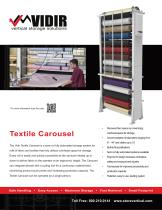
For more information scan the code. Textile Carousel overhead space for storage • • Semi or fully automated systems available Every roll is easily and quickly accessible as the carousel rotates up or Built-to-fit specifications rolls of fabric and textiles that fully utilizes overhead space for storage. Ergonomic design increases workplace down to deliver fabric to the operator at an ergonomic height. The Carousel can integrate directly with a cutting line for a continuous material feed, safety and reduces back injuries • minimizing product touch points and increasing production capacity. The Easy Access Maximum Storage Fast access for improved productivity and production capacity Textile Carousel can be operated by a single person. Accommodates roll diameters ranging from 6” - 44” and widths up to 15’ The Vidir Textile Carousel is a semi or fully automated storage system for Safe Handling Recovers floor space by maximizing Patented, easy to use, loading system Fast Retrieval Small Footprint
Open the catalog to page 1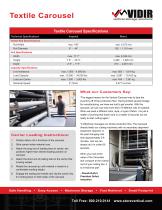
Textile Carousel **VIDIR vertical storage solutions Carrier Loading Instructions: 1. Position fabric roll in front/rear of the carousel. 2. Slide carrier inside material core. 3. Attach the long end of loading bars on carrier, two positions higher than desired loading position on carousel. 4. Attach the short end of loading bars to the carrier that is being loaded. 5. Rotate the carousel up until material is raised to a comfortable working height. 6. Engage the loading bar handle and clip the carrier into it's resting place on both sides of the carousel. What our Customers Say: “The biggest reason...
Open the catalog to page 2All Vidir catalogs and technical brochures
 Rack 'N' Roll Cutter
1 Page
 Print Cylinder Carousel
2 Pages
 Bar Stock / Linear VLS
2 Pages
 Garment Carousel
2 Pages
 Hollow Core Carousel
2 Pages
 MULTI TOWER CAROUSEL
1 Page
 RACK’N’ROLL CUTTER
1 Page
 CUT’N’ROLL II CUTTER
1 Page
 Wire Carousel
2 Pages
 Vinyl Carousel
2 Pages
 Sheet Metal VLS
2 Pages
 Pan Carousel
2 Pages
 Paint Can Carousel
2 Pages
 Carpet Carousel
2 Pages
 CAROUSEL MATE CUTTER
1 Page
 Hospital Bedlift
2 Pages
