
- Catalogs
- VITASSAY HEALTHCARE S.L.
- Vitassay-H.-pylori

Vitassay-H.-pylori

Vitassay-H.-pylori
Catalog excerpts
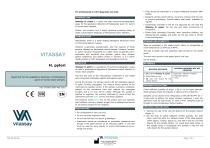
For professional in vitro diagnostic use only. Tests should be discarded in a proper biohazard container after testing. Reagents contain preservatives. Avoid any contact with the skin or mucous membrane. Consult safety data sheet, available on request. Vitassay H. pylori is a rapid one step immunochromatographic assay for the qualitative detection of Helicobacter pylori (H. pylori) in human stool samples. Simple, non-invasive and a highly sensitive screening assay to make a presumptive diagnosis of Helicobacter pylori infection. INTRODUCTION Helicobacter pylori is a spiral shaped pathogenic bacterium found on the human gastric mucosa. VITASSAY H. pylori Rapid test for the qualitative detection of Helicobacter pylori in human stool samples. Infection is generally asymptomatic, with the majority of those persons infected not developing clinical disease. However, because H. pylori has been recognized as a major cause of gastritis and is associated with duodenal ulcer disease, gastric ulcer disease, gastric lymphoma, and gastric cancer in humans, it is a public health problem in both developed and developing countries. PRINCIPLE Components provided in the kit are approved for use with the Vitassay H. pylori. Do not use any other commercial kit component. Follow Good Laboratory Practices, wear protective clothing, use disposal gloves, goggles and mask. Do not eat, drink or smoke in the working area. STORAGE AND STABILITY Store as packaged in the sealed pouch either at refrigerated or room temperature (2-30ºC/35.6-86ºF). The test is stable until the expiration date printed on the sealed pouch. The test must remain in the sealed pouch until use. Do not freeze. MATERIALS Vitassay H. pylori is a qualitative immunochromatographic assay to make a presumptive diagnosis of Helicobacter pylori infection in human stool samples. The test line zone of the nitrocellulose membrane is pre-coated with monoclonal antibodies against Helicobacter pylori. During the process, the sample reacts with the antibodies against H. pylori, forming conjugates. The mixture moves upward on the membrane by capillary action. If the sample is positive, antibodies present on the membrane (test line) capture the conjugate complex and a red line will be visible. Although the sample is positive or negative, the mixture continues to move across the membranes and the green control line always appears. The presence of this green line (in the control zone (C)) indicates that sufficient volume is added; proper flow is obtained and serves as an internal control for the reagents. MATERIAL PROVIDED 25 tests/kit Vitassay H. pylori Instructions for use. 25 vials with diluent for the sample dilution. MATERIAL REQUIRED BUT NOT PROVIDED Specimen collection container. Disposable gloves. Timer. SPECIMEN COLLECTION Collet sufficient quantity of feces: 1-2g or mL for liquid samples. Stool samples should be collected in clean and dry containers. Samples can be stored in the refrigerator (2-8ºC/36-46.4ºF) for 12 days prior to testing. For longer storage, maximum 1 year, the specimen must be kept frozen at -20ºC (-4ºF). Samples must be brought to room temperature before testing. SPECIMEN PREPARATION PRECAUTIONS For professional in vitro use only. Do not use after expiration date. Do not use the test if its pouch is damaged. Specimens should be considered as potentially hazardous and handle in the same manner as an infectious agent. A new test must be used for each sample to avoid contaminations errors. Single use device. 1. Remove the cap of the vial with diluent for the sample dilution (figure 1). 2. Use the stick to collect sufficient sample quantity. For solid stool, insert the stick in 4 different areas of the stool sample, taken approx. 125mg, (figure 2), and add it into the vial with diluent for the sample dilution. For liquid stool, take 125µL of the sample using a micropipette and transfer it into the vial with diluent for the sample dilution. Page 1 of 4 Parque Tecnológico WALQA Ctra. N.330, Km.566 22197-Cuarte
Open the catalog to page 1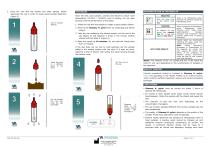
3. Close the vial with the diluent and stool sample. Shake vigorously the vial in order to assure good sample dispersion (figure 3). Vial for sample dilution. PROCEDURE Allow the test, stool sample, controls and diluent to reach room temperature (15-30ºC / 59-86ºF) prior to testing. Do not open pouches until the performance of the assay. 1. Shake the vial with the sample to obtain a good sample dilution. 2. Remove the Vitassay H. pylori from its sealed bag just before using it. 3. Take the vial containing the diluted sample, cut the end of the cap (figure 4) and dispense 4 drops in the circular...
Open the catalog to page 2
evaluated and must be based in the correlation of the results with further clinical observations. Negative results should not be considered as conclusive; it is possible that the concentration of antigens is lower than the detection limit. If symptoms or situation still persist, a Helicobacter pylori determination should be carried out, on a sample from an enrichment culture or using an invasive technique. EXPECTED VALUES Helicobacter pylori is a common bacterium, and approximately 50 percent of the world’s population has been estimated to be infected. Rates appear to be higher in developing...
Open the catalog to page 3
Page 4 of 4 Parque Tecnológico WALQA Ctra. N.330, Km.566 22197-Cuarte (Huesca, SPAIN) www.vitassay.com
Open the catalog to page 4All VITASSAY HEALTHCARE S.L. catalogs and technical brochures
 Vitassay_Catalogue
20 Pages
 Flu-A-Flu-B
32 Pages

- Detection kit
- Solvent reagent
- Blood detection kit
- Molecular biology reagent
- Plasma detection kit
- Blood rapid screening test
- Cassette rapid test
- Immunoassay rapid diagnostic test
- Infectious disease detection kit
- Diagnostic reagent
- Rapid virus test
- Molecular detection kit
- Enzyme reagent
- Respiratory disease assay kit
- Rapid infectious disease test
- Optical test kit
- Clinical detection kit
- Buffer solution reagent
- Fluorescence detection kit