

Competence in volume measurement

Competence in volume measurement
Volume measurement is essential in laboratories, with instruments such as volumetric flasks, graduated cylinders, burettes, and pipettes being standard. VITLAB, a leading manufacturer, highlights the importance of accuracy and proper handling in volume measurement.
Volumetric instruments are made from plastic or glass and classified into accuracy classes AS, A, or B. Precise measurements are achieved with volumetric flasks and pipettes, while graduated beakers serve as approximate guides.
VITLAB uses high-quality plastics like polymethylpentene (PMP) for Class A instruments due to its transparency and stability, and polypropylene (PP) for Class B products. Fluoroplastic PFA offers superior chemical and thermal resistance.
High-quality plastic granulates ensure desired properties in instruments. Strict testing ensures mechanical strength and volume stability. Labels are applied using durable methods like laser engraving.
Calibration types include "In" (TC) for contained volume and "Ex" (TD) for delivered volume. VITLAB calibrates instruments at 20°C, with adjustments needed for other temperatures. Class AS/A instruments offer the highest accuracy.
Accurate reading involves ensuring a level surface, avoiding liquid droplets, and maintaining the correct temperature. The meniscus should be read at eye level for precision.
Used for preparing solutions of known concentration, volumetric flasks are calibrated "In" (TC) and are highly accurate due to their slender necks. VITLAB offers flasks with screw caps and standard joint stoppers.
VITLAB® offers a range of laboratory equipment including opaque volumetric flasks, graduated cylinders, pipettes, and burettes. The opaque volumetric flasks are made from PMP, Class A, and are UV-absorbent to protect light-sensitive substances. They can withstand thermal stress up to 121 ºC and are available in sizes from 10 to 1,000 ml. Graduated cylinders are available in Class A and B, made from PP and SAN, with thermal stress limits of 121 ºC and 60 ºC respectively. Pipettes are calibrated for "Ex" (TD) and include both volumetric and graduated types. Burettes are made from borosilicate glass with Class B tolerances.
For volumetric flasks, ensure the meniscus is set accurately to the desired mark. Graduated cylinders should be read at eye level, and the vessel wall above the mark must not be wetted. Pipetting involves filling the pipette slightly above the desired mark, adjusting the meniscus, and ensuring no residual liquid enters the sample. Burettes require careful titration, with the standard solution added dropwise to avoid over-titration.
The equipment adheres to various DIN and ISO standards, such as DIN EN ISO 1042 for volumetric flasks, DIN 12681 and ISO 6706 for graduated cylinders, and DIN EN ISO 648 for pipettes. Burettes comply with DIN ISO 384.
For autoclaving, it is recommended to use designs with raised graduations. Pipette helpers are advised to avoid injury or infection risks associated with mouth pipetting. Motorized pipette helpers like VITLAB pipeo® are suitable for larger series, while manual helpers like VITLAB maneus® are for smaller volumes.
The light transmission diagram shows that VITLAB® opaque products provide better protection against UV light compared to brown glass, with significantly lower transmission rates in the UV range.
The document describes various types of graduated beakers made from different materials such as PP (Polypropylene), SAN (Styrene Acrylonitrile), ETFE (Ethylene Tetrafluoroethylene), PFA (Perfluoroalkoxy), and PMP (Polymethylpentene). These beakers are available in multiple sizes ranging from 10 ml to 5,000 ml and are suitable for contact with foodstuffs according to EC Directive No. 10/2011. Some are autoclavable at 121 °C according to DIN EN 285.
The document outlines the importance of testing equipment monitoring in laboratories, especially those following GLP guidelines or certified according to DIN EN ISO standards. It emphasizes the need for periodic inspection of volumetric instruments, which should be tested gravimetrically according to ISO 4787 and ISO 8655 standards.
The document references several standards, including DIN EN 285 for autoclaving, ISO 7056 for Griffin beakers, and DIN 12 600 for conformity-certified volumetric instruments. It also discusses the importance of accuracy, precision, tolerance, and the coefficient of variation in volumetric measurements.
It is recommended to carry out initial testing on a representative sample of conformity-certified volumetric instruments to document the initial status for subsequent testing. The document also suggests using volumetric instruments with an individual certificate for better accuracy.
A graphic illustration in the document explains precision and accuracy using a dartboard analogy, highlighting the importance of controlled manufacturing processes to minimize systematic deviations and ensure product quality.
VITLAB GmbH, Linus-Pauling-Str. 1, 63762 Grossostheim, Germany. Contact details include phone, fax, and email, along with banking details for transactions.
Catalog excerpts
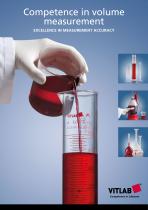
EXCELLENCE IN MEASUREMENT ACCURACY
Open the catalog to page 1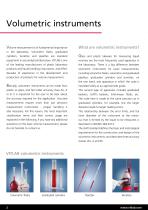
Volumetric instruments Volume measurement is of fundamental importance What are volumetric instruments? in the laboratory. Volumetric flasks, graduated cylinders, burettes and pipettes are standard equipment in any analytical laboratory. VITLAB is one volumes are the most frequently used apparatus in of the leading manufacturers of plastic laboratory the laboratory. There is a big difference between products and liquid handling instruments, and offers volumetric instruments for exact measurements, decades of experience in the development and including volumetric flasks, volumetric and graduated...
Open the catalog to page 2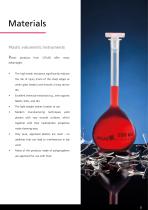
Materials Plastic volumetric instruments Plastic The high break resistance significantly reduces the risk of injury (none of the sharp edges as when glass breaks) and ensures a long service life Excellent chemical resistance (e.g., even against NaOH, KOH, and HF) The light weight makes it easier to use plastics with very smooth surfaces, which together with their hydrophobic properties make cleaning easy • Only pure, approved plastics are used - no additives that can lead to interferences in lab work Many of the products made of polypropylene are approved for use wit
Open the catalog to page 3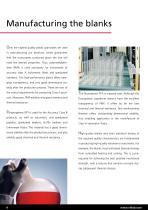
Manufacturing the blanks Only the highest quality plastic granulates are used in manufacturing our products, which guarantees that the instruments produced down the line will have the desired properties. Thus, polymethylpentene (PMP) is used exclusively for instruments of accuracy class A (volumetric flasks and graduated cylinders). This high-performance plastic offers nearglass transparency, and very good dimensional stability after the production process. These are two of the critical requirements for producing Class A prod- The fluoroplastic PFA is a special case. Although this ucts. Moreover,...
Open the catalog to page 4
Scales and labeling Techniques Various techniques are used for the labels on our To maintain the long-term readability of the scale, products and for imprinting the scales. Volumetric do not clean imprinted volumetric instruments at flasks and pipettes are imprinted by standard temperatures exceeding 60 °C. Obviously, laboratory methods using high-quality inks, but PFA is an dishwashers can be used. These are gentler than exception because of its surface structure. A special immersion baths. Due to the low weight, we process makes it possible to apply the ring mark recommend using washing nets....
Open the catalog to page 5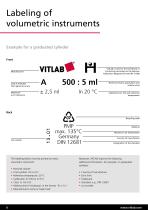
Labeling of volumetric instruments Example for a graduated cylinder Front VITLAB's mark for the Certificate of Conformity according to the German Calibration Regulations and DIN 12 600 Class A indicates the highest accuracy Nominal volume, graduation and volume units Maximum error tolerance Calibration (In, TC) and reference temperature Back Recycling code Material Maximum use temperature Country of manufacture The labeling below must be printed on every volumetric instrument: • Nominal volume • Units symbol: ml or cm³ • Reference temperature: 20 °C • Calibration: Ex (TD) or In (TC) • Class:...
Open the catalog to page 6
Certificates Quality certificate The quality assurance developed according to DIN EN ISO 9001 forms the basis for issuing factory calibration certificates, which serve as the quality certificates. These VITLAB factory test certificates are normally available in the form of a lot certificate, and an individual certificate can be obtained upon request. All test results are documented and archived for at least 7 years, so that individual results for any production times during this period can be accessed when the lot number or serial number is known. Individual certificate Quantity shipped per packing...
Open the catalog to page 7
Calibration Calibrations standard reference temperature, i.e., the temperature at which the volumetric instruments are calibrated, is 20 °C. If a calibration or measurement “In”: The contained quantity of liquid corresponds to the volume printed on the instrument is to be carried out at a different temperature, the measured values must be corrected accordingly. (volumetric flasks and graduated cylinders). “Ex”: The delivered quantity of liquid Accuracy classes corresponds to the volume printed on the instrument (pipettes and burettes). Volumetric instruments fall into two accuracy classes:...
Open the catalog to page 8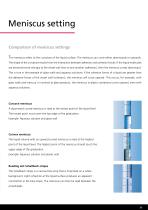
Meniscus setting Comparison of meniscus settings The meniscus refers to the curvature of the liquid surface. The meniscus can curve either downwards or upwards. The shape of the curvature results from the interaction between adhesion and cohesion forces. If the liquid molecules are attracted more strongly to the vessel wall than to one another (adhesion), then the meniscus curves downward. This is true in the example of glass walls and aqueous solutions. If the cohesion forces of a liquid are greater than the adhesive forces of the vessel wall (cohesion), the meniscus will curve upward. This...
Open the catalog to page 9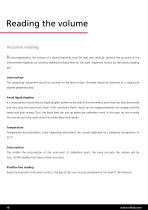
Reading the volume Accurate reading During experiments, the volume of a liquid frequently must be read very carefully, because the accuracy of the measurement depends on correctly reading the liquid level on the scale. Important factors for the correct reading are: Level surface The measuring instrument should be secured on the level surface. Burettes should be attached to a tripod and aligned perpendicularly. Avoid liquid droplets It is important to ensure that no liquid droplets adhere to the wall of the instrument, since they can flow downward and thus raise the liquid level. Note: With volumetric...
Open the catalog to page 10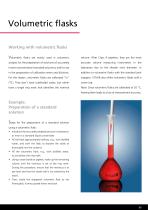
Volumetric flasks Working with volumetric flasks Volumetric flasks are mainly used in volumetric volume. After Class A pipettes, they are the most analysis for the preparation of solutions of accurately accurate volume measuring instruments in the known concentration (standard solutions), and for use laboratory due to the slender neck diameter. In in the preparation of calibration series and dilutions. addition to volumetric flasks with the standard joint For this reason, volumetric flasks are calibrated "In" stoppers, VITLAB also offers volumetric flasks with a (TC). They don't have subdivided...
Open the catalog to page 11All Vitlab catalogs and technical brochures
 VITLAB Product Range
109 Pages
 Colour up your Lab
4 Pages
Archived catalogs
 VITLAB opaque®
2 Pages
 VITLAB® micropipette
16 Pages
 VITLAB pipeo®
2 Pages
 VITLAB® Promotional
4 Pages
 Perfect Liquid Handling
16 Pages
 Dispenser VITLAB® TA
6 Pages
 VITLAB Labware range
160 Pages

- Sample tube
- Straight forceps
- Container
- Reusable forceps
- VITLAB sample container
- VITLAB laboratory rack
- Pipette tip
- Connector
- VITLAB laboratory flask
- VITLAB laboratory tube rack
- Transport container
- Test tube with screw cap
- Laboratory bottle
- Storage sample container
- Sample container with cap
- Micropipette
- Double spatula
- Laboratory container
- VITLAB flask with cap