Integrity™ V500 G2 System Product Specifications
Integrity™ V500 G2 System Product Specifications
The IntegrityTM V500 System is designed to assist in detecting hearing loss and lesions in the auditory pathway. It is a prescription device intended for use by trained professionals.
- Main Hardware Components: Includes a portable laptop with Windows 7/8, VivoLinkTM wireless interface, Amplitrode A81 and A82 bio-amplifiers, various transducers and probes.
- Software Modules: ABR, ASSR, DPOAE, ECochG, TEOAE, and 40 Hz ERP.
- Output: Customizable PDF reports and file export.
- ABR: Diagnostic and threshold estimation with various stimuli and calibration options.
- ASSR: Threshold estimation with automated detection and user-definable settings.
- DPOAE: Diagnostic and automated screening with flexible pass-refer criteria.
- ECochG: Diagnostic with specific measured variables.
- TEOAE: Diagnostic and automated screening with user-selectable criteria.
- 40 Hz ERP: Threshold estimation with specific stimuli and recording options.
- Computer: Dual-core laptop with Bluetooth and USB ports.
- VivoLinkTM: Features include a sampling rate of 38,400 sps and RF transmission capabilities.
- Amplitrode: High nominal gain and input impedance with low noise level.
- OAE Probe Options: P81-GP and P81-UG probes for general and infant use.
One-year warranty on most parts, with specific durations for Amplitrode and battery packs.
Complies with ISO 13485, FDA 21 CFR Part 820, and Medical Devices Directive 93/42/EEC.
Approved by Health Canada, TÜV SÜD, CE, FDA, and FCC. Specific licenses and registrations are listed for various regions.
Full-featured Integrity ABR/ECochG system with optional modules for ASSR, DPOAE/TEOAE, and 40 Hz ERP.
Catalog excerpts

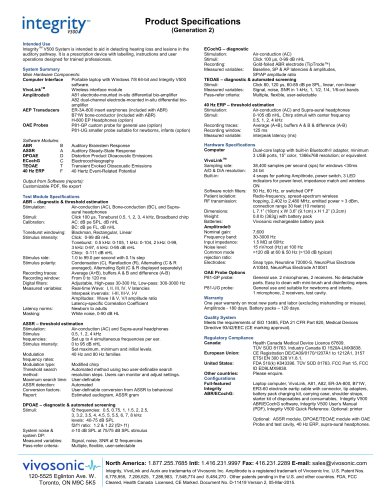
Product Specifications (Generation 2) Intended Use TM Integrity V500 System is intended to aid in detecting hearing loss and lesions in the auditory pathway. It is a prescription device with labelling, instructions and user operations designed for trained professionals. System Summary Main Hardware Components: Computer Interface Portable laptop with Windows 7/8 64-bit and Integrity V500 software. TM VivoLink Wireless interface module A81 electrode-mounted in-situ differential bio-amplifier Amplitrode A82 dual-channel electrode-mounted in-situ differential bioamplifier AEP Transducers ER-3A-800 insert earphones (included with ABR) B71W bone-conductor (included with ABR) H-800 EP Headphones (option) OAE Probes P81-GP custom probe for general use (option) P81-UG smaller probe suitable for newborns, infants (option) Software Modules: ABR B ASSR A DPOAE D ECochG C TEOAE T 40 Hz ERP F Auditory Brainstem Response Auditory Steady-State Response Distortion Product Otoacoustic Emissions Electrocochleography Transient Evoked Otoacoustic Emissions 40 Hertz Event-Related Potential Output from Software (reports): Customizable PDF, file export Test Module Specifications ABR – diagnostic & threshold estimation Stimulation: Air-conduction (AC), Bone-conduction (BC), and Supraaural headphones Stimuli: Click 100 μs, Toneburst 0.5, 1, 2, 3, 4 kHz, Broadband chirp Calibration: AC: dB pe SPL, dB nHL BC: dB pe FL, dB nHL Toneburst windowing: Blackman, Rectangular, Linear Stimulus intensity: Click: 0-99 dB nHL Toneburst: 0.5 kHz: 0-105, 1 kHz: 0-104, 2 kHz: 0-99, 3 kHz: 0-97, 4 kHz: 0-95 dB nHL Chirp: 0-111 dB nHL Stimulus rate: 1.0 to 99.0 per second with 0.1/s step Stimulus polarity: Condensation (C), Rarefaction (R), Alternating (C & R averaged), Alternating Split (C & R displayed separately) Recording traces: Average (A+B), buffers A & B and difference (A-B) Recording window: From 0 to 120 ms Digital filters: Adjustable, High-pass 30-300 Hz, Low-pass: 300-3000 Hz Measured variables: Real-time Wave: I, II, III, IV, V latencies Interpeak invervals: I-III, III-V, I-V Amplitudes: Wave I & V, V/I amplitude ratio Latency-specific Correlation Coefficient Latency norms: Newborn to adults Masking: White noise, 0-90 dB HL ASSR – threshold estimation Stimulation: Air-conduction (AC) and Supra-aural headphones Stimulus 0.5, 1, 2, 4 kHz frequencies: Set up to 4 simultaneous frequencies per ear. Stimulus intensity: 0 to 95 dB nHL Set maximum, minimum and initial levels. Modulation 40 Hz and 80 Hz families frequency rates: Modulation type: Modified chirp Threshold search Automated method using two user-definable search method: resolution steps. Users can monitor and adjust settings. Maximum search time: User-definable ASSR detection: Automated Conversion factors: User-definable conversion from ASSR to behavioral Report: Estimated audiogram, ASSR gram DPOAE – diagnostic & automated screening Stimuli: f2 frequencies: 0.5, 0.75, 1, 1.5, 2, 2.5, 3, 3.2, 3.5, 4, 4.5, 5, 5.5, 6, 7, 8 kHz levels: 40-75 dB SPL f2/f1 ratio: 1.2 & 1.22 (f2> f1) System noise & ≤-10 dB SPL at 75/75 dB SPL stimulus system DP: Measured variables: Signal, noise, SNR at f2 frequencies Pass-refer criteria: Multiple, flexible, user-selectable ECochG – diagnostic Stimulation: Stimuli: Recording: Measured variables: Air-conduction (AC) Click 100 μs, 0-99 dB nHL Gold-foiled ABR electrode (TipTrode™) Baseline, SP & AP latencies & amplitudes, SP/AP amplitude ratio TEOAE – diagnostic & automated screening Stimuli: Click 80, 120 μs, 60-85 dB pe SPL, linear, non-linear Measured variables: Signal, noise, SNR in 1-kHz, 1, 1/2, 1/4, 1/6-oct bands Pass-refer criteria: Multiple, flexible, user-selectable 40 Hz ERP – threshold estimation Stimulation: Air-conduction (AC) and Supra-aural headphones Stimuli: 0-105 dB nHL, Chirp stimuli with center frequency 0.5, 1, 2, 4 kHz Recording traces: Average (A+B), buffers A & B & difference (A-B) Recording window: 125 ms Measured variable: interpeak latency (ms) Hardware Specifications Computer Dual-core laptop with built-in Bluetooth adapter, minimum 3 USB ports, 15” color, 1366x768 resolution; or equivalent. TM VivoLink Sampling rate: 38,400 samples per second (sps) for windows <30ms A/D & D/A resolution: 24 bit Built-in: 4 snaps for parking Amplitrode, power switch, 3 LED indicators for power level, impedance match and wireless ON Software notch filters: 50 Hz, 60 Hz, or switched OFF Patient isolation: Radio-frequency, spread-spectrum wireless RF transmission: hopping, 2,402 to 2,480 MHz, emitted power < 3 dBm, connection range 30 feet (10 meters) Dimensions: L 7.1” (18cm) x W 3.6” (9.1cm) x H 1.2” (3.2cm) Weight: 0.8 lb (363g) with battery pack Batteries: Vivosonic rechargeable battery pack Amplitrode Nominal gain: 7,600 Frequency band: 30-3000 Hz Input impedance: 1.5 MΩ at 60Hz Noise level: 15 nV/root (Hz) at 100 Hz Common mode >120 dB at 60 & 50 Hz (>130 dB typical) rejection ratio: Electrodes: Snap type, Neuroline 72000-S, NeuroPlus Electrode A10040, NeuroPlus Electrode A10041 OAE Probe Options P81-GP probe: General use. 2 microphones, 2 receivers. No detachable parts. Easy to clean with mini-brush and disinfecting wipes. P81-UG probe: General use and suitable for newborns and infants. 1 microphone, 2 receivers, test cavity. Warranty One year warranty on most new parts and labor (excluding mishandling or misuse). Amplitrode - 180 days. Battery packs – 120 days. Quality System Meets the requirements of ISO 13485, FDA 21 CFR Part 820, Medical Devices Directive 93/42/EEC (CE marking approval). Regulatory Compliance Canada: Health Canada Medical Device Licence 67609. TÜV SÜD 81763. Industry Canada ID 1520A-LMX9838. European Union: CE Registration DE/CA09/0170/1207Ä1 to 1212Ä1, 3157 ETSI EN 300 328 V1.8.1. United States: FDA 510(k) K043396. TÜV SÜD 81763. FCC Part 15, FCC ID ED9LMX9838. Other countries: Please enquire. Configurations Full-featured Laptop computer, VivoLink, A81, A82, ER-3A-800, B71W, Integrity ER3-60 electrode eartip cable with connector, tip adapters, ABR/ECochG: battery pack charging kit, carrying case, shoulder straps, starter kit of disposables and consumables, Integrity V500 ABR/ECochG software, Integrity V500 User’s Manual (PDF), Integrity V500 Quick Reference. Optional: printer Optional: ASSR module, DPOAE/TEOAE module with OAE Probe and test cavity, 40 Hz ERP, supra-aural headphones. North America: 1.877.255.7685 Intl: 1.416.231.9997 Fax: 416.231.2289 E-mail: [email protected] 120-5525 Eglinton Ave. W. Toronto, ON M9C 5K5 Integrity, VivoLink and Aurix are trademarks of Vivosonic Inc. Amplitrode is a registered trademark of Vivosonic Inc. U.S. Patent Nos. 6,778,955, 7,206,625, 7,286,983, 7,548,774 and 8,484,270 . Other patents pending in the U.S. and other countries. FDA, FCC Cleared, Health Canada Licensed, CE Marked. Document No. D-11419 Version 2, 05-Mar-2015.
Open the catalog to page 1All Vivosonic catalogs and technical brochures
 Software Version 8.9
2 Pages
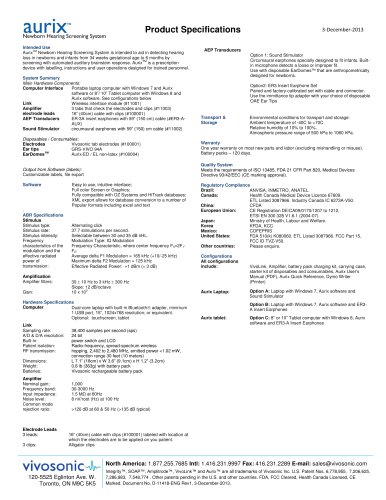
 Aurix™ Brochure
3 Pages
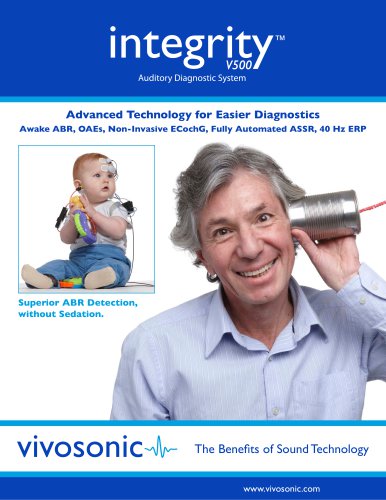
 Integrity™ Reliable ABR
2 Pages