
- Catalogs
- vVardis AG
- Curodont™Repair Fluoride Plus

Curodont™Repair Fluoride Plus

Curodont™Repair Fluoride Plus
- Activate the applicator to allow liquid flow into the sponge. The sponge and liquid must be used together.
- Wait 10 seconds for the sponge to saturate; do not re-insert.
- Unwaxed floss can be used for interproximal surfaces.
- No need for separators or wedges; the sponge does not need to touch the lesion directly.
- Squeeze the sponge on the lesion; for interproximal areas, apply from lingual and buccal sides.
- The liquid is absorbed quickly through capillary action on etched enamel.
- Remove pellicle using preferred methods (e.g., pumice, prophy paste).
- Rinse and dry the area.
- Etch with 35% phosphoric acid for 20 seconds, then rinse and dry.
- Isolate the treatment area using basic methods; no rubber dam needed.
- Activate the applicator by pushing cylinders together to saturate the sponge.
- Remove the applicator from its cover and apply by squeezing the sponge on the lesion.
- Wait 5 minutes without rinsing.
- Instruct the patient not to rinse, eat, or drink for 30 minutes post-application.
- Discard the applicator after single use.
- Interproximal caries in the first or second half of enamel.
- Interproximal surfaces facing cavitated lesions.
- Smooth surfaces, occlusal surfaces, and around orthodontic brackets.
- Remineralizes over time, dependent on patient risk factors.
- Helps maintain natural tooth structure.
- Prevents progression of 'watch areas'.
Catalog excerpts

How to apply CURODONTTM REPAIR FLUORIDE PLUS The non-invasive treatment with CURODONTTM REPAIR FLUORIDE PLUS is as safe as its application is easy. The application process is completed within 5 minutes, without drilling, anesthesia, or pain. 1. Remove pellicle using your preferred method (i.e. pumice, prophy paste, air polisher or 2% sodium hypochlorite). Etch using 35% phosphoric acid for 20 seconds. 4. Rinse and dry. 5. Basic isolation of the treatment area (cotton rolls, dry aids, etc.) No rubber dam necessary. 6. Proceed with the application of CURODONTTM REPAIR FLUORIDE PLUS, as per instructions below. 7. Remove safety clip (black). REPAIR FLUORIDE PLUS applicator by pushing the two cylinders together so that the liquid flows into the sponge. Wait 10 seconds until the sponge is saturated. 9. Remove the CURODONTTM REPAIR FLUORIDE PLUS applicator from the protective cover. The sponge applicator and liquid must be used together. 10. Apply CURODONTTM REPAIR FLUORIDE PLUS by squeezing the sponge on the lesion. If interproximal apply from buccal and lingual sides, the use of separators or wedges are not needed. 11. Wait for 5 minutes. Do not rinse. APPLICATION TIPS • Activate the applicator so that the liquid flows into the sponge. The sponge applicator and liquid MUST be used together. Wait 10 secs until the sponge is saturated (do not re-insert). Unwaxed floss can be used to gently apply etch for interproximal surfaces. No need to use separators or a wedge (sponge doesn’t have to touch the lesion). Simply squeeze the sponge on the lesion, if interproximal apply from lingual and buccal sides. The liquid will quickly be absorbed on the etched enamel surface through capillary action. Scan the QR code to access the CURODONT™ REPAIR FLUORIDE PLUS application videos and other educational materials 12. Instruct patient not to rinse, eat or drink for 30 minutes. The applicator is for single patient use only! Discard the applicator un
Open the catalog to page 1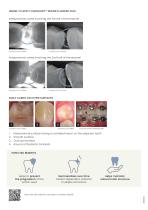
WHERE TO APPLY CURODONTTM REPAIR FLUORIDE PLUS Interproximal caries involving the 1st half of the enamel Interproximal caries involving the 2nd half of the enamel EARLY CARIES ON OTHER SURFACES 4 Courtesy of Misty Mattingly, RDH Interproximal surface facing a cavitated lesion on the adjacent tooth Smooth surface Occlusal surface Around orthodontic brackets EXPECTED BENEFITS Helps to prevent the progression of the ‘watch area’ Remineralizes over time Patient dependent, linked to multiple risk factors Helps maintain natural tooth structure Scan the QR code for our team’s contact details M10128
Open the catalog to page 2