
- Catalogs
- Wallstein Pharmaceutical Equipment
- LAMINAR FLOW HOODS

LAMINAR FLOW HOODS
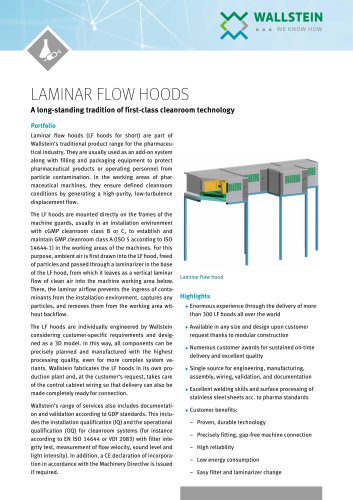
LAMINAR FLOW HOODS
Laminar flow hoods (LF hoods) are essential components in the pharmaceutical industry, designed to maintain cleanroom conditions by generating a high-purity, low-turbulence displacement flow. They are typically used alongside filling and packaging equipment to protect products and personnel from contamination.
Specifications
LF hoods are mounted on machine guards in environments with cGMP cleanroom class B or C to achieve GMP cleanroom class A (ISO 5). They draw in ambient air, filter it, and release it as a vertical laminar flow to prevent contaminants from entering the working area.
Design and Manufacturing
Wallstein custom-engineers LF hoods based on customer requirements, using 3D modeling for precise planning and manufacturing. The hoods are produced in-house, with options for complete wiring and ready-for-connection delivery.
Validation and Documentation
Wallstein provides documentation and validation according to GDP standards, including installation qualification (IQ) and operational qualification (OQ) for cleanroom systems. A CE declaration of incorporation is available if needed.
Key Features
- Experience with over 300 LF hoods delivered globally.
- Customizable sizes and designs due to modular construction.
- Recognized for on-time delivery and quality.
- Comprehensive service from engineering to documentation.
- High-quality welding and surface processing of stainless steel.
Customer Benefits
- Durable and reliable technology.
- Precise, gap-free machine connections.
- Low energy consumption.
- Easy maintenance with simple filter and laminarizer changes.
Applications
Examples include LF hoods for pharmaceutical factories in Lenoir and Shanghai, designed for specific operational needs and standards.
Main Components
LF hoods consist of an intake casing, prefilter, fan, pressure casing, main filter, laminarizer, lighting, measuring equipment, control cabinet, and electrics. The casing is self-supporting, made from high-quality materials, and designed for optimal air flow and filtration.
Technology
The fan draws ambient air through the prefilter, which is then forced through the main filter and laminarizer, resulting in a vertical laminar flow of clean air into the enclosed machine working area.
Catalog excerpts
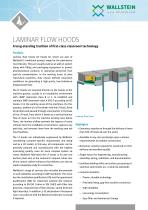
LAMINAR FLOW HOODSA long-standing tradition of first-class cleanroom technologyPortfolio Laminar flow hoods (LF hoods for short) are part of Wallstein‘s traditional product range for the pharmaceutical industry. They are usually used as an add-on system along with filling and packaging equipment to protect pharmaceutical products or operating personnel from particle contamination. In the working areas of pharmaceutical machines, they ensure defined cleanroom conditions by generating a high-purity, low-turbulence displacement flow. The LF hoods are mounted directly on the frames of the machine guards, usually in an installation environment with cGMP cleanroom class B or C, to establish and maintain GMP cleanroom class A (ISO 5 according to ISO 14644-1) in the working areas of the machines. For this purpose, ambient air is first drawn into the LF hood, freed of particles and passed through a laminarizer in the base of the LF hood, from which it leaves as a vertical laminar flow of clean air into the machine working area below. There, the laminar airflow prevents the ingress of contaminants from the installation environment, captures any particles, and removes them from the working area without backflow. ♦ Enormous experience through the delivery of more than 300 LF hoods all over the world The LF hoods are individually engineered by Wallstein considering customer-specific requirements and designed as a 3D model. In this way, all components can be precisely planned and manufactured with the highest processing quality, even for more complex system variants. Wallstein fabricates the LF hoods in its own production plant and, at the customers request, takes care of the control cabinet wiring so that delivery can also be made completely ready for connection. Wallstein‘s range of services also includes documentation and validation according to GDP standards. This includes the installation qualification (IQ) and the operational qualification (OQ) for cleanroom systems (for instance according to EN ISO 14644 or VDI 2083) with filter integrity test, measurement of flow velocity, sound level and light intensity). In addition, a CE declaration of incorporation in accordance with the Machinery Directive is issued if required. ♦ Available in any size and design upon customer request thanks to modular construction ♦ Numerous customer awards for sustained on-time delivery and excellent quality ♦ Single source for engineering, manufacturing, assembly, wiring, validation, and documentation ♦ Excellent welding skills and surface processing of stainless steel sheets acc. to pharma standards - Proven, durable technology - Precisely fitting, gap-free machine connection - High reliability - Easy filter and laminarizer change
Open the catalog to page 1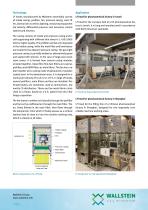
LF hoods manufactured by Wallstein essentially consist of intake casing, prefilter, fan, pressure casing, main filter, laminarizer as well as lighting, measuring equipment (air velocity, differential pressure, test aerosols), control cabinet and electrics. LF hood for pharmaceutical factory in Lenoir The casing consists of intake and pressure casing and is self-supporting with stiffened thin sheet in 1.4301 (AISI 304) or higher quality. The prefilter and fan are integrated in the intake casing, while the main filter and laminarizer are located in the adjacent pressure casing. The gas-tight pressure...
Open the catalog to page 2All Wallstein Pharmaceutical Equipment catalogs and technical brochures
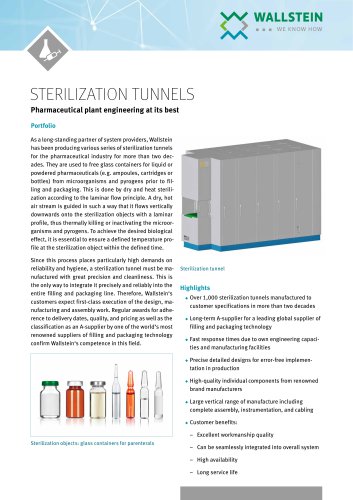 STERILIZATION TUNNELS
2 Pages
 WHAT WE DO WE DO WELL
16 Pages
- Aseptic isolator
- Class III isolator
- Pharmaceutical isolator
- Isolator with HEPA filter
- Negative pressure isolator
- Stainless steel isolator
- Laminar flow isolator
- Transfer isolator
- Modular isolator
- Research isolator
- Production isolator
- Medical isolator
- Custom isolator
- Toxic product isolator
- Powder handling isolator
- Horizontal laminar flow module
- Vertical laminar flow module
- Cleanroom laminar flow module
- Benchtop isolation chamber
- Recirculating isolator