- Catalogs
- Weber Medical
- Presentation Intravenous Low-Level-Laser-Therapy

- Company
- Products
- Catalogs
- News & Trends
- Exhibitions
Presentation Intravenous Low-Level-Laser-Therapy

Presentation Intravenous Low-Level-Laser-Therapy
- Biochemical Effects: LLLT involves the absorption of specific light wavelengths by photoreceptors in cells, affecting cellular signals, metabolism, and gene expression. Mitochondria are crucial, with different complexes absorbing various light colors.
- Historical Context: UV light therapy began in the early 20th century for tuberculosis treatment. Systemic laser therapy was introduced in Russia in 1981 for cardiovascular diseases, improving blood properties and microcirculation.
- Introduction: The Weberneedle® Endolaser employs multiple laser wavelengths for various medical applications, including intravenous and external therapies.
- Approvals: The device has international medical approvals, including CE and FDA for external use.
- Company Background: Established in 2003, Weber Medical focuses on evidence-based medicine and collaborates globally with research institutions.
- Red Laser: Enhances blood properties, immune response, and ATP production, with analgesic and sedative effects.
- Green Laser: Improves oxygen delivery and blood flow, activates reparative pathways, and affects cellular homeostasis.
- Blue Laser: Releases nitric oxide, aiding vasodilation, anti-aging, and anti-inflammatory effects.
- Yellow and UV Lasers: Yellow laser impacts mood and pain relief, while UV laser strengthens the immune system and deactivates pathogens.
- General Applications: LLLT is used for stem cell activation, cancer therapy, and antimicrobial treatments.
- Practical Applications: Includes intravenous LLLT, emphasizing patient safety and experiences.
- UV light increases reactive oxygen species (ROS) production, delaying pathogen replication.
- Exposure leads to sub-lethal effects, stopping replication and increasing susceptibility to immune degradation.
- Pathogen damage releases antigens, aiding the immune system in building specific antibodies.
- Interrupts cell DNA sequence and inhibits pathogen binding.
- Boosts cellular energy by increasing ATP synthesis.
- Stimulates the immune system and improves microcirculation.
- Activates macrophages and has positive effects on heart and metabolism.
- Improves red blood cell function and increases oxygen delivery.
- Activates reparative pathways and releases nitric oxide.
- Reduces blood pressure, inflammation, and provides pain relief.
- Deactivates pathogens and has detoxifying effects.
- Improves serotonin and vitamin-D production.
- Treats internal diseases, metabolic disorders, cardiovascular diseases, chronic pain, and more.
- Used in anti-aging, sports performance, and as adjuvant cancer therapy.
- Laser irradiation increases stem cell viability, proliferation, and tissue regeneration.
- Harvard research shows lasers stimulate stem cells to regrow tissue.
- Combines photosensitizing agents with specific light wavelengths to destroy tumor tissue.
- Effective against microbial pathogens using anti-microbial photodynamic therapy (aPDT).
- Uses a standardized canula or weberneedle® butterfly for laser application.
- All wavelengths are used for maximum cellular effects, with specific protocols available.
- Low power lasers minimize side effects, confirmed by extensive clinical data.
- Patient education and informed consent are recommended in regions where therapy is not well-established.
- Chronic Liver Disease: Significant decrease in liver and lipid parameters.
- Diabetes: Reduction in blood sugar levels and HbA1C.
- Cardiovascular Disease: Improvement in myocardial perfusion and functional class.
- Multiple Sclerosis: Significant improvement in quality of life.
- Fibromyalgia: Significant improvement in pain and depression ratings.
- Lyme Disease: Positive results with yellow and blue laser therapy.
- Physical Fitness: Enhanced performance in sports medicine.
- Juvenile Idiopathic Arthritis: Increased efficacy of Etanercept with laser therapy.
Catalog excerpts
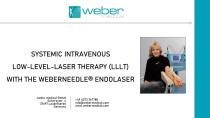
SYSTEMIC INTRAVENOUS LOW-LEVEL-LASER THERAPY (LLLT) WITH THE WEBERNEEDLE® ENDOLASER weber medical GmbH Sohnreystr. 4 37697 Lauenfoerde Germany
Open the catalog to page 1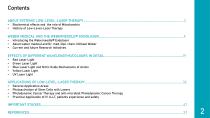
Contents ABOUT SYSTEMIC LOW-LEVEL-LASER THERAPY………………………………………………………………………………………………………………………………...3 • • Biochemical effects and the role of Mitochondria History of Low-Level-Laser Therapy WEBER MEDICAL AND THE WEBERNEEDLE® ENDOLASER…………………………………………………………………………………………………………….9 • • • Introducing the Weberneedle® Endolaser About weber medical and Dr. med. Dipl. chem. Michael Weber Current and future Research Initiatives EFFECTS OF DIFFERENT WAVELENGTHS/COLOURS IN DETAIL…………………………………………………………………………………………………….19 • • • • • Red Laser Light Green Laser Light Blue Laser Light and Nitric Oxide Mechanisms...
Open the catalog to page 2
ABOUT SYSTEMIC LOW-LEVEL-LASER THERAPY
Open the catalog to page 3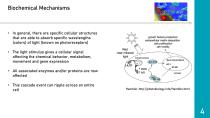
Biochemical Mechanisms • In general, there are specific cellular structures that are able to absorb specific wavelengths (colors) of light (known as photoreceptors) • The light stimulus gives a cellular signal affecting the chemical behavior, metabolism, movement and gene expression • All associated enzymes and/or proteins are now affected • This cascade event can ripple across an entire cell Hamblin: http://photobiology.info/Hamblin.ht
Open the catalog to page 4
Absorption of Difference Light Wavelengths (Colors) in Mitochondria One example for the absorption of different colors within cells is the process in the mitochondrial respiratory chain [21] Complex 1 (NADH dehydrogenase) absorbs blue and ultraviolet light Complex 3 (cytochrome c reductase) absorbs green and yellow light Complex 4 (cytochrome c oxidase) absorbs red and infrared lig
Open the catalog to page 5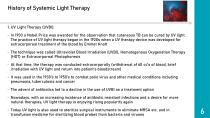
History of Systemic Light Therapy 1. UV Light Therapy (UVBI): • In 1903 a Nobel Price was awarded for the observation that cutaneous TB can be cured by UV light. The practice of UV light therapy began in the 1920s when a UV therapy device was developed for extracorporeal treatment of the blood by Emmet Knott The technique was called Ultraviolet Blood Irradiation (UVBI), Hematogenous Oxygenation Therapy (HOT) or Extracorporeal Photophoresis At that time, the therapy was conducted extracorporally (withdrawal of 60 cc's of blood, brief irradiation with UV light and return into patient’s bloodstream)...
Open the catalog to page 6
History of Systemic Light Therapy 2. Systemic Laser Therapy in Russia: • The method of intravenous laser blood irradiation was first introduced into therapy by the Soviet scientists E.N.Meschalkin and V.S.Sergiewski in 1981 [37] for the treatment of cardiovascular diseases A red light laser (632nm) with a power of 1-3 mW was used for 20-60 min Improvement of rheologic properties of the blood as well as improvement of microcirculation and reduction of the area of infarction had been proved. Further reductions of dysrhythmia and sudden cardiac death occurred [5,24] In the years after, many (for...
Open the catalog to page 7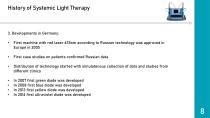
History of Systemic Light Therapy First machine with red laser 635nm according to Russian technology was approved in Europe in 2005 First case studies on patients confirmed Russian data Distribution of technology started with simulatenous collection of data and studies from different clinics In 2007 first green diode was developed In 2008 first blue diode was developed In 2013 first yellow diode was developed In 2016 first ultraviolet diode was d
Open the catalog to page 8
WEBER MEDICAL AND THE WEBERNEEDLE® ENDOLASER
Open the catalog to page 9
* Developed with the support of German Government and European Union Weberneedle® Endolaser* with Infrared, Red, Green, Yellow, Blue and Ultraviolet Light Lasers
Open the catalog to page 10
International Medical Approvals Health Canada US-FDA for External Laser Therapy (IV application = off-label use) TGA Australia for External Laser Therapy
Open the catalog to page 11
Technical Information and Comparison to Other Devices The Weberneedle® laser devices are modular systems that can be equipped with up to 12 lasers with different wavelengths/ colors FDA, CE, Health Canada and other international approvals Disposables such as needles and catheters available at a reasonable price Using real lasers instead of cheap LED technology (coherent light with high specificity to various cellular components and deeper penetration in blood and tissue) All available wavelengths/ colors (infrared, red, green, blue, yellow, ultraviolet) available Weberneedle® devices can also...
Open the catalog to page 12
About weber medical Products Made in Germany Focus on evidence-based medicine → cooperation with several research institutions Established in 2003 after many years of research and development in the field of medical lasers Received financial aid from the German government and the European Union in 2004 for the development of the world’s first multichannel laser systems for invasive laser therapy CE approval since 2005 → 12 years of clinical experience with data from more than 1500 clinics worldwide Weber Medical has quickly become one of the world’s leading companies in medical laser technology...
Open the catalog to page 13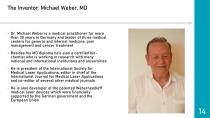
The Inventor: Michael Weber, MD Dr. Michael Weber is a medical practitioner for more than 30 years in Germany and leader of three medical centers for general and internal medicine, pain management and cancer treatment Besides his MD diploma he’s also a certified biochemist who is working in research with many national and international institutions and universities He is president of the International Society for Medical Laser Applications, editor in chief of the International Journal for Medical Laser Applications and co-editor of several other medical journals He is also developer of the patented...
Open the catalog to page 14All Weber Medical catalogs and technical brochures
 Science behind the WeberBrain®
30 Pages
 Endolight Band
11 Pages
 Mental Health Workshops
8 Pages
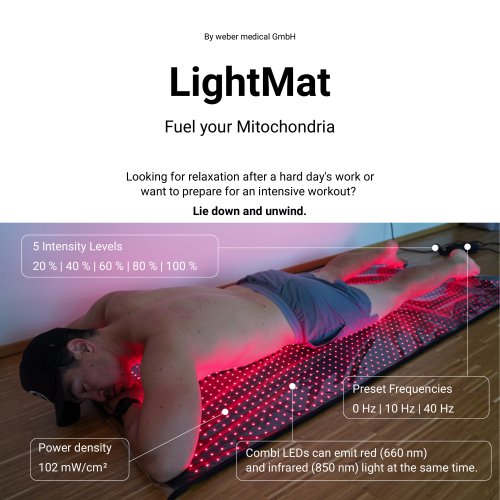 Light Mat
2 Pages
 Product Flyer Endolaser
9 Pages
 WeberMedical
34 Pages