- Catalogs
- Weber Medical
- Update: Science behind the Weber Brain

- Company
- Products
- Catalogs
- News & Trends
- Exhibitions
Update: Science behind the Weber Brain
Update: Science behind the Weber Brain
Photobiomodulation (PBM) is a technique that utilizes light to influence biological processes by absorbing photons through chromophores, enhancing cellular and tissue functions. Red and infrared light are particularly effective for non-invasive applications.
PBM primarily targets mitochondria, where red and infrared light absorbed by cytochrome C oxidase enhances mitochondrial function, oxygenation, and perfusion. Both lasers and LEDs serve as light sources, with applications in brain health, pain management, and dermatology.
Brain PBM involves applying infrared light to the scalp to penetrate the skull and target cortical brain structures. It is a non-invasive, safe method used in integrative neurology and preventive care to support brain health without significant side effects.
Brain health is influenced by lifestyle, hormonal and nutritional factors, environmental exposures, and genetics. Key processes include mitochondrial function, nutrient and oxygen supply, neuroplasticity, and brain network communication.
Chronic neuroinflammation is a hallmark of neurodegenerative disorders, involving a cycle of protein aggregates and damaged neurons that amplify inflammation, leading to neurodegeneration. Mitochondrial dysfunction and impaired cerebral perfusion are critical factors.
Studies indicate that PBM enhances ATP production, improves cerebral blood flow, and modulates brain neural oscillations. It shows potential in treating neuroinflammation by altering microglial polarization and regulating cytokine levels.
Brain PBM offers promising applications in enhancing brain health and treating neurodegenerative conditions by improving mitochondrial function, supporting the glymphatic system, and reducing neuroinflammation.
This section discusses using MEG and EEG as neuroimaging tools to validate EEG findings, highlighting MEG's higher spatial resolution. A study with 25 healthy subjects showed significant post-stimulation effects in the alpha and beta bands, enhancing brain network complexity and information flow.
A systematic review of 36 studies showed positive results in dementia treatment with no adverse effects, though larger trials are needed due to small sample sizes and lack of placebo controls.
A study on dementia patients reported improved sleep, mood, and cognition after daily sessions over eight weeks.
Studies demonstrated significant improvements in mobility, cognition, and balance in Parkinson's patients using photobiomodulation, with long-term benefits and no side effects.
A systematic review found that transcranial photobiomodulation (tPBM) improved cognitive functions in 82.9% of studies, particularly in dementia cases.
Photobiomodulation increased cerebral blood flow and improved outcomes after mild traumatic brain injury (mTBI), with no significant adverse effects.
Photobiomodulation effectively reduced depression symptoms, with systemic PBM showing superior results. A study on anxiety patients showed significant improvements using transcranial near-infrared stimulation.
Studies on adults and children with ASD showed improvements in social behavior, cognitive functions, and quality of life after photobiomodulation treatment.
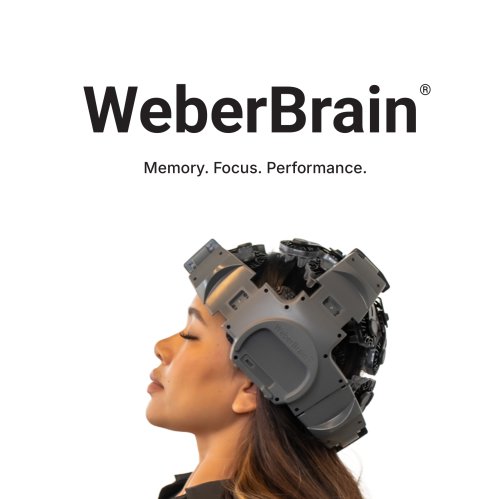
Weber Medical's new product uses laser technology for enhanced penetration, available in PRO and HOME models, featuring adjustable size and sophisticated lens systems for different brain area treatments.
A guide by Dr. Michael Weber and colleagues covers non-invasive and invasive PBM, providing comprehensive protocols for clinical practice.
Catalog excerpts
ISR Cell Conference - March 28th 2026 Brain Photobiomodulation to support Brain Health An overview of mechanisms of action, clinical evidence, and the latest technology.
Open the catalog to page 1
Goals of the lecture • Provide basic knowledge about Photobiomodulation (PBM). • Remind you of the key aspects related to brain health. • Explain the mechanisms of action of brain PBM. • Provide a brief overview of the current research and areas of application. • Overall: Help you understand whether brain PBM can enhance your clinical practice. Presented By : Martin Jung
Open the catalog to page 2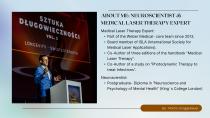
ABOUTM E: NEUROECIENTIST MEDICAL LASER THERAPY EXPERT Medical Laser Therapy Expert: • Part of the Weber Medical- core team since 2013. • Board member of ISLA (International Society for Medical Laser Applications). • Co-Author of three editions of the handbook "Medical Laser Therapy". • Co-Author of a study on "Photodynamic Therapy to treat Infections". • Postgraduate- Diploma in "Neuroscience and Psychology of Mental Health" (King's College London)
Open the catalog to page 3
ISR Cell Conference - March 28th 2026 Exploring Photobiomodulation In a nutshell - what is PBM and how does it influence human biology? Presented By : Martin Junggebauer
Open the catalog to page 4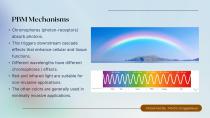
PBM Mechanisms • Chromophores (photon-receptors) absorb photons. • This triggers downstream cascade effects that enhance cellular and tissue functions. • Different wavelengths have different chromophores / effects. • Red and infrared light are suitable for non-invasive applications. • The other colors are generally used in minimally invasive applications. Presented By : Martin Jung
Open the catalog to page 5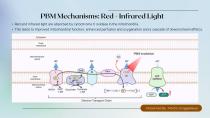
• Red and infrared light are absorbed by cytochrome C oxidase in the mitochondria.• This leads to improved mitochondrial function, enhanced perfusion and oxygenation and a cascade of dowonstream effetcs. Cytoplasm Succinate Fumarate Electron Transport Chain Presented By : Martin Junggebauer
Open the catalog to page 6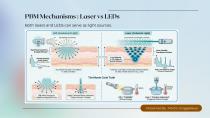
Superficial Scattering & Rapid Diffusion Average Intensity Drops Quickly LED (Incoherent Light) Wavelength (incoherent) Local Intensity 5-1 Ox Higher in "Speckle Hotspot" Laser (Coherent Light) Synchronized, wavelength (coherent) _ Laser Speckle: Interference Pattern Incoherent LED light is too diffuse for deep activation Coherent Laser light creates high-intensity islands for deep cellular activation (e g., CCO) High Local Intensity Trigger The Monte Carlo Truth Warm LED: Wide Divergence, Significant Superficial Loss Laser: Collimated Beam, Maintains “Photon Corridor" to Depth LED = "Flashlight'...
Open the catalog to page 7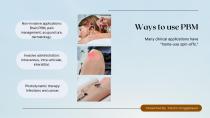
Non-invasive applications: Brain PBM, pain management, acupuncture, dermatology. Ways to use PBM Many clinical applications have "home-use spin-offs." Invasive administration: Intravenous, intra-articular, interstitial. Photodynamic therapy: Infections and cancer. Presented By : Martin Junggebauer
Open the catalog to page 8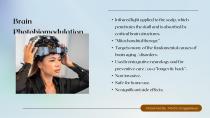
Brain Photobiomodulation • Infrared light applied to the scalp, which penetrates the skull and is absorbed by cortical brain structures. • “Mitochondrial therapy” • Targets many of the fundamental causes of brain aging / disorders. • Used in integrative neurology and for preventive care / as a “longevity hack”. • Non -invasive. • Safe for home use. • No significant side effects.
Open the catalog to page 9
ISR Cell Conference - March 28th 2026 Brain Health vs. Neurodegeneration Contributing factors and manifestation on the level of the brain. Presented By : Martin Junggebauer
Open the catalog to page 10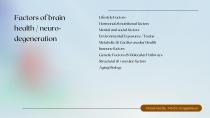
Factors of brain health / neuro degeneration Lifestyle Factors Hormonal & nutritional factors Mental and social factors Environmental Exposures / Toxins Metabolic & Cardiovascular Health Immune factors Genetic Factors & Molecular Pathways Structural & vascular factors Aging Biology Presented By : Martin Junggebauer
Open the catalog to page 11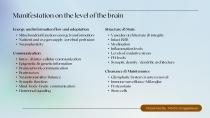
• Mitochondrial function (energy transformation • Nutrient and oxygen supply (cerebral perfusion • Intra-/ <fo inter-cellular communication • Epigenetic <fo genetic information • Brain network communication • Neurotransmitter Balance • Synaptic function • Mind- body- brain- communication • Hormonal signaling Struatur e&State • Vascular architecture & integrity • Inflammation levels • Levels of oxidative stress • Synaptic density / dendritic architecture Cieaoance MMainienance • Glymphatic System (waste removal • Immune surveillance (Mikroglia • Stem cells
Open the catalog to page 12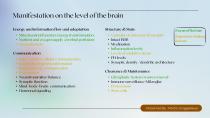
Important during lecture Energ yan dintorninrion flow andadaptation • Mitochondrial function (energy transformation • Nutrient and oxygen supply (cerebral perfusion • Intra-/ <fo inter-cellular communication • Epigenetic <fo genetic information • Brain network communication • Neurotransmitter Balance • Synaptic function • Mind- body- brain- communication • Hormonal signaling Struatur e&State • Vascular architecture & integrity • Inflammation levels • Levels of oxidative stress • Synaptic density / dendritic architecture Cieaoance MMainienance • Glymphatic System (waste removal • Immune surveillance...
Open the catalog to page 13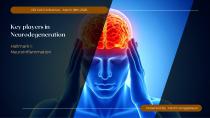
ISR Cell Conference - March 28th 2026 Key players in Neurodegeneration Hallmark I: Neuroinflammation Presented By : Martin Junggebauer
Open the catalog to page 14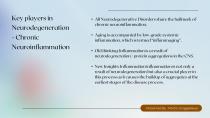
• All Neurodegenerative Disorders share the hallmark of chronic neuroinflammation. • Aging is accompanied by low -grade systemic inflammation, which is termed “inflammaging”. • Old thinking: Inflammation is a result of neurodegeneration / protein aggregations in the CNS. • New Insights: Inflammation inflammation is not only a result of neurodegeneration but also a crucial player in this process as it causes the buildup of aggregates at the earliest stages of the disease process.
Open the catalog to page 15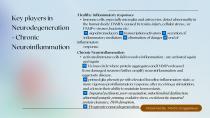
Keyplayers in Neurodegeneration - Chronic Presented By : Martin Junggebauer Healthy) inflammatory responses • Immune cells, especially microglia and astrocytes, detect abnormality in the human body: DAMPs (caused by toxins, injury, cellular stress..) or PAMPs (viruses, bacteria etc) Q signal transducers B transcription activators B secretion of inflammatory mediators B elimination of danger B end of inflammatory response. Chronic Neuroinflammation • activated immune cells fail to resolve inflammation / are activated again and again B Vicious circle where protein aggregates and DAMPs released...
Open the catalog to page 16All Weber Medical catalogs and technical brochures
 Science behind the WeberBrain®
30 Pages
 Endolight Band
11 Pages
 Mental Health Workshops
8 Pages
 Light Mat
2 Pages
 Product Flyer Endolaser
9 Pages
 WeberMedical
34 Pages