
- Catalogs
- WEINMANN Emergency Medical Technology
- MODUL System


- Products
- Catalogs
- News & Trends
- Exhibitions
MODUL System

MODUL System
Continuous Positive Airway Pressure (CPAP) therapy is utilized in pre-hospital settings for patients with acute pulmonary edema. It significantly improves oxygen saturation, respiratory frequency, and heart rate, often avoiding the need for risky intubation and resulting in shorter hospital stays.
- Expulsion of alveolar fluid into the intracellular space.
- Reduction of the end-expiratory tendency of alveoli to collapse.
- Re-opening and maintaining open closed alveoli.
- Reduction in airway resistance.
- Reduction in the work of breathing.
- CPAP therapy should be started immediately upon diagnosis at the emergency scene.
- It can be used as a secondary measure if previous drug treatments fail.
- Effective therapy often begins at about 7.5 mbar. If insufficient, pressure can be increased up to 15 mbar using MODUL CPAP.
- As the patient's condition improves, CPAP pressure can often be decreased.
- MODUL CPAP WM 29100 and CPAP Boussignac Valve are used for WEINMANN Emergency MODUL CPAP Set.
- Disposable CPAP/NIV masks are available in sizes S, M, and L.
- LIFE-BASE portable systems integrate MEDUMAT Standarda ventilator, MODUL CPAP, and OXYWAY Fast II for comprehensive respiratory emergency treatment.
- Connect the CPAP Boussignac valve to the CPAP mask.
- Explain CPAP therapy to the patient and secure the mask with headgear if tolerated.
- Slowly increase CPAP pressure (2 mbar per minute) until the target pressure is reached.
- Choose a suitable CPAP mask based on the patient's facial dimensions.
- Ensure the control dial is at the minimum before switching on MODUL CPAP and gradually increase pressure.
- Continuously monitor the patient's condition and adjust the mask to prevent leaks.
Catalog excerpts

CPAP Therapy Why use CPAP therapy for acute pulmonary edema? The pre-hospital use of CPAP therapy (CPAP = Continuous Positive Airway Pressure) for patients with acute pulmonary edema has been shown to significantly improve oxygen saturation, respiratory frequency and heart rate. With the use of CPAP, risky intubation can be avoided in many cases, resulting in shorter hospital stays. CPAP Boussignac Valve for WEINMANN Emergency MODUL CPAP Set, 10 pieces WM 15638 CPAP / NIV Mask What effect does CPAP have on acute pulmonary edema? as disposable mask in the sizes Size S WM 20703 Size M WM 20704 Size L WM 20705 Expulsion of alveolar fluid in the intracellular space MODUL CPAP Reduction of end-expiratory tendency of alveoli to collapse Re-opening and keeping open closed alveoli MODUL CPAP on the LIFE-BASE portable system Reduction in airway resistance Everything on hand on just one LIFE-BASE portable system: Thanks to the expansion of our MODUL System with MODUL CPAP, you can now provide ideal treatment in all respiratory emergencies: Reduction in work of breathing When should CPAP therapy be started? Immediately upon diagnosis at emergency scene Secondary: upon failure of previously attempted drug treatment Which CPAP pressure should be used? Controlled and assisted ventilation with MEDUMAT Standarda Non-invasive CPAP therapy with MODUL CPAP Oxygen inhalation with OXYWAY Fast II Effective therapy can often be administered at about 7.5 mbar. If that is insufficient, pressure can be raised. You can increase the pressure to 15 mbar with MODUL CPAP. CPAP therapy for acute pulmonary edema When the patient‘s condition improves, the CPAP pressure can be decreased in many cases. with ventilator MEDUMAT Standarda, MODUL CPAP and OXYWAY Fast II WM 9121 This step-by-step guide does not replace the instructions for use of the device. Please refer to the instructions for use for proper and safe usage of the device. with ventilator MEDUMAT Standarda, MODUL CPAP and OXYWAY Fast II WM 8251 weinmann-emergency.de | weinmann-emergency.fr weinmann-emergenc y.ru | weinmann-emergency.cn Step-by-step instructions for CPAP therapy with MODUL CPAP and CPAP Boussignac valve 83534-EN-03/2014 LIFE-BASE Mini
Open the catalog to page 1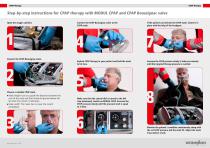
CPAP Therapy CPAP Therapy Step-by-step instructions for CPAP therapy with MODUL CPAP and CPAP Boussignac valve Open the oxygen cylinder. 1 Connect the CPAP Boussignac valve. Connect the CPAP Boussignac valve to the CPAP mask. 4 Explain CPAP therapy to your patient and hold the mask to his face. Choose a suitable CPAP mask. Mask length: Use as a guide the distance between the root of the nose and the horizontal groove below the lip when the mouth is half open. Mask width: The mask has to cover the mouth completely. Make sure that the control dial is turned to the left stop (minimum). Switch on...
Open the catalog to page 2All WEINMANN Emergency Medical Technology catalogs and technical brochures
 Supply Catalog 2026
202 Pages
 Product-catalog
92 Pages

Archived catalogs
 ULM CASE III
20 Pages
 ULM Case
118 Pages
 CCSV
CCSV8 Pages
 ULM CASE II
16 Pages
 Product catalogue 2022/2023
113 Pages
- Analysis software
- Patient monitor
- Medical gas pressure reducer
- Connector
- External defibrillator
- Non-invasive ventilator
- Clinical patient monitor
- Medical pressure regulator
- Data management software
- CO2 patient monitor
- Medical device connector
- Oxygen pressure reducer
- Oxygen mask
- Portable ventilator
- Intensive care ventilator
- Emergency ventilator
- EtCO2 patient monitor
- Backpack
- Test software
- Multi-mode ventilator