
- Catalogs
- Welch Allyn
- Best Practices in Blood Pressure Measurement

- Products
- Catalogs
- News & Trends
- Exhibitions
Best Practices in Blood Pressure Measurement

Best Practices in Blood Pressure Measurement
Introduction
Accurate blood pressure measurement is crucial for diagnosing and managing hypertension, especially with the updated American Heart Association (AHA) guidelines that define high blood pressure as 130/80 mm Hg or higher. This document outlines best practices for blood pressure measurement and highlights the importance of accurate readings both in and out of the clinical setting.
Importance of Accurate Measurement
Hypertension is a leading risk factor for heart attack, stroke, and kidney disease. With nearly half of American adults affected, accurate diagnosis and management are essential. Manual readings can be inaccurate due to errors and improper techniques, emphasizing the need for reliable digital devices.
Challenges and Solutions
In-office readings may not suffice due to factors like white-coat hypertension. Home monitoring often lacks clinical accuracy, and patients may not communicate readings effectively. Automated blood pressure averaging and ambulatory monitoring are recommended to improve diagnostic accuracy.
Recommended Practices
- Identify: Use automated vital signs with blood pressure averaging, such as the Connex® Spot Monitor.
- Diagnose: Employ ambulatory blood pressure monitoring with devices like the ABPM 7100.
- Manage: Implement home monitoring programs, such as the Welch Allyn Home™ Hypertension Program, to help patients reach target blood pressure levels.
Conclusion
Welch Allyn provides comprehensive solutions for identifying, diagnosing, and managing hypertension, supporting healthcare providers across the care continuum. For more information, visit their website.
Catalog excerpts

Best Practices in Blood Pressure Measurement Assess, diagnose and treat hypertension with confidence.
Open the catalog to page 1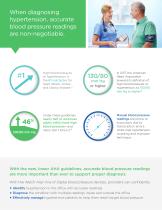
When diagnosing hypertension, accurate blood pressure readings are non-negotiable. High blood pressure, or hypertension, is the #1 risk factor for heart attack, stroke and kidney disease.1,2 Under these guidelines, nearly half of American adults (46%) have high blood pressure—and many don’t know it.⁴ In 2017, the American Heart Association lowered its definition of high blood pressure, or hypertension, to 130/80 mm Hg or higher.³ Manual blood pressure readings are prone to inaccuracy due to transcription errors, white coat hypertension, rounding and improper technique. With the new, lower AHA...
Open the catalog to page 2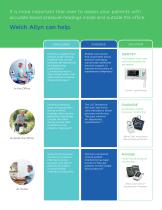
It is more important than ever to assess your patients with accurate blood pressure readings inside and outside the office. Welch Allyn can help. CHALLENGE Evidence suggests that manual single-reading methods may not be sufficient for identifying and diagnosing hypertension.5 Contributing factors may include white-coat effect and inconsistent clinical technique.6 Studies have shown that automated blood pressure averaging can provide additional decision support to improve the accuracy of hypertension diagnoses.7 IDENTIFY Automated vital signs with blood pressure averaging Connex® Spot Monitor...
Open the catalog to page 3
Welch Allyn is uniquely positioned to help providers identify, diagnose and manage hypertension across the care continuum. Learn more at www.welchallyn.com. ¹ ayo Clinic. High blood pressure dangers: Hypertension’s effects on your body. Mayo Clinic website. http://www.mayoclinic.org/diseases-conditions/high-blood-pressure/ M in-depth/high-blood-pressure/art-20045868. February 18, 2014. Accessed October 17, 2016. ² orld Heart Federation. Cardiovascular disease: Risk factors. World Heart Federation website. http://www.world-heart-federation.org/fileadmin/user_upload/documents/ W Fact_sheets/2012/PressBackgrounderApril2012RiskFactors.pdf....
Open the catalog to page 4All Welch Allyn catalogs and technical brochures
 Diagnostic Cardiology Suite
8 Pages
 SYNCLARA COUGH SYSTEM
5 Pages
 HEALTHCARE FURNITURE
11 Pages

Archived catalogs
 ABPM 6100
4 Pages
 Durashock
2 Pages
 ABPM 7100
12 Pages
 SURVEYOR™ S4
3 Pages
 SCALE-TRONIX®
3 Pages
 RetinaVue700
180 Pages
 SureTemp® Plus
34 Pages
 Welch Allyn ABPM 7100
4 Pages
 Ophthalmoscope and iExaminer
2 Pages
 Connex® Spot Monitor
4 Pages
 Advancing Frontline Care
12 Pages
 Insight™
2 Pages
 KleenSpec®
3 Pages
 Connecting Health o meter
3 Pages
 Integrated Wall System
3 Pages
 CP 150 Electrocardiograph
4 Pages
 Protecting Patient Privacy
2 Pages
 GS 777 Veterinary, Brochure
2 Pages
 Spot LXI Wireless Module
2 Pages
 Spot Vital Signs LXI
2 Pages
 Green Series Lights for Vets
2 Pages
 Lighting Products
8 Pages
 Cardiopulmonary Solutions
4 Pages
 PC-Based Resting ECG
4 Pages
 Holter Monitor
2 Pages
 CP 200 Electrocardiograph
4 Pages
 CP 100 Electrocardiograph
2 Pages
 CP 50 Electrocardiograph
2 Pages
 CP 50 - Hospitals
2 Pages
 Connex VM
4 Pages
 Veterinary Stethoscope
1 Page
 SET ME UP Program Rewards
4 Pages
 READY. SET. SAVE
5 Pages
 EpiScope
2 Pages
 Welch Allyn Stethoscopes
2 Pages
 Women's Health
8 Pages
 Ambulatory Surgery Solutions
5 Pages
 Endoscopy, Full Line Catalog
10 Pages
 Stethoscopes, Full Line Catalog
12 Pages
 Ear Wash System
4 Pages
 AM 282 Manual Audiometer
2 Pages
 LumiView?
3 Pages
 Laryngoscope Brochure
8 Pages
 Harvey? Elite® Stethoscope
4 Pages
 SureSight? Vision Screener
4 Pages
 Elite? Retinoscope
2 Pages
 PanOptic? Ophthalmoscope
2 Pages


- Hospital bed
- Hospital wardrobe
- Surgical lighting system
- Inclinable bed
- LED surgery light
- Trendelenburg bed
- Thermometer
- Ceiling-mounted surgical light
- Medical thermometer
- Patient monitor
- Endoscope
- Wardrobe with drawer
- Digital thermometer
- Surgical light with control panel
- 1-unit wardrobe
- Blood pressure patient monitor
- Digital electrocardiograph
- EKG
- 96 surgical light
- Portable patient monitor