
- Catalogs
- The West Group Ltd
- Glossary of Terminology


- Company
- Products
- Catalogs
- News & Trends
- Exhibitions
Glossary of Terminology
Glossary of Terminology
- ATEX: Refers to equipment intended for use in explosive atmospheres. Products on the website are generally not intended for such use unless specified.
- CE Mark: Indicates compliance with health and safety regulations within the European Economic Area, typically applied to end products rather than components.
- Clean Room Classifications: Describes manufacturing environments as uncontrolled, controlled, or certified, based on environmental standards.
- Connections: Details various connection types (primary, secondary, etc.) and their typical uses in devices.
- Country of Origin: Defines the country where the final manufacturing or assembly process occurs.
- Effective Orifice Size: Describes the impact of a component on system performance, measured by flow through the component.
- Flow/Flow Rate: Indicates flow direction sensitivity and rates at specific pressure drops.
- Hysteresis: Describes the variance in set points based on previous values, expressed as a percentage.
- IP Rating: Specifies the level of protection against dust and water, following EN 60529/IEC529 standards.
- Linearity: Measures the proportionality between input and output parameters, with deviations expressed as a percentage.
- Pressure Specifications: Includes maximum and minimum inlet pressures, and operating outlet pressure guidelines.
- Regulatory Compliance: Covers REACH, RoHS, and WEEE directives, ensuring products meet environmental and safety standards.
- Technical Parameters: Discusses sensitivity, temperature ranges (ambient, media, operating), vacuum definitions, voltage, wattage, and wetted materials.
- Abbreviations and Thread Forms: Lists common abbreviations and thread forms used in technical specifications.
Catalog excerpts

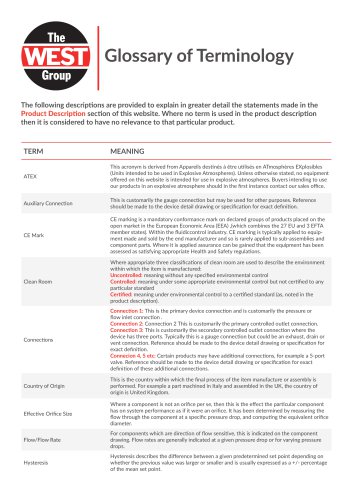
Glossary of Terminology The following descriptions are provided to explain in greater detail the statements made in the Product Description section of this website. Where no term is used in the product description then it is considered to have no relevance to that particular product. This acronym is derived from Appareils destinés à être utilisés en ATmosphères EXplosibles (Units intended to be used in Explosive Atmospheres). Unless otherwise stated, no equipment offered on this website is intended for use in explosive atmospheres. Buyers intending to use our products in an explosive atmosphere should in the first instance contact our sales office. Auxiliary Connection This is customarily the gauge connection but may be used for other purposes. Reference should be made to the device detail drawing or specification for exact definition. CE marking is a mandatory conformance mark on declared groups of products placed on the open market in the European Economic Area (EEA) ,(which combines the 27 EU and 3 EFTA member states). Within the fluidiccontrol industry, CE marking is typically applied to equipment made and sold by the end manufacturer and so is rarely applied to sub-assemblies and component parts. Where it is applied assurance can be gained that the equipment has been assessed as satisfying appropriate Health and Safety regulations. Clean Room Where appropriate three classifications of clean room are used to describe the environment within which the item is manufactured: Uncontrolled: meaning without any specified environmental control Controlled: meaning under some appropriate environmental control but not certified to any particular standard Certified: meaning under environmental control to a certified standard (as, noted in the product description). Connection 1: This is the primary device connection and is customarily the pressure or flow inlet connection . Connection 2: Connection 2 This is customarily the primary controlled outlet connection. Connection 3: This is customarily the secondary controlled outlet connection where the device has three ports. Typically this is a gauge connection but could be an exhaust, drain or vent connection. Reference should be made to the device detail drawing or specification for exact definition. Connecion 4, 5 etc: Certain products may have additional connections, for example a 5-port valve. Reference should be made to the device detail drawing or specification for exact definition of these additional connections. This is the country within which the final process of the item manufacture or assembly is performed. For example a part machined in Italy and assembled in the UK, the country of origin is United Kingdom. Effective Orifice Size Where a component is not an orifice per se, then this is the effect the particular component has on system performance as if it were an orifice. It has been determined by measuring the flow through the component at a specific pressure drop, and computing the equivalent orifice diameter. Flow/Flow Rate For components which are direction of flow sensitive, this is indicated on the component drawing. Flow rates are generally indicated at a given pressure drop or for varying pressure drops. Hysteresis describes the difference between a given predetermined set point depending on whether the previous value was larger or smaller and is usually expressed as a +/- percentage of the mean set poin
Open the catalog to page 1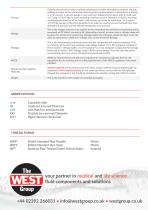
Wetted and Non-Wetted Materials Weight A partial vacuum exists when a referenced pressure is below atmospheric pressure. Vacuum readings increase as the referenced pressure goes from atmospheric to absolute zero (0psia), or a full vacuum. A vacuum gauge at rest reads zero (0psig) and increases until it could read -14.7 psig or 29.92”Hg if it were measuring a perfect vacuum. However, on Earth, assuming an atmospheric pressure of 14.7 psia, a full vacuum can never be more than -14.7 psig or -29.92”Hg. Vacuum is therefore generally to be taken as a partial vacuum between less than atmospheric pressure...
Open the catalog to page 3All The West Group Ltd catalogs and technical brochures
 West Group Check Valve Catalogue
41 Pages
 NTC Catalogue
3 Pages
 The West Group Brochure
8 Pages

- Medical valve
- Gas filter
- Connector
- Surgical tubing
- Air filter
- Laboratory filter
- Medical filter
- Solenoid valve
- Transparent tubing
- Medical device connector
- Gas valve
- Stainless steel valve
- Flexible tubing
- Artificial ventilation filter
- Medical device adapter
- Manifold
- Medical gas tubing
- Pressure control system
- Plastic cap