
- Catalogs
- West Medica
- V-Chromer® I — Automated stainer for microscopic samples

V-Chromer® I — Automated stainer for microscopic samples

V-Chromer® I — Automated stainer for microscopic samples
- Productivity: Capable of processing up to 100 slides per hour with minimal reagent consumption.
- Safety: Equipped with a charcoal filter to neutralize evaporations and odors, protecting personnel and the environment.
- Contamination Prevention: Features a drip system to prevent reagent contamination and vessels that open only when in use.
- Ease of Use: No exhaust hood or water supply connection required. Automatic draining of used reagents.
- Barcode Compatibility: Allows staining of slides with barcodes without immersing label fields in staining agents.
- Place slides in the holder.
- Run the automated staining cycle.
- Retrieve standardized stained slides.
- Power: 220 ± 10 % V, 50 Hz, 120 W
- Size and Weight: 500×450×450 mm, 12 kg
- Reagent Vessels: 5 solvent-resistant vessels, 200 ml each
- Washing and Drying: Automatic filling/draining system and hot air ventilation
- V-Chromer® I automated slide stainer: 80.0003.01
- Reagents and Accessories: Various sets and components available for different staining protocols.
Catalog excerpts
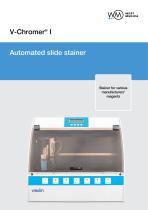
V-Chromer® I Automated slide stainer Stainer for various manufacturers’ reagents
Open the catalog to page 1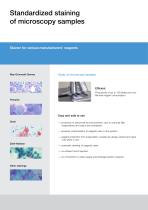
Standardized staining of microscopy samples Stainer for various manufacturers’ reagents May-Grünwald Giemsa Study of microscopy samples Efficient Productivity of up to 100 slides per hour. Minimal reagent consumption. Panoptic Easy and safe to use Gram — protection of personnel and environment, due to charcoal filter evaporations and odour are neutralized — prevents contamination of reagents due to drip system — reagent protection from evaporation; vessels are always closed and open only when in use — automatic draining of reagents used — no exhaust hood required — no connection to water supply...
Open the catalog to page 2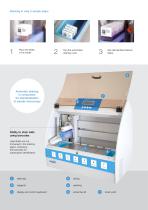
Staining in only 3 simple steps Place the slides in the holder Run the automated staining cycle Get standardized stained slides Automatic staining is compulsory for standardization of sample microscopy Ability to stain slide using barcodes Label fields are not immersed in the staining agent, protecting the barcodes for subsequent identification slide tray display and control keyboard
Open the catalog to page 3
open stainer for use various manufacturers' reagents staining protocol is transferred to the instrument via smart card User interface user panel: 4 keys (Esc, 1,1, OK) LCD alphanumeric display, 4 lines Reagent vessels 5 pes., plastic solvent-resistant vessels with lid, Washing station vessel with automatic filling/draining system Drying station vessel with hot air ventilation Drop protection built-in drip system with drying plates for drop collection, reducing contamination automatic draining of used reagents Water supply not required, loading and draining of the washing fluid via external containers...
Open the catalog to page 4All West Medica catalogs and technical brochures
 Vision Hema® Network
1 Page
 Vision Hema® Integro
4 Pages
 V-Counter® PC-analyzer
4 Pages
 Vision Hema® Remote
4 Pages
 V-Counter® PC Analyzer
4 Pages
 Vision Master catalogue 2014
62 Pages


Archived catalogs

- Cell imaging system
- Automatic cell imaging system
- Hospital management system
- Laboratory cell imaging system
- Fluorescence cell imaging system
- Laboratory management system
- Diagnostic cell imaging system
- Molecular biology cell imaging system
- Phase contrast cell imaging system
- Bright field cell imaging system
- Blood cell cell imaging system
- Hematology cell imaging system
- Clinical cell imaging system
- Veterinary laboratory cell imaging system
- Karyotyping cell imaging system
- FISH cell imaging system