
- Catalogs
- Wincomm Corporation
- White Paper - AI Joins with Embedded to Create Medical AI


- Company
- Products
- Catalogs
- News & Trends
- Exhibitions
White Paper - AI Joins with Embedded to Create Medical AI
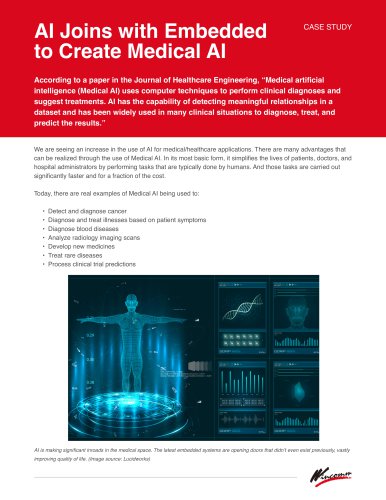
White Paper - AI Joins with Embedded to Create Medical AI
Medical artificial intelligence (AI) is revolutionizing healthcare by using computer techniques to perform clinical diagnoses and suggest treatments. It identifies meaningful relationships in datasets, aiding in diagnosis, treatment, and prediction in clinical settings. The integration of AI in healthcare simplifies tasks for patients, doctors, and administrators, offering faster and cost-effective solutions.
Applications of Medical AI
Medical AI is currently used in various applications, including cancer detection, illness diagnosis and treatment, blood disease diagnosis, radiology imaging analysis, new medicine development, rare disease treatment, and clinical trial predictions.
Case Study: EndoBRAIN Diagnostic System
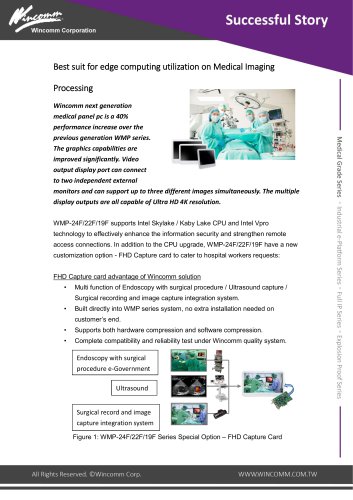
The EndoBRAIN diagnostic system, powered by Wincomm’s WMP-K series of embedded computers, assists in colonoscopy procedures by detecting and analyzing colorectal polyps and lesions. The system, developed in collaboration with CYBERNET SYSTEMS CO., LTD., uses AI to achieve a sensitivity rate of 96.9% and an accuracy of 98%, comparable to senior specialists. It reduces patient discomfort and hospital staff burden.
Technological Advancements
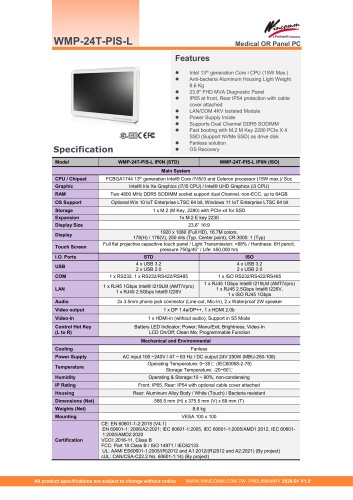
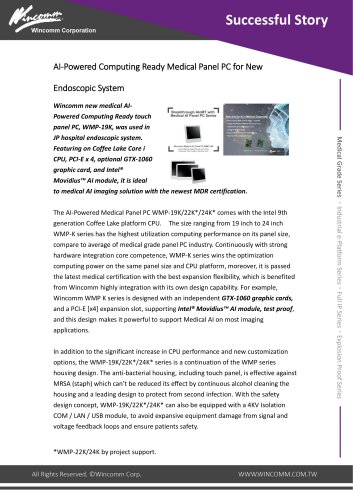
Recent advancements in microprocessors and algorithms have enhanced AI's role in medical applications. Wincomm’s AI-powered medical panel PCs, equipped with Intel’s 9th Generation Coffee Lake processors, offer high performance for complex imaging and AI tasks. These systems are certified for medical use and feature anti-bacterial housing and optional isolation modules for patient safety.
Deployment and Benefits
The WMP-K series meets hospital criteria, including anti-microbial surfaces, fast boot times, and PCIe expansion slots. Its compact design allows for versatile use in operating rooms or on medical carts. The series supports various medical AI applications, such as bronchoscopy detection and lung vision investigation.
Conclusion
Medical AI offers significant benefits by planning, learning, reasoning, and solving problems in real-time, reducing human error. The collaboration between medical and technology professionals is crucial for developing effective solutions. Wincomm’s technology exemplifies the potential of AI in enhancing healthcare delivery.
Catalog excerpts
AI Joins with Embedded to Create Medical AI CASE STUDY According to a paper in the Journal of Healthcare Engineering, “Medical artificial intelligence (Medical AI) uses computer techniques to perform clinical diagnoses and suggest treatments. AI has the capability of detecting meaningful relationships in a dataset and has been widely used in many clinical situations to diagnose, treat, and predict the results.” We are seeing an increase in the use of AI for medical/healthcare applications. There are many advantages that can be realized through the use of Medical AI. In its most basic form, it simplifies the lives of patients, doctors, and hospital administrators by performing tasks that are typically done by humans. And those tasks are carried out significantly faster and for a fraction of the cost. Today, there are real examples of Medical AI being used to: • Detect and diagnose cancer • Diagnose and treat illnesses based on patient symptoms • Diagnose blood diseases • Analyze radiology imaging scans • Develop new medicines • Treat rare diseases • Process clinical trial predictions AI is making significant inroads in the medical space. The latest embedded systems are opening doors that didn’t even exist previously, vastly improving quality of life. (Image s
Open the catalog to page 1
The Need Is Obvious It is clear that Medical AI is solving a serious problem in the medical/healthcare arena. Patients need better and faster care, doctors need techniques that are trustworthy, and hospitals and administrators need tools that are cost effective. Medical AI can answer all of these needs. specialists. Using artificial intelligence to automatically judge the key parts of the image enlargement, the diagnosis is brief, thereby reducing patient discomfort and reducing the burden placed on the hospital staff in terms of scheduling and training. That hardware-software combination is...
Open the catalog to page 2
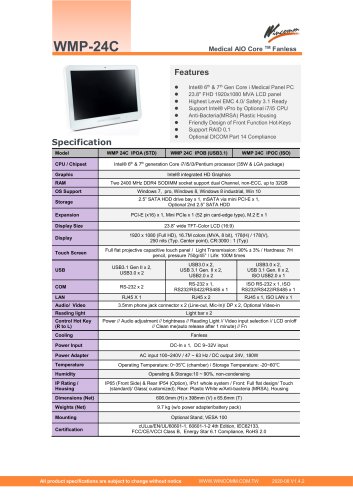
The Solutions Are Here While the AI technology is not new, in fact it’s been around for decades in some instances, there’s been a recent surge of microprocessors and algorithms that are designed specifically for AI in medical applications. Those CPUs are deployed in Wincomm Corp.’s AI-powered medical panel PCs (the WMP-19K/22K/24K). The platform is designed with Intel’s 9th Generation Coffee Lake processor family and a touch panel that ranges in size from 19 to 24 in. The high-end CPU choice permits much higher performance when compared to conventional medical-grade platforms. Simple operation...
Open the catalog to page 3All Wincomm Corporation catalogs and technical brochures
 Wincomm Medical Brief Solution
28 Pages
 WMP-24M-PIS Data Sheet
2 Pages
 WMP-105 Celeron N3350 10.1"
2 Pages
 WMP-24J Datasheet
2 Pages
 WMP-19K
2 Pages
 WMP-155 Apollo Lake 15
2 Pages


Archived catalogs
 WMP-24M Data Sheet
2 Pages
 WMP-101 Celeron® N2930 10
2 Pages




- Medical support arm
- Monitor support arm
- Wincomm Corporation HDMI display
- DVI display
- VESA mounting support arm
- Full HD monitor
- 16:9 display
- VGA display
- Desk support arm
- Wincomm Corporation high-brightness display
- Wincomm Corporation medical panel PC with touchscreen
- Wincomm Corporation fanless medical panel PC
- Wincomm Corporation medical PC
- Wincomm Corporation medical panel PC with USB
- Wincomm Corporation Intel® Core™ medical panel PC
- Wincomm Corporation healthcare facility medical panel PC
- 24" display
- Wincomm Corporation medical box PC
- Wincomm Corporation waterproof display