
- Catalogs
- WISAP Medical Technology
- Cervical Cancer Prevention

- Company
- Products
- Catalogs
- News & Trends
- Exhibitions
Cervical Cancer Prevention

Cervical Cancer Prevention
Catalog excerpts

COLD COAGULATOR Device for Cervical Cancer Prevention WHAT IS THE DIFFERENCE BETWEEN COLD COAGULATION AND CRYOTHERAPY? CLINICAL BACKGROUND Both systems use temperature to destroy tissue and so both are considered to be ablative treatment methods. Cryotherapy uses a cool tip (below -50 °C) to destroy abnormal tissue. Cold coagulation on the other hand uses a hot tip. In high-resource settings, we are fighting cervical cancer quite successfully. In these settings, secondary prevention with cervical cytology linked with timely treatment of precancer has led to considerable declines in mortality. However, cervical cancer is still a major killer of women worldwide, with nearly 90% of new cases diagnosed in low- and middle-income countries (LMICs). Unlike many other cancers, there are primary prevention strategies for cervical cancer that can lead to decreased incidence. Finding out that the human papillomavirus (HPV) is the cause of cervical cancer has led to revolutionary prevention strategies such as prophylactic HPV vaccination, which are effective against seven high-risk HPV types responsible for causing approximately 90% of cervical cancers worldwide. Unfortunately, prophylactic HPV vaccines do not treat pre-existing HPV infections and related conditions. Thus, even if HPV vaccines were immediately distributed worldwide, two to three generations of currently HPV-positive women would not benefit from them. Furthermore, since only a small percentage of women are presently vaccinated, mortality will hardly decrease in the next couple of years. Secondary prevention strategies for the detection and treatment of precancerous lesions are needed for the foreseeable future. Pre-cancer is defined as cervical intraepithelial neoplasia grade 2 [CIN2], grade 3 [CIN3] and adenocarcinoma in situ [AIS], together “CIN2+”. Regardless of screening strategy, access to effective treatment for women with cervical precancer is crucial. In some countries, up to 80% of women diagnosed with cervical pre-cancer do not receive the recommended treatment. Therefore it is crucial to implement a clinically tested and highly efficacious treatment method, which is easy to handle and cheap to run.
Open the catalog to page 1
CERVICAL CANCER PREVENTIONin low- and middle-income countries HOW DOES COLD COAGULATION WORK? The treatment method of a thermo tip can be compared to the properties of a pan, used for cooking. The thermo tip is electrically heated to up to 100 °C. The tissue is destroyed by heat. The device controls the temperature to remain at the pre-set temperature for the duration of the treatment. The probe has an anti-stick surface to make sure that no tissue will be stuck when retracting the probe from the cervix at the end of the treatment. Cold coagulation cannot be compared to HF coagulation though....
Open the catalog to page 2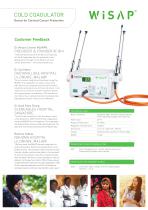
COLD COAGULATOR Device for Cervical Cancer Prevention Customer Feedback Dr. Miriam Cremer MD/MPH, “I believe that because of the devices simplicity the Cold Coagulator has the potential to be a global game-changer in the field of cervical cancer prevention.” www.basichealth.org DAEYANG LUKE HOSPITAL LILONGWE, MALAWI “At our mission hospital we have been using the WISAP cold coagulator for about a year and a half. We are very pleased with the performance, reliability and ease of use of this instrument. I can easily carry it with me to other hospitals where I offer gynecologic consultations. This...
Open the catalog to page 3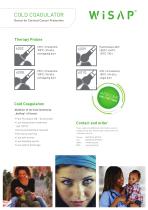
Device for Cervical Cancer Prevention Cold Coagulation Ablation of cervical lesions by „boiling“ of tissue Contact and order If you need any additional information, we are happy to help you. Please get in touch with our customer service: Phone: 0049 8104 89 08 0 eMail: [email protected] Fast Procedure (20 - 60 seconds) • Low temperature treatment (60-120°C) • No local anesthesia required • No tissue scarring • Low pain scores • Low bleeding events • Low watery discharge
Open the catalog to page 4All WISAP Medical Technology catalogs and technical brochures
 INSUFFLATION
12 Pages
 VISUALIZATION
24 Pages
 Instruments
44 Pages
 Morcellation
10 Pages
 Gynecology
26 Pages
Archived catalogs
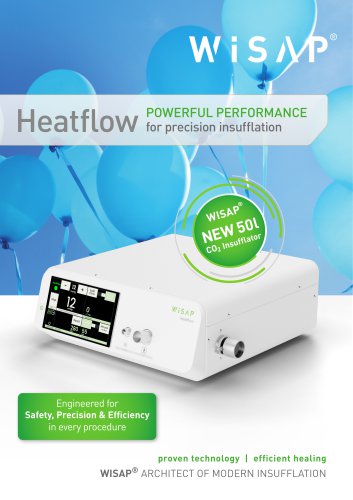 Heatflow CO2 Insufflator
2 Pages
 Visualization
24 Pages
 Insufflation
12 Pages
 C3 Cervical Cold Coagulator
2 Pages
 C3 CERVICAL COLD COAGULATOR
2 Pages
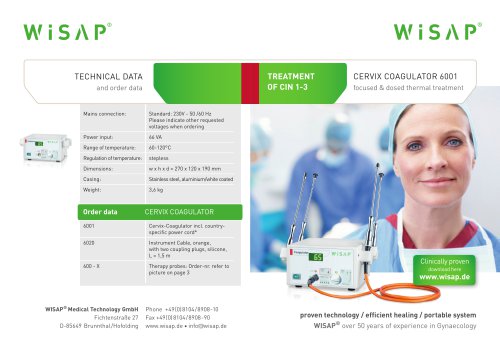 CERVIX COAGULATOR
2 Pages

- Surgical system
- Endoscope
- Cutting electrosurgical system
- Coagulation surgical system
- HDMI display
- DVI display
- Surgical tubing
- LED light source
- Endoscope camera
- Full HD monitor
- 16:9 display
- LED camera
- Endoscope light source
- HD camera
- Flexible tubing
- Compact light source
- Ultra-high resolution camera
- High-definition medical endoscope
- Digital camera head
- Silicone tubing