
- Catalogs
- Wolf-e Robotics
- Shining a Light on UV-C Disinfection – Myths Vs. Reality

- Company
- Products
- Catalogs
- News & Trends
- Exhibitions
Shining a Light on UV-C Disinfection – Myths Vs. Reality
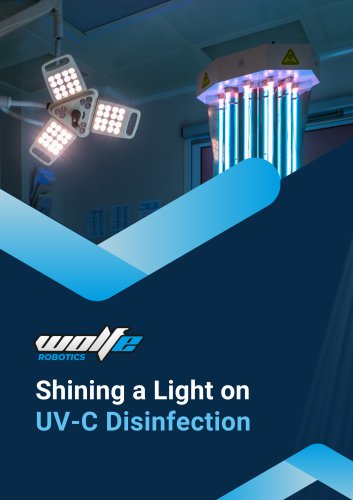
Shining a Light on UV-C Disinfection – Myths Vs. Reality
UV-C disinfection technology has been used for over 140 years to deactivate pathogens by breaking down their DNA. It is increasingly popular for sanitizing surfaces and air, especially after COVID-19.
Specifications and Efficiency
The CoBOT Ultra by Wolf-e Robotics is a powerful UV-C robot with a disinfection efficiency of up to 99.9999%. It operates at 3250W with an irradiance of 11050 microW/cm2@1m, effectively inactivating pathogens like MRSA and SARS CoV2.
Operational Considerations
Efficiency depends on exposure time, device power, and distance. The CoBOT Ultra can disinfect a 4x4m area in seconds, but optimal results require careful calculation of these factors.
Environmental and Safety Benefits
UV-C disinfection is non-toxic and environmentally friendly, unlike chemical methods. It does not emit ozone and is safe for food-related industries. Safety features like motion sensors ensure safe operation around humans.
Cost-Effectiveness
UV-C systems are cost-effective over time, reducing the need for chemical disinfectants. The CoBOT Ultra offers long lamp life and maintenance alerts, enhancing cost efficiency.
Technological Integration
Wolf-e Robotics provides a UV-C exposure time calculator to optimize disinfection cycles. The CoBOT Ultra features autonomous navigation, real-time mapping, and centralized management for comprehensive disinfection.
Myths vs. Reality
Common myths include perceived toxicity and high cost. In reality, UV-C systems are safe, environmentally friendly, and economically viable when used correctly.
Conclusion
UV-C disinfection is a powerful, safe, and efficient method for pathogen control, offering significant advantages over traditional chemical methods.
Catalog excerpts
Shining a Light on UV-C Disinfection
Open the catalog to page 1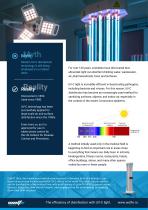
Modern UV-C disinfection technology is still being employed on a modest basis. For over 140 years, scientists have discovered that ultraviolet light can disinfect drinking water, wastewater, air, pharmaceuticals, food, and surfaces. UV-C light is incredibly efficient in deactivating pathogens, including bacteria and viruses. For this reason, UV-C Discovered in 1800. Used since 1880. sanitizing surfaces, objects, and indoor air, especially in disinfection has become an increasingly used method for the context of the recent Coronavirus epidemic. UV-C technology has been successfully applied for...
Open the catalog to page 2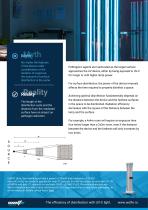
No matter the features of the places under consideration or the duration of exposure, the outcome of surface disinfection is the same. Pathogenic agents are inactivated as the target surface approaches the UV device, either by being exposed to UV-C for longer or with higher lamp power. For surface disinfection, the power of the device inversely The length of the disinfection cycle and the distance from the irradiated surface have an impact on pathogen reduction. affects the time required to properly disinfect a space. Achieving optimal disinfection fundamentally depends on the distance between...
Open the catalog to page 3
Disinfection with UV light is toxic and harmful to humans and the environment. Undoubtedly, the most significant benefit of UV-C light disinfection is that it is non-toxic, unlike nebulization and other cleaning and disinfecting products. In practice, there The UV-C light used for disinfection is safe to use and environmentally friendly. This disinfection method is free of chemicals, making it one of the safest procedures, with no impact on underlying health conditions such as asthma. are no toxic chemicals or carcinogenic by-products that remain in suspension or on surfaces when UV-C disinfection...
Open the catalog to page 4
Any space can be disinfected in approximately 15 minutes. Time is essential, and UV-C dosage is a relatively simple calculation based on irradiance and distance. In other words, spaces require different amounts of time allocated for disinfection, depending on the power of the UV-C device and the dimensions of the room where it is used. It is true that disinfection depends on time, but the time must be calculated in the particular context of the proposed spaces for disinfection. 2 seconds, 10 seconds, 5 minutes or 15 minutes mean nothing in a general context. Faster does not necessarily mean better,...
Open the catalog to page 5
One single positioning of a UV-C light device can disinfect all surfaces and areas of a room, regardless of how many objects, surfaces are in that space. UV-C technology works by exposing bacteria to germicidal UV light (253.7 nm), eliminating their capacity to proliferate and cause disease. There are several sorts of surfaces in rooms where microorganisms dwell, some of which reflect limited quantities of UV-C radiation, some of which absorb Reality Reality most or all of the UV-C energy, and some of which are covered by other items put in front of them. As a result, if a surface is "shaded"...
Open the catalog to page 6
UV-C light disinfection is very expensive and very few companies, institutions and organizations can afford to purchase such UV-C based devices. Many UV-C devices will save you money in the long run. This is because instead of having to buy numerous sprays, complementary devices, different chemicals, and disinfectants, all you need to do is purchase a UV-C disinfection device once. After that, you can use the device as many times as you want and only need to replace the lamps and filters when UV-C disinfection is not expensive. UV-C disinfection systems are often smaller and easier to use than...
Open the catalog to page 7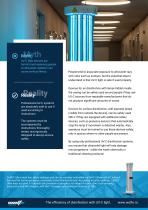
UV-C light devices are harmful and exposing people to ultraviolet radiation can cause serious illness. People tend to associate exposure to ultraviolet rays with risks such as sunburn, but the essential idea to understand is that UV-C light is safe if used properly. Reality Reality Professional UV-C systems are absolutely safe to use if used according to instructions. Devices for air disinfection with lamps hidden inside the casing can be safely used around people if they use UV-C sources from reputable manufacturers that do not produce significant amounts of ozone. Devices for surface disinfection,...
Open the catalog to page 8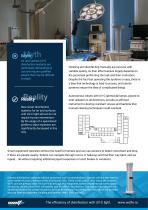
Air and surface UV-C disinfection systems are particularly demanding to use and require qualified people that may be difficult to teach. Cleaning and disinfecting manually are services with variable quality, as their effectiveness largely depends on the personnel performing the task and their motivation. Despite the fact that operating the systems is easy, there is a bias that technology is hard to access, and robotic systems induce the idea of complicated things. Reality Reality New smart disinfection systems for air and surfaces with UV-C light almost do not require human intervention! By the...
Open the catalog to page 9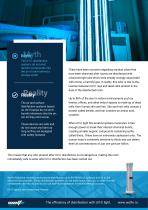
The UV-C disinfection systems do not emit harmful compounds into the air or leave behind a strange smell. There have been concerns regarding residual odors that have been observed after rooms are disinfected with ultraviolet light and which were initially wrongly associated with ozone, a harmful gas. In reality, this odor is due to the reaction between UV-C rays and dead cells present in the dust of the disinfected room. Up to 80% of the dust in indoor environments such as The air and surface disinfection systems based on UV-C lamps do not emit harmful elements into the air, nor do they emit...
Open the catalog to page 10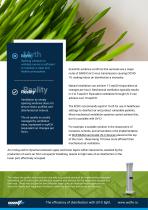
Opening windows to ventilate rooms is sufficient to maintain a clean and healthy atmosphere. Scientific evidence confirms that aerosols are a major route of SARS-CoV-2 virus transmission causing COVID19, making indoor air disinfection a necessity. Ventilation by simply opening windows does not ensure clean, purified, and disinfected air indoors. The air quality is usually managed by ventilation rates, expressed in eqACH (equivalent air changes per hour). Natural ventilation can achieve 1-2 eqACH (equivalent air changes per hour). Mechanical ventilation typically results in 2 to 5 eqACH. Equivalent...
Open the catalog to page 11All Wolf-e Robotics catalogs and technical brochures
- Healthcare facility air sterilizer
- Medical lamp
- Hospital air recirculator
- Germicidal air sterilizer
- UV air recirculator
- Air purifier with HEPA filter
- Mobile air sanitizer
- Wall-mounted air sterilizer
- Scrubber-dryer
- Disinfection lamp
- Air purifier with microbial elimination
- Mobile application
- Mobile vacuum cleaner
- Medical mobile application
- Lamp on casters
- Ceiling-mounted air sterilizer
- UVC lamp
- UVC air sterilizer
- Disinfection robot
- Mobile disinfection robot