
- Catalogs
- Zamar Care
- Brain_katalog

- Products
- Catalogs
- News & Trends
- Exhibitions
Brain_katalog

Brain_katalog
Therapeutic hypothermia (TH) is a medical intervention used to lower body temperature to 32-34°C in comatose patients after cardiac arrest. This process helps protect brain cells by slowing enzyme activity, reducing free radicals, stabilizing cell membranes, decreasing oxygen needs, and inhibiting harmful neurotransmitter activity. It is endorsed by the American Heart Association (AHA) and European Resuscitation Council (ERC).
Significant clinical trials in 2002 by Holzer et al. and Bernard et al. demonstrated improved neurological outcomes in patients treated with TH compared to normothermia. The International Liaison Committee on Resuscitation (ILCOR) recommended TH as a fundamental post-resuscitation strategy for comatose patients with return of spontaneous circulation (ROSC).
The BrainLife device provides a portable solution for TH, suitable for intensive care and ambulance use. Key features include:
- Temperature control via multiple probes (tympanic, esophageal, epidermal, rectal).
- A 10” touch screen for easy operation.
- Preset and customizable programs with USB updates.
- Disposable, sterile wraps for effective heat exchange.
- No-Tox coolant in a closed circuit for safe cooling.
The BrainLife device operates in four phases:
- Induction: Rapidly achieves target temperature.
- Maintenance: Keeps temperature stable.
- Heating: Gradually warms to normothermia.
- Monitoring: Continuous temperature monitoring via ear probe.
The BrainLife device aligns with AHA and ERC guidelines, providing a non-invasive, efficient solution for TH in post-cardiac arrest care. Its design ensures reliable and effective treatment.
The BrainLife system includes a touch screen with an amorphous silicon TFT display, ensuring usability in various conditions. It offers several preset programs and updates via USB. The anatomical wraps and chest jacket facilitate emergency resuscitation, using a No-Tox coolant for optimal tissue adherence.
Zamar BrainLife complies with AHA and ERC recommendations for using hypothermia in unconscious patients with ROSC after cardiac arrest. It is classified as a Class IIa electro-medical device.
Therapeutic hypothermia has been shown to protect brain cells by suppressing free radicals and stabilizing cell membranes. Studies by Holzer et al. and Bernard et al. demonstrated improved neurological outcomes with hypothermia treatment.
The Zamar BrainLife system is a versatile tool for intensive care, offering automated temperature management with high precision, based on extensive medical expertise.
Catalog excerpts

Brain Life CardioTemp
Open the catalog to page 1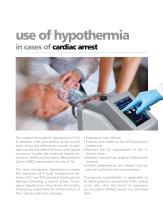
use of hypothermia in cases of cardiac arrest The usage of therapeutic hypothermia (T.H.) in patients with post-cardiac arrest anoxic brain injury has definitively proven to possess a protective effect for brain cells, based on several studies the American Hearth Association (AHA) and European Resuscitation Council (ERC) recommend the use of TH. The term therapeutic hypothermia means the induction of a body temperature between 32°C and 34°C aimed at limiting brain damage following a cardiac arrest. Therapeutic hypothermia slows down the activity of enzymes responsible for the formation of free...
Open the catalog to page 2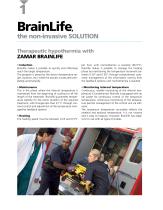
Therapeutic hypothermia with ZAMAR BRAINLIFE • Induction Brainlife makes it possible to quickly and effectively reach the target temperature. The program is preset by the doctor (temperature target, duration, etc.) while the process is executed completely automatically. per hour until normothermia is reached (36.5°C). Brainlife makes it possible to manage the heating phase by maintaining the temperature increment between 0.20° and 0.50°, through computerised, automatic management of the information coming from the feedback systems until normothermia is reached. • Maintenance This is the phase...
Open the catalog to page 3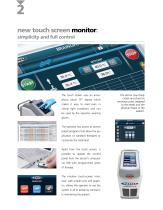
2 new touch screen monitor: simplicity and full control The touch screen uses an amorphous silicon TFT display which makes it easy to read even in critical light conditions and can be used by the operator wearing gloves. The operator has access to several preset programs that allow the application of standard therapies or customize the treatment. Apart from the touch screen, is possible to update the control panel from the doctor’s computer via USB with programmed cycles of therapy. The intuitive touch-screen interface, with simple icons and graphics, allows the operator to use the system in...
Open the catalog to page 4
3 The anatomic wraps are easy to apply and remove during emergency manoeuvres. Zamar BrainLife Wraps quick and efficacy Brainlife reachs target temperature though a chest jacket and two wraps for legs and groins, with rapid application and removal in case of necessity allowing emergency resuscitation The application of wraps and jackets containing the No Tox coolant, disposable and sterile, helps to maintain optimal adherence to tissue without irritating the skin and without using adhesive, and allow a prolonged use on the patient. The wraps configuration, the technical tissue utilized as well...
Open the catalog to page 5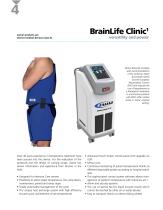
4 Zamar products are electro-medical devices Class IIa Zamar BrainLife complies with recommendations of the American Heart Association (AHA) and the European Resuscitation Council (ERC) that indicate the use of hypothermia as a therapeutic treatment in unconscious patients with ROSC after cardiac arrest in “extra” hospital setting. Over 40 years experience in temperature treatment have been poured into this device. For the realization of the protocols and the design of cooling wraps, Zamar has drawn information and experience from doctors in the field. • Designed for Intensive Care centres •...
Open the catalog to page 6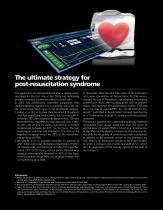
The ultimate strategy for post-resuscitation syndrome The application of mild hypothermia after a cardiac arrest, described for the first time in the 1950s has definitively proven to possess a protective effect for brain cells. In 2002 two randomised, controlled prospective trials used therapeutic hypothermia in patients with post-cardiac arrest anoxic brain injury in out-of-hospital contexts: 1.Holzer et al (6), in Europe they recruited 275 patients who had undergone cardiac arrest due to ventricular fibrillation; 137 were treated with hypothermia, 138 with normothermia; Hypothermia was obtained...
Open the catalog to page 7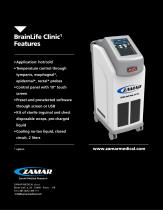
BrainLife Clinic1 Features • Application: hot/cold • Temperature control through tympanic, esophageal*, epidermal*, rectal* probes • Control panel with 10’’ touch screen • Preset and preselected software through screen or USB • Kit of sterile inguinal and chest disposable wraps, pre-charged liquid • Cooling no-tox liquid, closed circuit, 2 liters * option ZAMAR MEDICAL d.o.o. a, Mate Vlaši 26 - 52440 - Porec HR Tel.+385 (0)52 496 111 [email protected]
Open the catalog to page 8All Zamar Care catalogs and technical brochures
 Equine catalogue
4 Pages
 THERAPY
8 Pages
 CarePace
4 Pages
