

E-Helper

E-Helper
- Patients recovering from stroke with mobility issues.
- Patients with traumatic brain injuries affecting mobility.
- Individuals with spinal injuries.
- Patients with gait pathologies due to musculoskeletal disorders.
- Patients with cerebral palsy and multiple sclerosis facing mobility challenges.
Exoskeletons aid in rehabilitation by leveraging neural plasticity, which allows the central nervous system (CNS) to reorganize structurally and functionally. Studies show that exoskeletons can activate neural plasticity in patients with balance and gait disorders by enhancing afferent flow from affected limbs through regular and targeted training.
- Separate motor power adjustment for each leg, beneficial for hemiparesis rehabilitation.
- Detection of initial muscle strain to facilitate movement.
- Dynamic evaluation of spasticity through motor power monitoring.
- 8 hours of autonomous operation.
- Supports patients weighing up to 110 kg and height between 150-190 cm.
- Capable of climbing stairs and turning.
- Durable motors with no costly annual servicing required.
- Easy to wear due to foldable joints.
- Reduces workload for medical staff.
- Increases safety during rehabilitation.
Two usage options include free positioning on a treadmill or affixing to a treadmill, similar to the Lokomat system.
Combining the exoskeleton with an 8-channel electrostimulation and electromyography system enhances efferent stimulation and neural plasticity. The system, comprising four blocks with two channels each, tracks muscle involvement during walking and detects muscle movement attempts during step initiation. MA for this system is expected in Q2-Q3 of 2021.
The E-Helper can be used in conjunction with the Reaterra treadmill for enhanced rehabilitation capabilities.
Catalog excerpts

EXOSKELETON NEW OPPORTUNITIES OF PHYSICAL REHABILITATION. Who will benefit from “exorehabillitation”? - Patients recovering from stoke with mobility issues; - Patients after a traumatic brain injury with mobility issues; - Patients with traumatic injury of the spine; - Patients with gait pathologies due to musculoskeletal system disorders; - Patients with cerebral palsy and multiple sclerosis with mobility issues. There has been positive experience in use of exoskeleton in rehabilitation of patients recovering from stroke. Based on modern data, regenerative and compensatory processes in the CNS (due to stroke or trauma etc.) are maintained due to a biological phenomenon of neural plasticity. Neural plasticity is the ability of CNS to structurally and functionally reorganize neuronal elements and systems. Multiple studies have demonstrated the possibility of activation of neural plasticity processes in patients with balance and gait disorders due to boosting of the afferent flow from paretic extremities. Regular, lengthy, and targeted training can ensure adequate and continuous afferent supply. Exorehabilitation provides that possibility. What improves the effectiveness of rehabilitation? 1. Separate adjustment of motor power for each leg. This function can be used for rehabilitation of patients with hemiparesis. 2. Initiation of the first step. During physical rehabilitation it is important to detect even the slightest muscle strain and to continue the ensuing movement. 3. Dynamic evaluation of spasticity. Exoskeleton monitors the change in power of the electrical motors that provide movement to the extremities. Technical specifications of the E-Helper exoskeleton: - 8 hours of autonomous operation; - Patient weight up to 110 kg, height – 150-190 cm; - Ability to climb stairs, turn around; - Reducing motors with added durability; - Does not require costly annual servicing; EASY TO PUT ON The extremities of the exoskeleton have joints that allow them to fold out sidewa
Open the catalog to page 1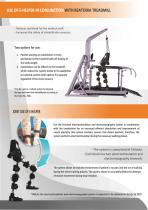
USE OF E-HELPER IN CONJUNCTION WITH REATERRA TREADMILL - Reduces workload for the medical staff. - Increases the safety of rehabilitation process. Two options for use: 1. Patient wearing an exoskeleton is freely positioned on the treadmill with off-loading of the body weight. 2. Exoskeleton can be affixed on the treadmill, which makes this system similar in its capabilities to Lokomat system (with options for separate regulation of the motor power). *Can be used as a robotic system for physical therapy and lower limb rehabilitation according to the Order No. 788n. JOINT USE OF E-HELPER Use the...
Open the catalog to page 2All ZARYA catalogs and technical brochures
 MEDICAL EQUIPMENT STANDARD
44 Pages
Archived catalogs
 Rehabilitation solutions
40 Pages
 NEUROHELPER
1 Page
- Electric stimulator
- Patient lifter
- Massage table
- Electric patient lift
- Patient lift on casters
- Lifting patient lift
- Rehabilitation system
- Electric massage table
- Massage table on casters
- Lower extremity prosthesis
- Treadmill with handrails
- Massage table with armrests
- Computer-assisted rehabilitation system
- Robotic rehabilitation system
- 3-section massage table
- Ceiling-mounted patient lift
- Transcranial stimulator
- Treadmill with incline
- Emergency patient lift