- Catalogs
- Ziemer Group
- Cataract Steel Knives / Technical Information

Cataract Steel Knives / Technical Information

Cataract Steel Knives / Technical Information
The blade is made from rust-proof stainless steel, chosen for its hardness, strength, and corrosion resistance, making it ideal for surgical blades.
The production begins with a thorough examination of the raw wire material for stability, hardness, and chemical composition. The wire undergoes multiple-phase forming to enhance mechanical properties, followed by vacuum thermal treatment to optimize hardness and elasticity. The blade's sharpness is achieved through a chemical process, followed by complex cleaning and a new biocompatible coating that enhances penetration and precision.
The biocompatible coating improves the blade's penetration and gliding qualities without compromising sharpness, allowing for precise cutting with minimal tissue damage.
Final sharpness is achieved through chemical etching, offering advantages over mechanical sharpening by maintaining reproducibility and producing a non-reflective surface for better visibility during operations. The cutting edge has a light wavy shape post-etching.
The blade's geometry and coating reduce the primary cutting force required for incisions, as tested on pig's eyes.
The knives are produced and assembled in clean-room conditions and sterilized using gamma radiation according to DIN EN 552 standards.
The product range includes a variety of cataract knives with different widths, shapes, and angles, allowing for optimal coordination with incision types.
Catalog excerpts

Cataract Steel Knives / Technical Information Basic Material of the Blade Blade Sharpness Rust-proof stainless steel is exclusively used for the blade. This material is particularly suitable for blades due to its ideal combination of hardness and strength, as well as its corrosion-resisting properties. SIS blades obtain their final sharpness by means of chemical etching treatment. This procedure provides significant advantages over the frequently used method of mechanical sharpening on a grinding wheel. Reproducibility can be maintained within very exacting tolerances as it is not dependent on the inevitable abrasion of the grinding wheel. Furthermore, a non-reflecting, dull surface is produced after etching. This improves the blade’s visibility during an operation. The cutting edge has a characteristic light wavy shape after chemical etching. Production Process of the Blade The raw material, in the form of wire, is examined prior to actual production for various criteria (form stability, hardness, chemical composition. A log data sheet documents all the production-relevant parameters. The wire is subjected to a multiple-phase forming operation and thus, in addition to the desired shape and dimensions, acquires improved mechanical properties. Finally, by means of vacuum thermal treatment, the blade’s combination of hardness and elasticity is optimized. The extreme sharpness of SIS blades is achieved via a chemical process. Complex cleaning processes and a new type of coating follow. Coating The new biocompatible coating of the blade improves its penetration and gliding qualities to a great extent, however, without reducing sharpness. Practically effortless cutting becomes possible and consequently greatest precision with less damage to surrounding tissue.
Open the catalog to page 1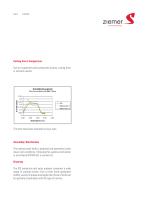
Cutting Force Comparison Due to its geometry and coating less primary, cutting force Char Carica Knivui SLraiqliL 2.7 5inm The tests have been executed on pig's eyes. The cataract steel knife is produced and assembled under clean-room conditions. Following this, gamma sterilization The SIS production and sales program comprises a wide range of cataract knives. Due to their finely graduated widths, variety of shapes and angles the choice of knife can be optimally coordinated with the type of incision.
Open the catalog to page 2All Ziemer Group catalogs and technical brochures
 Galilei
2 Pages
 Pascal
6 Pages
 SWISSBLADE
8 Pages
 Femto LDV
20 Pages
 Amadeus II
6 Pages