


ZedScan
ZedScan
The document discusses the ZedScan™I, a device used in colposcopy to improve the detection of cervical intraepithelial neoplasia (CIN) through Electrical Impedance Spectroscopy (EIS). It integrates seamlessly into standard colposcopic practice, enhancing diagnostic accuracy and patient management.
Specifications and Functionality
The ZedScan™I is a portable, hand-held device that uses a single-use EIS sensor to assess cervical tissue. It provides real-time results that assist clinicians in determining the presence of neoplasia and deciding on biopsy sites or immediate treatment options ('See and Treat').
Clinical Study and Performance
A European multi-centre clinical study involving 429 patients demonstrated that using EIS as an adjunct significantly improved colposcopy performance. The sensitivity for detecting high-grade CIN (HG-CIN) increased to 88.5%, and specificity improved from 38.5% to 65.1% when using ZedScan. The device also enhanced the Positive Predictive Value (PPV) and Positive Likelihood Ratio for both colposcopic impression and disease presence.
Benefits and Recommendations
The ZedScan™I offers objective, real-time information, improving the accuracy of colposcopic examinations. It helps distinguish between patients needing treatment and those who can return to routine screening. The device meets the National Health Service Cervical Screening Programme standards, achieving a PPV >90% for HG-CIN.
Conclusion
The ZedScan™I enhances colposcopic practice by providing more accurate assessments, reducing the need for multiple biopsies, and improving patient management. It represents a new standard in cervical cancer diagnostics.
Catalog excerpts

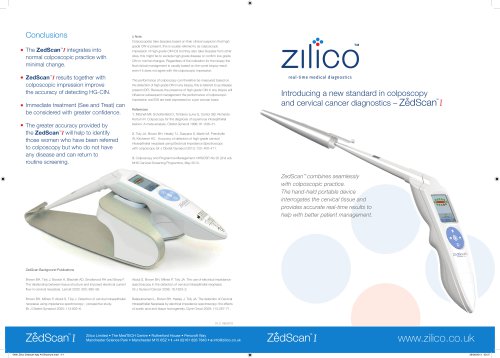
Conclusions The ZedScan™I integrates into normal colposcopic practice with minimal change. ZedScan™I results together with colposcopic impression improve the accuracy of detecting HG-CIN. Immediate treatment (See and Treat) can be considered with greater confidence. The greater accuracy provided by the ZedScan™I will help to identify those women who have been referred to colposcopy but who do not have any disease and can return to routine screening. ‡ Note Colposcopists take biopsies based on their clinical suspicion that high grade CIN is present, this is usually referred to as colposcopic impression of high grade CIN (CI) but they also take biopsies from other sites, this might be to exclude high grade disease or confirm low grade CIN or normal changes. Regardless of the indication for the biopsy the final clinical management is usually based on the worst biopsy result even if it does not agree with the colposcopic impression. The performance of colposcopy can therefore be measured based on the detection of high grade CIN in any biopsy, this is referred to as disease present (DP). Because the presence of high grade CIN in any biopsy will inuence subsequent management the performance of colposcopic impression and EIS are best expressed on a per woman basis. Introducing a new standard in colposcopy and cervical cancer diagnostics – References 1. Mitchell MF, Schottenfeld D, Tortolero-Luna G, Cantor SB, RichardsKortum R. Colposcopy for the diagnosis of squamous intraepithelial lesions: A meta-analysis, Obstet Gynecol 1998; 91: 626–31. 2. Tidy JA, Brown BH, Healey TJ, Daayana S, Martin M, Prendiville W, Kitchener HC. Accuracy of detection of high-grade cervical intraepithelial neoplasia using Electrical Impedance Spectroscopy with colposcopy. Br J Obstet Gynaecol 2013; 120: 400–411. 3. Colposcopy and Programme Management. NHSCSP, No 20 (2nd ed). NHS Cervical Screening Programme, May 2010. ZedScan™ combines seamlessly with colposcopic practice. The hand-held portable device interrogates the cervical tissue and provides accurate real-time results to help with better patient management. ZedScan Background Publications Brown BH, Tidy J, Boston K, Blackett AD, Smallwood RH and Sharp F. The relationship between tissue structure and imposed electrical current ow in cervical neoplasia. Lancet 2000; 355: 892–95. Abdul S, Brown BH, Milnes P, Tidy JA. The use of electrical impedance spectroscopy in the detection of cervical intraepithelial neoplasia. Int J Gynecol Cancer 2006; 16:1823–2. Brown BH, Milnes P, Abdul S, Tidy J. Detection of cervical intraepithelial neoplasia using impedance spectroscopy - prospective study. Br J Obstet Gynaecol 2005; 112:802–6. Balasubramani L, Brown BH, Healey J, Tidy JA. The detection of Cervical Intraepithelial Neoplasia by electrical impedance spectroscopy: the effects of acetic acid and tissue homogeneity. Gyne Oncol 2009; 115:267–71. Zilico Limited • The MedTECH Centre • Rutherford House • Pencroft Way Manchester Science Park • Manchester M15 6SZ • t +44 (0)161 826 7840 • e [email protected]
Open the catalog to page 1
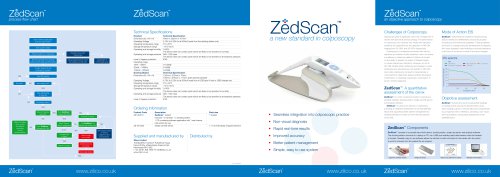
from Zilico Using the ZedScan to locate sites for biopsy, the sensitivity Colposcopy is reported to have sensitivity and specificity to detect CIN2+ (HG-CIN) ranging between 30–99% and 39–92%. (the ability to identify true positives) was 88.5%. The data from our recent European multi-centre clinical study on the use of EIS in colposcopy, in 429 patients, demonstrated that The ZedScan uses Electrical Impedance Spectroscopy (EIS) to provide an objective assessment of cervical epithelial tissue that can be seamlessly combined with the standard colposcopic examination to improve the accuracy of the...
Open the catalog to page 2All Zilico catalogs and technical brochures
 ZedScan
2 Pages
