
- Catalogs
- Zimmer Biomet
- PERFORMANCE EVALUATION OF THE TRABECULAR METAL GLENOID


PERFORMANCE EVALUATION OF THE TRABECULAR METAL GLENOID

PERFORMANCE EVALUATION OF THE TRABECULAR METAL GLENOID
Total shoulder arthroplasty is effective for pain relief and joint function restoration, but glenoid implant loosening is a common issue. The Zimmer® Trabecular Metal™ Glenoid aims for long-term fixation through biological ingrowth. This document details the testing and analysis of the implant's performance under expected in vivo conditions.
Methods
The implant's strength was assessed using fatigue and static tests, with initial fixation evaluated per ASTM F 2028-05 standards. Comparisons were made with a cemented UHMWPE design. Finite element analyses (FEA) compared contact stresses in UHMWPE versus a solid metal-backed design.
Results
The Trabecular Metal Glenoid met performance requirements, showing reduced displacement in initial fixation tests compared to cemented UHMWPE designs. Contact stresses in UHMWPE were lower than in metal-backed designs under key loading conditions.
Conclusions
Testing demonstrated the Trabecular Metal Glenoid's ability to withstand repetitive loading, provide superior initial fixation, and reduce contact stresses compared to metal-backed designs.
Introduction
Glenoid component failure is a common complication in shoulder arthroplasty, often due to inadequate fixation, improper seating, eccentric loading, and poor bone quality.
Performance Evaluation
The Trabecular Metal Glenoid is a monoblock implant with a Trabecular Metal base and UHMWPE surface, designed for reconstructive shoulder arthroplasty. It features five posts for fixation, offering initial press-fit fixation and long-term biological ingrowth.
Strength Testing
The implant was tested for strength through mechanical testing, including specimen preparation, fatigue testing, and post-cyclic shear testing. The implant demonstrated high resistance to fatigue and maintained strength after testing.
Initial Fixation
Dynamic loosening tests assessed initial fixation, comparing fully cemented and backside cemented conditions with a Bigliani/Flatow® polyethylene keeled glenoid. The Trabecular Metal Glenoid showed reduced displacement, indicating better fixation.
Joint Kinematics
The implant aims to restore normal joint motion using a design similar to the Bigliani/Flatow, with congruent and incongruent regions for natural motion patterns.
Articular Surface Integrity
The monoblock design eliminates potential wear debris from the UHMWPE surface. FEA showed lower contact stresses in the Trabecular Metal Glenoid compared to metal-backed designs.
Conclusions
The Trabecular Metal Glenoid withstands eccentric loading, offers superior initial fixation, restores joint kinematics, and reduces UHMWPE contact stresses compared to metal-backed designs.
Catalog excerpts
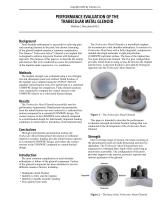
PERFORMANCE EVALUATION OF THE TRABECULAR METAL GLENOID Matthew L. Mroczkowski M.S. Total shoulder arthroplasty is successful in relieving pain and restoring function to the joint, but chronic loosening of the glenoid implant remains a common complication. The Zimmer® Trabecular Metal™ Glenoid is an implant that is designed to achieve long-term fixation with biological ingrowth. The purpose of this paper is to describe the testing and analyses that were conducted to assess the performance of the implant under expected in vivo conditions. The Trabecular Metal Glenoid is a monoblock implant for reconstructive total shoulder arthroplasty. It consists of a Trabecular Metal base with a fully integrated, compression molded ultra-high molecular weight polyethylene (UHMWPE) articular surface. The base of the implant has five posts that provide fixation. The five post configuration provides initial fixation using a press-fit between the implant and the bone. Long-term fixation is provided by biological ingrowth into the Trabecular Metal material. The implant strength was evaluated using a novel fatigue test and subsequent static test method. Initial fixation of the implant was evaluated using the ASTM F 2028-05 standard. Initial fixation tests were performed on a cemented UHMWPE design for comparison. Finite element analyses were conducted to compare the contact stresses in the UHMWPE relative to a solid metal-backed design. The Trabecular Metal Glenoid successfully met the performance requirement. Displacement measurements from the initial fixation test were reduced (i.e. indicated less motion) compared to a cemented UHMWPE design. The contact stresses in the UHMWPE were reduced compared to a metal-backed design for functionally important loading conditions in which there is translation of the humeral head. Through experimental and analytical testing, the Trabecular Metal Glenoid has been shown to withstand repetitive eccentric loading, provide initial fixation superior to a cemented UHMWPE design, and reduce the contact stresses in the UHMWPE compared to a metal-backed design. The most common complication in total shoulder arthroplasty is failure of the glenoid component. Failure of the glenoid component has been attributed to several different causative factors1 including: , • Inadequate initial fixation • Inability to fully seat the implant • Inability to handle eccentric loading • Poor quality bone stock Figure 1 – The Trabecular Metal Glenoid This paper is intended to describe the performance evaluation (strength and initial fixation testing) that was conducted in the development of the Trabecular Metal Glenoid. Due to its large range of motion, the loads occurring at the glenohumeral joint are multi-directional and activitydependent. The Trabecular Metal Glenoid base was engineered to withstand these loads while conserving as much bone as possible. The configuration of the posts provides support in the anterior, posterior, superior and inferior quadrants of the glenoid. Anterior Figure 2 – The base of the Trabecular M
Open the catalog to page 1
The strength of the Trabecular Metal Glenoid was evaluated through mechanical testing, which consisted of the following steps: 1. Specimen preparation (Figure 3) – Blocks of rigid polyurethane foam were prepared to simulate a situation in which the glenoid implant is not fully seated, and a gap is present around the perimeter of the articular surface. The keel portion of the glenoid test specimens was rigidly fixed by PMMA bone cement in a cavity inside the foam block. 2. Fatigue testing – A dynamic test was performed, in which load was applied repeatedly to determine the implant’s resistance...
Open the catalog to page 2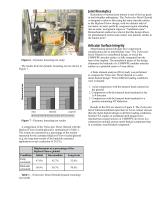
The results from the dynamic loosening test are shown in Figure 7. A comparison of the Trabecular Metal Glenoid with the Bigliani/Flatow keeled glenoid is summarized in Table 1. The results are expressed as a percentage of the motion measured for the cemented Bigliani/Flatow keeled glenoid (e.g. the long-term results of the backside cemented application reveal a reduction of 29.2%). Joint Kinematics Restoration of normal joint motion is one of the key goals in total shoulder arthroplasty. The Trabecular Metal Glenoid is designed to achieve this using the same articular surface as the Bigliani/Flatow...
Open the catalog to page 3
Axial Compression A-P Translation90° AbductionSolid metal-backed (Ti) design Trabecular Metal Glenoid design (.PRESS GLEB _S/HEAD. Figure 8 - Finite element analysis results Conclusions Through experimental and analytical testing, the Trabecular Metal Glenoid has been shown to: • Withstand repetitive eccentric loading • Provide initial fixation superior to a cemented polyethylene design • Restore more normal glenohumeral joint kinematics and contact area patterns • Reduce contact stresses in the UHMWPE compared to a metal-backed design References 1. Matsen FA, et al. Glenoid component failure...
Open the catalog to page 4All Zimmer Biomet catalogs and technical brochures
 Oxford® Partial Kne
60 Pages
 Distal Femoral Replacement
72 Pages
 ROSA ONE® Brain System
7 Pages
Archived catalogs
 MODULAR FEMORAL Revision System
14 Pages
 A.L.P.S.®
44 Pages
 Constrained Posterior Stabilized
12 Pages
 Persona PERSONALIZED KNEE
7 Pages
 Avenir® Femoral Hip System
12 Pages
 The CLS® Spotorno® Stem
16 Pages
 Alloclassic®Zweymüller®Stem
12 Pages
 ®Zimmer® Segmental System
6 Pages
 Zimmer Natural Nail System
8 Pages
 modern-cementing-technique
16 Pages
 CoAxial Spray Kit
8 Pages
 Biologics
24 Pages
 PowerPump DP System
2 Pages
 Sidus
Sidus40 Pages
 Ankle Fix System 4.0
8 Pages
 Anatomical Shoulder System
6 Pages
 NexGen® RH Knee
8 Pages
 tourniquet-systems-brochure
8 Pages
 Persona-Partial
12 Pages
 Fitmore Hip Stems
6 Pages
 NexGen High-Flex Implant
8 Pages
 Trabecular Metal ™Glenoid
4 Pages
 Anatomical Shoulder ™ System
6 Pages
 Zimmer ® PSI Shoulder
6 Pages
 Zimmer personna
12 Pages
 ZImmer iASSIST
44 Pages
 Fitmore ® Hip Stem
24 Pages
 Persona Knee
6 Pages
 Trauma Solutions
10 Pages
 Colagen Repair Patch
2 Pages
 Fitmore® Hip Stem
6 Pages
 Zimmer® Segmental System
6 Pages



- Detection kit
- ZIMMER BIOMET bone plate
- ZIMMER BIOMET compression plate
- ZIMMER BIOMET metallic compression plate
- Immunoassay detection kit
- ZIMMER BIOMET locking compression plate
- Infectious disease detection kit
- Titanium compression plate
- Surgical system
- Distal compression plate
- Cutting electrosurgical system
- Tablet computer software
- Cassette detection kit
- Chromatographic immunoassay test kit
- Coagulation surgical system
- Agitator
- ELISA detection kit
- Proximal compression plate
- Benchtop agitator
- Planning software