
- Catalogs
- Zimmer Biomet
- Versanail® Humeral Proximal Nailing System Product Rationale & Surgical Technique


Versanail® Humeral Proximal Nailing System Product Rationale & Surgical Technique

Versanail® Humeral Proximal Nailing System Product Rationale & Surgical Technique
The VersaNail® Humeral Proximal Nailing System is engineered for intramedullary fixation of proximal humeral fractures. It incorporates a proprietary locking sleeve technology to secure proximal screws, minimizing the risk of back-out. The system is user-friendly, featuring intuitive assembly and color-coded screw placement to enhance surgical efficiency.
The implant is available in 8 mm and 10 mm diameters and 150 mm length. It includes proximal screws for enhanced fragment fixation and distal screws for additional stability. The design minimizes dissection, promoting rapid postoperative mobilization and improved rehabilitation.
Surgeons must avoid damaging the axillary and radial nerves during surgery. The axillary nerve is approximately 10 mm below the oblique screw, and the radial nerve is well below the distal part of the proximal nail.
Proper patient positioning in a beach chair position is crucial for optimal access and visualization. The entry site should align with the humeral shaft's longitudinal axis to prevent complications. K-wires are used for proper alignment of the humeral head.
The nail is inserted using a targeting jig that simplifies screw placement. Proximal and distal locking screws secure the nail, with color-coded instrumentation aiding the process.
An end cap is placed to prevent screw back-out, with specific procedures outlined for nail removal when necessary.
Details for ordering system components ensure all necessary parts are available for the surgical procedure.
The document provides detailed procedural instructions for using the Versanail® Humeral Proximal Nailing System, focusing on nail entry site identification, entry and canal preparation, fracture reduction, nail insertion, and locking mechanisms.
The procedure begins with identifying the nail entry site using K-wires and a jig arm under radiographic guidance. An incision is made anterior to the acromion, and dissection exposes the supraspinatus tendon. Soft tissue protection is emphasized, recommending sutures and a tissue protector during reaming.
Anatomic reduction is achieved using a reduction tool, and the canal is prepared without reaming in cases of poor bone quality. The proximal nail is inserted using a guide wire and jig assembly.
Nail size is determined pre-operatively, and the nail is inserted using a jig assembly. The document details the assembly and insertion process, emphasizing correct alignment and gentle insertion techniques.
The system offers multiple locking options, with specific screws recommended for proximal and distal locking. The procedure for locking through the jig is outlined, including the use of protective sheaths and drill sleeves.
The end cap is inserted and threaded into the nail to lock the screws in place. Proper seating of the end cap is crucial to ensure the stability of the construct.
The document provides comprehensive instructions for using the Versanail® system, emphasizing precision in each step to ensure successful outcomes.
The system includes proximal nail extractor bolts, hex drivers, and T-handle Hudsons for nail extraction. It details the sizes and specifications of humeral proximal nails and screws, including diameters, lengths, and catalog numbers for both sterile and non-sterile options.
Instructions are provided for locating the top of the nail through an incision, removing the end cap using specific screwdrivers, and utilizing additional tools like the SolidLok screwdriver for assistance. The document outlines the steps for canal preparation, nail insertion, proximal and distal locking, and nail removal.
Comprehensive ordering details are provided for various components, including proximal humeral nails, cortical screws, cancellous screws, and associated tools. Each item is listed with its catalog number and description.
The document highlights contraindications for the use of screws, plates, and nails, such as active infections, insufficient bone quality, and conditions that impede healing. It warns against the use of these components in full weight-bearing applications and outlines potential adverse events like loosening, bending, and infection.
Common adverse events include loosening, bending, cracking, or fracture of components, loss of fixation, infection, and allergic reactions. Specific warnings are given for targeting and drilling proximal screws in tibial nails to avoid nerve injury.
The document emphasizes that the implants are intended to guide normal healing and are not substitutes for normal body structures. It also provides contact information for Biomet Orthopedics and notes that the material is intended for use by the Biomet sales force and physicians.
Catalog excerpts
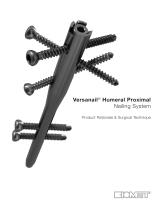
Versanail ® Humeral Proximal Nailing System Product Rationale & Surgical Technique
Open the catalog to page 1
Note: This brochure presents a surgical technique available for use with the Biomet, Inc., VersaNail® Platform instruments and implants. Surgeons may need to make modifications as appropriate in their own surgical technique with these devices depending on individual patient requirements. 1
Open the catalog to page 3
Versanail ® Humeral Proximal Nailing System Intramedullary Fixation of Humeral Proximal Fractures • Nail design to treat simple to complex proximal humeral fractures The VersaNail® Humeral Proximal Nail is part of a long bone nailing system that offers a complete portfolio of implants and instruments based on a single, standardized technology platform. The Humeral Proximal Nailing System from the VersaNail® Platform offers options to treat a range of proximal humeral fractures with one implant. The implant includes a proprietary locking sleeve technology which locks all three proximal screws,...
Open the catalog to page 5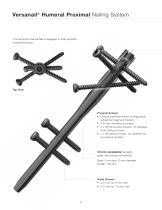
Versanail ® Humeral Proximal Nailing System The Humeral Proximal Nail is designed to treat proximal humeral fractures. Proximal Screws: • Unique proximal screw configuration enhances fragment fixation • 4.8 mm cancellous screws • 2 L-M transverse screws: 30 degrees from oblique screw • 1 L-M oblique screw: 45 degrees for provisional fixation 3.0 mm cannulation accepts guide wire during nail insertion S izes: 8 mm and 10 mm diameter Length: 150 mm Distal Screws: • 3.5 mm for 8 mm nail • 4.5 mm for 10
Open the catalog to page 6
Humeral Proximal Jig The proximal humeral trigger jig is designed with the jig mechanics up and out of the way so that the entry site can be targeted from a distance. The targeting arm rotates with the push of a button to target the proximal locking options. The rotating design also allows the jig to be repositioned without disassembly for convenience during the nailing procedure to improve visualization of the nail seating and screw length. prevent potential screw back-out Color-Coded Locking Instrumentation Color Screw Size
Open the catalog to page 7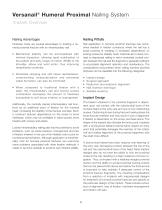
Nailing Advantages Intuitively, there are several advantages to treating a humeral proximal fracture with an intramedullary nail. • Mechanical stability can be accomplished with minimal dissection, allowing rapid mobilization of the patient and early range of motion (ROM) of the shoulder, elbow and wrist joints, thus improving rehabilitation potential. • Periosteal stripping and soft tissue devitalization, compromising revascularization and periosteal callus formation, can also be minimized. • When compared to traditional fixation with a plate, the intramedullary nail and locking screws combination...
Open the catalog to page 8
Surgical Approach and Fracture Reduction Axillary Nerve Familiarization with techniques to select and expose the correct entry site and nail entry angle as well as the use of the nail as a tool to align the fracture is necessary. It is also crucial to obtain orthogonal x-ray views and avoid destruction of the rotator cuff during implant/instrument insertion. The axillary nerve is the nerve most often damaged during the injury and iatrogenically—even by closed manipulation and percutaneous fixation. During open reduction, the damage occurs especially during soft tissue retraction and percutaneous...
Open the catalog to page 9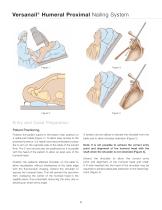
Versanail ® Humeral Proximal Nailing System Entry and Canal Preparation Patient Positioning A bolster can be utilized to elevate the shoulder from the table and to allow shoulder extension (Figure 2). Position the patient supine in the beach chair position on a radiolucent table (Figure 1). To allow easy access to the proximal humerus, it is helpful and recommended to place the C-arm on the opposite side of the table of the injured limb. The C-arm should also be positioned so it is parallel with the head of the patient to allow an axial view of the humeral head. Note: It is not possible to achieve...
Open the catalog to page 10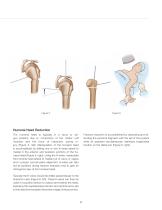
Humeral Head Reduction Fracture reduction is accomplished by adducting and extending the proximal fragment with the aid of the joystick while an assistant simultaneously maintains longitudinal traction on the distal arm (Figure 6, right). The humeral head is typically in a varus or valgus position due to contraction of the rotator cuff muscles and the force of impaction during injury (Figure 5, left). Manipulation of the humeral head is accomplished by drilling one or two K-wires lateral to medial in the anterior and posterior portions of the humeral head (Figure 5, right). Using the K-wires,...
Open the catalog to page 11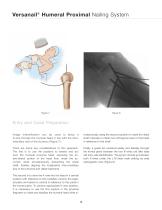
Versanail ® Humeral Proximal Nailing System Entry and Canal Preparation Image intensification can be used to place a K-wire through the humeral head in line with the intramedullary axis of the humerus (Figure 7). multaneously using the second joystick to rotate the distal shaft manually to obtain two orthogonal views of the head in reference to the shaft. There are some key considerations to this approach. The first is to use the joysticks to extend and adduct the humeral proximal head, exposing the antero-lateral portion of the head from under the acromion while simultaneously distracting the...
Open the catalog to page 12
Entry Site and Incision Placement Soft Tissue Protection Make an incision just anterior to the anterior edge of the acromion. The anterior edge may be difficult to palpate and differentiate from the humeral head due to edema and hematoma from the fracture. Therefore, it is helpful to use a K-wire under image intensification to locate the anterior edge of the acromion angle where it intersects the longitudinal axis of the humerus (Figure 9). In cases where the greater tuberosity is intact or non-displaced, a 1 to 1.5 cm incision can be made in the supraspinatus tendon in line with its fibers,...
Open the catalog to page 13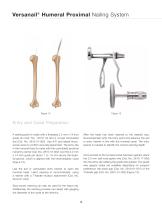
Versanail ® Humeral Proximal Nailing System Entry and Canal Preparation After the head has been reamed to the desired size, fluoroscopically verify the entry point and advance the awl or entry reamer in line with the humeral canal. The entry reamer is marked to identify the correct reaming depth. A starting point is made with a threaded 3.2 mm x 14 inch guide pin (Cat. No. 14012-14) and a curved cannulated awl (Cat. No. 2810-01-005). Use A-P and lateral fluoroscope views to confirm accurate placement. The entry site in the humeral head is made with the cannulated proximal nail entry reamer (Cat....
Open the catalog to page 14All Zimmer Biomet catalogs and technical brochures
 Oxford® Partial Kne
60 Pages
 Distal Femoral Replacement
72 Pages
 ROSA ONE® Brain System
7 Pages
Archived catalogs
 MODULAR FEMORAL Revision System
14 Pages
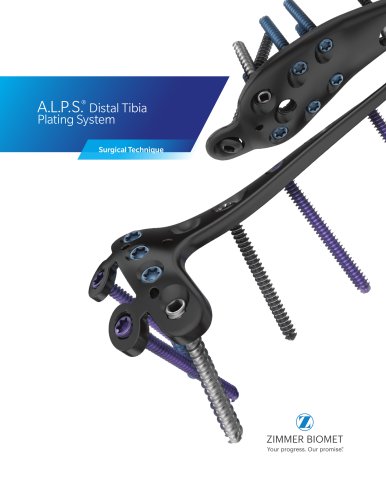 A.L.P.S.®
44 Pages
 Constrained Posterior Stabilized
12 Pages
 Persona PERSONALIZED KNEE
7 Pages
 Avenir® Femoral Hip System
12 Pages
 The CLS® Spotorno® Stem
16 Pages
 Alloclassic®Zweymüller®Stem
12 Pages
 ®Zimmer® Segmental System
6 Pages
 Zimmer Natural Nail System
8 Pages
 modern-cementing-technique
16 Pages
 CoAxial Spray Kit
8 Pages
 Biologics
24 Pages
 PowerPump DP System
2 Pages
 Sidus
Sidus40 Pages
 Ankle Fix System 4.0
8 Pages
 Anatomical Shoulder System
6 Pages
 NexGen® RH Knee
8 Pages
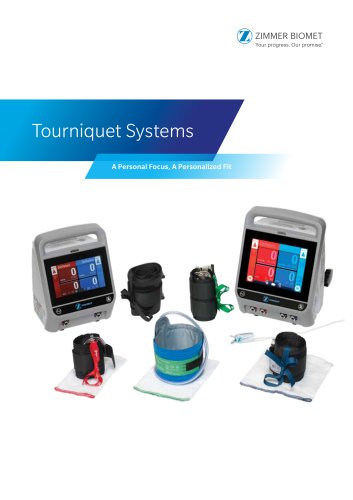
 tourniquet-systems-brochure
8 Pages
 Persona-Partial
12 Pages
 Fitmore Hip Stems
6 Pages
 NexGen High-Flex Implant
8 Pages
 Trabecular Metal ™Glenoid
4 Pages
 Anatomical Shoulder ™ System
6 Pages
 Zimmer ® PSI Shoulder
6 Pages
 Zimmer personna
12 Pages
 ZImmer iASSIST
44 Pages
 Fitmore ® Hip Stem
24 Pages
 Persona Knee
6 Pages
 Trauma Solutions
10 Pages
 Colagen Repair Patch
2 Pages
 Fitmore® Hip Stem
6 Pages
 Zimmer® Segmental System
6 Pages



- Detection kit
- ZIMMER BIOMET bone plate
- ZIMMER BIOMET compression plate
- ZIMMER BIOMET metallic compression plate
- Immunoassay detection kit
- ZIMMER BIOMET locking compression plate
- Infectious disease detection kit
- Titanium compression plate
- Surgical system
- Distal compression plate
- Cutting electrosurgical system
- Tablet computer software
- Cassette detection kit
- Chromatographic immunoassay test kit
- Coagulation surgical system
- Agitator
- ELISA detection kit
- Proximal compression plate
- Benchtop agitator
- Planning software