
- Catalogs
- Zimmer Biomet
- Zimmer® Trabecular Metal Humeral Stem


Zimmer® Trabecular Metal Humeral Stem

Zimmer® Trabecular Metal Humeral Stem
- High Friction Implant Stability: The Trabecular Metal Material offers a high coefficient of friction (0.98) with cancellous bone, reducing the risk of early implant motion.
- Biologic Ingrowth Support: The material supports vascularization and maximizes bone and soft-tissue ingrowth, promoting more normal bone remodeling.
- Anatomical Reconstruction Flexibility: Multiple neck angles and head options allow for optimal anatomical reconstruction in 95% of patients, ensuring proper stem height and version.
- Porosity: The humeral stem features the highest volume of porosity among its peers, facilitating biologic integration.
Catalog excerpts

Zimmer Trabecular Metal Humeral Stem ®
Open the catalog to page 1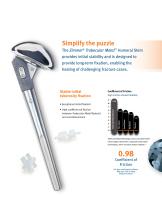
Simplify the puzzle The Zimmer® Trabecular Metal™ Humeral Stem provides initial stability and is designed to provide long-term fixation, enabling the healing of challenging fracture cases. Coefficient of Friction High Friction Implant Stability .9 Small Beads • High coefficient of friction between Trabecular Metal Material and cancellous bone Fiber Metal Trabecular Metal Material Stable initial tuberosity fixation Trabecular Metal Technology construct provides better friction against bone when compared to alternative technologies, which increases implant stability.1,2 Coefficient of Friction...
Open the catalog to page 2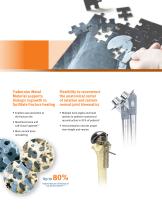
Trabecular Metal Material supports biologic ingrowth to facilitate fracture healing Flexibility to reconstruct the anatomical center of rotation and restore normal joint kinematics • Enables vascularization at the fracture site • Multiple neck angles and head options to optimize anatomical reconstruction in 95% of patients5 • Maximizes bone and soft-tissue ingrowth2,3 • Instrumentation ensures proper stem height and version • More normal bone remodeling Highest Volume of Porosity of any Humeral St
Open the catalog to page 3
Stable initial tuberosity fixation Trabecular Metal Material supports biologic ingrowth to facilitate fracture healing Flexibility to reconstruct the anatomical center of rotation and restore normal joint kinematics References 1. Zhang, Y., et al., Interfacial Frictional Behavior: Cancellous Bone, Cortical Bone, and a Novel Porous Tantalum Biomaterial, Journal of Musculoskeletal Research, Vol. 3, No. 4: 245-251, 1999 2. Levine, B., et al., A New Era in Porous Metals: Applications in Orthopaedics, Advanced Engineering Materials, Vol 10 No 9, page 788-792, 2008 3. Bobyn JD, Hacking SA, Chan SP,...
Open the catalog to page 4All Zimmer Biomet catalogs and technical brochures
 Oxford® Partial Kne
60 Pages
 Distal Femoral Replacement
72 Pages
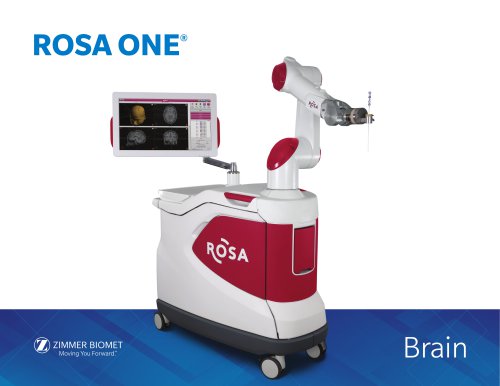 ROSA ONE® Brain System
7 Pages
Archived catalogs
 MODULAR FEMORAL Revision System
14 Pages
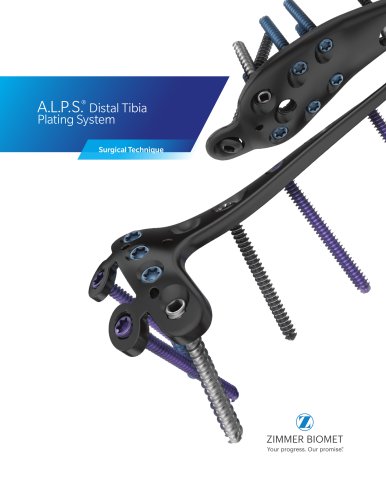 A.L.P.S.®
44 Pages
 Constrained Posterior Stabilized
12 Pages
 Persona PERSONALIZED KNEE
7 Pages
 Avenir® Femoral Hip System
12 Pages
 The CLS® Spotorno® Stem
16 Pages
 Alloclassic®Zweymüller®Stem
12 Pages
 ®Zimmer® Segmental System
6 Pages
 Zimmer Natural Nail System
8 Pages
 modern-cementing-technique
16 Pages
 CoAxial Spray Kit
8 Pages
 Biologics
24 Pages
 PowerPump DP System
2 Pages
 Sidus
Sidus40 Pages
 Ankle Fix System 4.0
8 Pages
 Anatomical Shoulder System
6 Pages
 NexGen® RH Knee
8 Pages
 tourniquet-systems-brochure
8 Pages
 Persona-Partial
12 Pages
 Fitmore Hip Stems
6 Pages
 NexGen High-Flex Implant
8 Pages
 Trabecular Metal ™Glenoid
4 Pages
 Anatomical Shoulder ™ System
6 Pages
 Zimmer ® PSI Shoulder
6 Pages
 Zimmer personna
12 Pages
 ZImmer iASSIST
44 Pages
 Fitmore ® Hip Stem
24 Pages
 Persona Knee
6 Pages
 Trauma Solutions
10 Pages
 Colagen Repair Patch
2 Pages
 Fitmore® Hip Stem
6 Pages
 Zimmer® Segmental System
6 Pages



- Detection kit
- ZIMMER BIOMET bone plate
- ZIMMER BIOMET compression plate
- ZIMMER BIOMET metallic compression plate
- Immunoassay detection kit
- ZIMMER BIOMET locking compression plate
- Infectious disease detection kit
- Titanium compression plate
- Surgical system
- Distal compression plate
- Cutting electrosurgical system
- Tablet computer software
- Cassette detection kit
- Chromatographic immunoassay test kit
- Coagulation surgical system
- Agitator
- ELISA detection kit
- Proximal compression plate
- Benchtop agitator
- Planning software