
- Catalogs
- Zimmer Dental
- Trabecular Metal Material Brochure


- Products
- Catalogs
- News & Trends
- Exhibitions
Trabecular Metal Material Brochure

Trabecular Metal Material Brochure
Trabecular Metal Technology is a three-dimensional material used in implant dentistry, resembling the structure of cancellous bone. It is not merely a surface or coating but a unique material made from tantalum, known for its biocompatibility and corrosion resistance. This technology has been utilized in various implantable devices for over 60 years, including dental implants.
Material Composition and Properties
The material is fabricated using a thermal deposition process that deposits tantalum onto a substrate, creating a nanotextured surface. This process ensures a structure similar to cancellous bone, with a low modulus of elasticity (2.5-3.9 GPa), closer to that of natural bone compared to other materials like titanium or stainless steel. The material exhibits high ductility and contributes to the primary stability of implants.
Osseoincorporation
Unlike conventional implant surfaces that allow only bone ongrowth, Trabecular Metal Material supports both ongrowth and ingrowth, termed osseoincorporation. Its open, interconnected pore network allows bone to grow onto and into the material, enhancing stability and integration.
Applications and Research
Trabecular Metal Technology has been applied in joint reconstruction, bone void filling, and soft tissue repair. Studies in canine models have shown bone ingrowth as early as two weeks post-implantation. Further research is ongoing to explore its potential in human dental applications.
Comparison with Other Materials
While other manufacturers have attempted to replicate its properties, Trabecular Metal Material's high porosity and consistent pore structure set it apart from conventional porous coatings. Its unique attributes contribute to its osteoconductive properties, making it a preferred choice in implant dentistry.
Conclusion
Trabecular Metal Technology represents a significant advancement in implant materials, offering enhanced integration and stability through its unique structure and composition. Its continued development and application in dental and orthopedic fields highlight its potential to improve patient outcomes.
Catalog excerpts
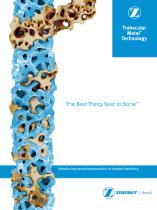
The Best Thing Next to Bone™ Introducing osseoincorporation to implant dentistry.
Open the catalog to page 1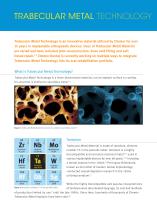
TRABECULAR METAL TECHNOLOGY Trabecular Metal Technology is an innovative material utilized by Zimmer for over 15 years in implantable orthopaedic devices. Uses of Trabecular Metal Material are varied and have included joint reconstruction, bone void filling and soft tissue repair.13 Zimmer Dental is currently working on multiple ways to integrate Trabecular Metal Technology into its oral rehabilitation portfolio. What is Trabecular Metal Technology? Trabecular Metal Technology is a three-dimensional material, not an implant surface or coating. Its structure is similar to cancellous bone.4 6 Figure...
Open the catalog to page 2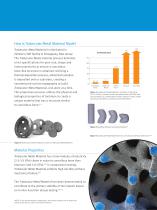
How is Trabecular Metal Material Made? Trabecular Metal Material is fabricated in Zimmer’s TMT facility in Parsippany, New Jersey. The Trabecular Metal material process demands strict specifications for pore size, shape and interconnectivity to ensure a cancellous bone-like structure is obtained. Utilizing a thermal deposition process, elemental tantalum is deposited onto a substrate, creating a nanotextured surface topography to build Trabecular Metal Material, one atom at a time. This proprietary process utilizes the physical and biological properties of tantalum to create a unique material...
Open the catalog to page 3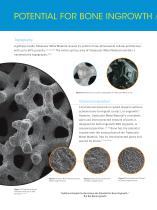
potential for bone ingrowth a Topography A glimpse inside Trabecular Metal Material reveals its uniform three-dimensional cellular architecture with up to 80% porosity.2-4,6,24,25 The entire surface area of Trabecular Metal Material exhibits a nanotextured topography.26,27 Figure 8 Nanotextured surface topography of Trabecular Metal struts Osseoincorporation Conventional textured or coated implant surfaces achieve bone-to-implant contact, or ongrowth.17 However, Trabecular Metal Material’s consistent, open and interconnected network of pores is designed for both ongrowth AND ingrowth, or osseoincorporation.2,4,24...
Open the catalog to page 4
Bone Ingrowth in Canine Mandibular Models BONE TRABECULAR METAL In a study of Trabecular Metal Implants placed in canine mandibular models, evidence of ingrowth by maturing bone has been documented as early as two weeks after implantation.33,34 Further research is required to determine the rate of ingrowth and its effects on secondary stability in human dental applications. Figure 12 Documented ingrowth in canine mandible While other manufacturers have tried to mimic the attributes of Trabecular Metal Technology, sintered bead and other conventional porous coatings and materials differ significantly...
Open the catalog to page 5
Macheras GA, Papagelopoulos PJ, Kateros K, Kostakos AT, Baltas D, Karachalios TS. Radiological evaluation of the metal-bone interface of a porous tantalum monoblock acetabular component. J Bone Joint Surg Br. 2006;88-B:304-309. 2. Wigfield C, Robertson J, Gill S, Nelson R. Clinical experience with porous tantalum cervical interbody implants in a prospective randomized controlled trial. Br J Neurosurg. 2003;17(5):418-425. Nasser S, Poggie RA. Revision and salvage patellar arthroplasty using a porous tantalum implant. Unger AS, Lewis RJ, Gruen T. Evaluation of a porous tantalum uncemented acetabular...
Open the catalog to page 6
Zhang Y, et al. Interfacial frictional behavior: Cancellous bone, cortical bone, and a novel porous tantalum biomaterial. J Musculoskel Res. 1999;3(4):245-251. Data on file with Zimmer Dental Inc. Bobyn JD, Stackpool GJ, Hacking SA, Tanzer M, Krygier JJ. Characteristics of bone ingrowth and interface mechanics of a new porous tantalum biomaterial. J Bone Joint Surg Br. 1999; 81:907-914. Tsao AK, Roberson JR, Christie MJ, Dore DD, Heck DA, Robertson DD, Poggie RA. Biomechanical and clinical evaluations of a porous tantalum implant for the treatment of early-stage osteonecrosis. J Bone Joint Data...
Open the catalog to page 7
©2012 Zimmer Dental Inc. All rights reserved. 2396, Rev. 10/12. SLActive is a trademark of Straumann AG. TiUnite is a registered trademark of Nobel Biocare. Endopore is a registered trademark of Sybron Implant Solutions. SEMs taken by Zimmer Dental Inc. Please note that not all products are registered or available in every country/region. Please check with a Zimmer Dental representative for availability and additional information. For more information about our Products, Regenerative Materials and Educational Opportunities, contact us: To receive our eNews visit us at http://www.zimmerdental.com/news_eNewsLetterSignUp.aspx...
Open the catalog to page 8All Zimmer Dental catalogs and technical brochures
 Product_Catalog
40 Pages
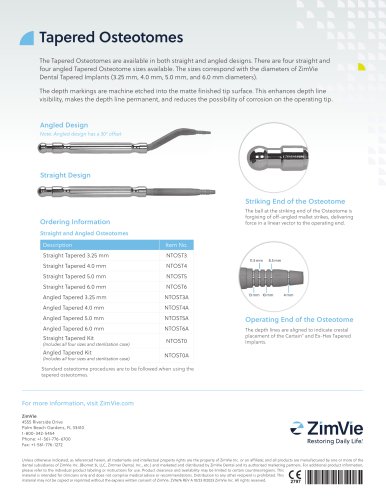 tapered_osteotomes
1 Page
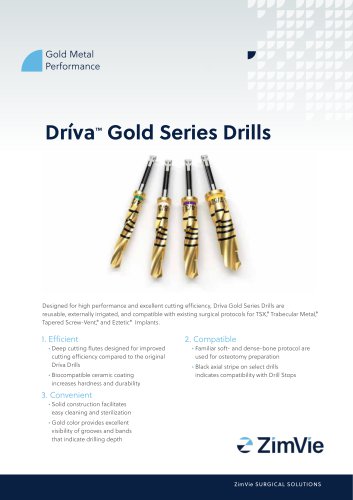 driva_gold_drills
2 Pages
 Eztetic ™ 3.1 mmD Implant System
20 Pages
Archived catalogs
 iTero Element 5D®
2 Pages
 T3_Implant
8 Pages
 slim kit
6 Pages
 Implant_Removal_Kit
4 Pages
 Puros_Block
2 Pages
 External Hex Implant System
32 Pages
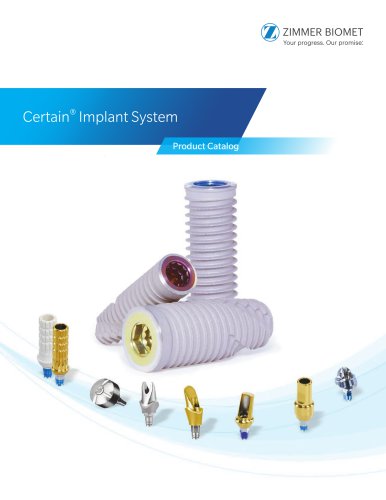
 Certain® Implant System
16 Pages
 External Hex Implant System
16 Pages
 SmileZ Today™
2 Pages
 Endobon Xenograft Brochure
4 Pages
 Puros® Dermis
1 Page
 Driva - Drill
2 Pages
 Screw-Vent® Product Catalog
8 Pages
 sinus lateral approach kit
2 Pages
 Regenerative_Portfolio
24 Pages
 LOCATOR
8 Pages
 Product Catalog
79 Pages
 zim
zim12 Pages
 SwissPlus ® Implant System
2 Pages
 S p l i n e ®
36 Pages
 Zimmer One-Piece Implant
2 Pages
 Eztetic
6 Pages
 Drill Stop Kit Brochure
2 Pages
 Single-Patient Drill
2 Pages


- Implant abutment
- Titanium implant abutment
- Straight implant abutment
- Dental surgery instrument kit
- Titanium dental implant
- Orthopedic surgery instrument kit
- Internal implant abutment
- Conical dental implant
- Angled implant abutment
- Drill bit
- Straight dental implant
- Dental implant surgery instrument kit
- Hexagonal implant abutment
- Bone substitute
- Screw implant abutment
- Internal dental implant
- Cylindrical dental implant
- Dental implant analog
- Internal hexagon implant abutment